I am happy that I can share the slides of my talk about „MOOCs for adult education“for the DISTANCE EDUCATION CONFERENCE on LIFELONG LEARNING last year in Istanbul, Turkey:


Digitale Lehre an und rund um der Technischen Universität Graz
Here are the slides of my keynote talk about „Game based Learning & Gamification in (Higher) Education“ at 2. FHGR Gamification & Serious Games Event in Graubünden (Switzerland):
Im Rahmen der DELFI 2021 haben wir über unsere Entwicklungen rund um eine Studierenden-Dashboard an der TU Graz berichtet. Hier findet man den Foliensatz:

Im Rahmen des Open Education Austria Projektes ist die TU Graz zusammen mit der FNMA verantwortlich ein Konzept für eine Zertifizierung zu entwicklen. Den Stand hierzu haben wir auf der OER-Konferenz jetzt einem internationalen Publikum präsentiert.
Zusammenfassung:
Das Forum Neue Medien in der Lehre Austria (fnma) ist im Rahmen des Projekts «Open Education Austria Advanced» für die Entwicklung und Einführung eines Verfahrens zum Nachweis und Sichtbarmachung von Aktivitäten in Bezug auf offene Bildungsressourcen (Open Educational Resources; kurz OER) verantwortlich. Im Beitrag wird zu OER aus Perspektive österreichischer Hochschulen zu den Hintergründen und Kriterien für die OER-Zertifizierung, bisherigen Entwicklungsarbeiten sowie der Konzeption berichtet.
[Beitrag @ ResearchGate]
[Tagungsband]
Referenz: Schön, Sandra; Ebner, Martin; Brandhofer, Gerhard; Berger, Elfriede; Gröblinger, Ortrun; Jadin, Tanja; Kopp, Michael & Steinbacher, Hans- Peter (2021). OER-Zertifikate für Lehrende und Hochschulen. Kompetenzen und Aktivitäten sichtbar machen. In: Cinzia Gabellini, Sabrina Gallner, Franziska Imboden, Maaike Kuurstra und Peter Tremp (Hrsg.) Lehrentwicklung by Openness – Open Educational Resources im Hochschulkontext, Luzern: Pädagogische Hochschule Luzern, S. 29-32, https://doi.org/10.5281/zenodo.5004445
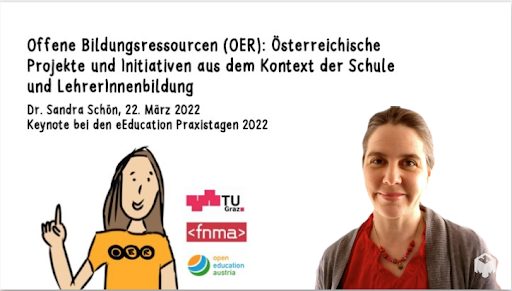
Wir wurden letztes Jahr gefragt ob wir für die Campus Innovation Konferenz 2021 eine Keynote halten wollen, rund um Digitale Souveränität und die Rolle von OER. Als besondere Herausforderung wünscht man sich, dass Sandra und ich dies gemeinsam machen sollen. Wir haben es probiert und hoffen auch, dass es gut angekommen ist – hier gibt es nachträglich noch die Vortragsfolien:

Referenz: Martin Ebner und Sandra Schön (2021). Digitale Souveränität durch offene Bildung und OER. Chance und Verantwortung der Hochschulen.Keynote auf der Campus Innovation 2021, 19.11.2021 [.pdf]
Im Rahmen der OER-Konferenz gab es noch einen weiteren Beitrag von uns zu „Dezentral bereitstellen – zentral finden. Zur Umsetzung hochschulübergreifender OER-Angebote“. Hier beschreiben wir erstmals die technische Komponente des Projekts im Open Education Austria Projekt.
Abstract:
Um OER nutzen zu können, müssen sie gefunden werden. Dieser Beitrag beschreibt eine Lösung für den österreichischen Hochschulraum durch die Zusammenführung von lokalen Hochschul-OER-Repositorien.
[Beitrag @ ReserachGate]
[Konferenzproceeding]
Referenz: Gröblinger, O., Ganguly, R., Hack, C., Ebner, M., Kopp, M. (2021). Dezentral bereitstellen – zentral finden. Zur Umsetzung hochschulübergreifender OER-Angebote. In: Cinzia Gabellini, Sabrina Gallner, Franziska Imboden, Maaike Kuurstra und Peter Tremp (Hrsg.) Lehrentwicklung by Openness – Open Educational Resources im Hochschulkontext, Luzern: Pädagogische Hochschule Luzern, S. 39-44, https://doi.org/10.5281/zenodo.5004445
Our contribuation to this year ED-Media 2021 conference about „The relation of prior IT usage, IT skills and field of study: A multiple correspondence analysis of first-year students at a University of Technology“ got published. The slides are already here online.
Abstract:
Starting from the question of whether the students in the different fields of study differ in terms of several variables related to IT and learning with IT, namely their general extent of IT usage, the extent of IT usage for learning, the IT skills of the students, their participation in online courses, if they learned coding basics at school and the extent of IT usage in class at school, a multiple correspondence analysis (MCA) was chosen to find answers. The MCA resulted in four clusters of fields of study. The inclusion of the variables in the biplot shows that for one dimension the IT skills of the students are crucial, and for the second dimension a further variable, the type of school added as supplementary points, explains the differences between subjects. Finally, the article discusses that these insights might change drastically – especially due to the changed conditions of first-year students with regard to their experiences with the use of IT in learning as a result of the school closures during COVID-19 pandemic. The data for this analysis come from the survey of first-year students at Graz University of Technology (TU Graz) in 2020 (N=955) which is subjected to a secondary analysis in this article.
[article @ learntechlib]
[preprint @ ResearchGate]
Refrence: Mair, B., Ebner, M., Nagler, W., Edelsbrunner, S. & Schön, S. (2021). The relation of prior IT usage, IT skills and field of study: A multiple correspondence analysis of first-year students at a University of Technology. In T. Bastiaens (Ed.), Proceedings of EdMedia + Innovate Learning (pp. 304-312). United States: Association for the Advancement of Computing in Education (AACE). Retrieved August 15, 2021 from https://www.learntechlib.org/primary/p/219673/.
Ich bin eingeladen worden für die GMW Tagung 2022 (12.-9-14.9.22) ins Programmkomitee zu kommen. Dem bin ich natürlich gerne gefolgt. Jetzt gibt es den Call for Papers:
Mit dem vorliegenden Aufruf laden wir Wissenschaftlerinnen und Praktikerinnen aller Fachdisziplinen dazu ein, Beiträge zu folgenden Themenbereichen vorzuschlagen:
Den ganzen Call findet man hier. Wichtig ist auch die Deadline für die Einreichung: 31.3.2022 (für Beiträge, alle anderen sind dann hier gelistet)
Our contribuation to this year ED-Media 2021 conference about „Change of IT equipment and communication applications used by first-semester students from 2011 to 2020 and possible effects of the COVID-19 pandemic: Analysis of a long-term“ got published. The slides are already here online.
Abstract:
The technical equipment of first-year students and their preferred communication applications are changing. This paper presents the two latest, unpublished surveys of first-year students at Graz University of Technology (TU Graz) from 2019 (N=824) and 2020 (N=955) and compares the results concerning devices and applications with the results of the surveys conducted since 2011. The analysis shows that laptops, desktop computers and smartphones are among the most important and widespread multifunctional devices, while the MP3 player in particular or the social media application Facebook have lost most of their former importance. The increasing importance of photo-based social media applications, first and foremost Instagram, is striking. If comparing the data from 2019 to those from 2020, the first academic year start that took place within the COVID-19 pandemic, the same applies to the use of Facebook and Facebook Messenger, which now only have the same minor significance as Telegram, Signal, Skype, or others. Concerning effects of the COVID-19 pandemic on the equipment and communication tools used, the authors see a major impact on the prevalence of portable powerpacks.
[article @ learntechlib]
[preprint @ ResearchGate]
Reference: Nagler, W., Mair, B., Ebner, M., Edelsbrunner, S. & Schön, S. (2021). Change of IT equipment and communication applications used by first-semester students from 2011 to 2020 and possible effects of the COVID-19 pandemic: Analysis of a long-term survey. In T. Bastiaens (Ed.), Proceedings of EdMedia + Innovate Learning (pp. 107-114). United States: Association for the Advancement of Computing in Education (AACE). Retrieved August 15, 2021 from https://www.learntechlib.org/primary/p/219645/.