
[presentation] Digital Equipment Evolution and IT Activity of TU Graz study beginners (2011‑2025): Challenges of Tablet and AI Dominance for University Digital‑Sovereignty Initiatives #edmedia

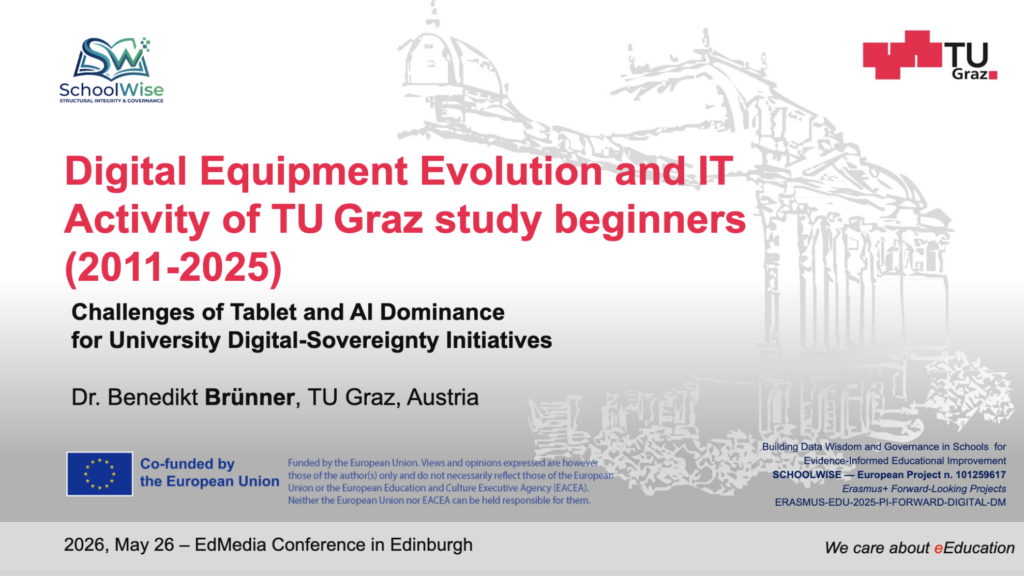
Thanks to Benedikt, who will present our paper about „Digital Equipment Evolution and IT Activity of TU Graz study beginners (2011‑2025): Challenges of Tablet and AI Dominance for University Digital‑Sovereignty Initiatives“ at this year’s EDMedia 2026 conference in Edinburgh:

Over the last thirteen years, more than 14 000 freshmen at the Graz University of Technology (TU Graz) have taken part in the annual “Welcome Days” surveys. This study analyses the responses collected between 2011 and 2025 to chart the shifting digital profile of incoming students. The results highlight evolving patterns in hardware ownership, social‑media activity, communication preferences, digital recreation, and the utilization of online information sources. Notably, the data reveal a steady increase in the adoption of artificial‑intelligence applications and tablet devices, alongside a decline in the use of Wikipedia and open‑source software. These trends pose significant challenges for TU Graz, prompting the need for initiatives that strengthen digital sovereignty and promote on‑premise hosting of open‑source solutions.
[Link to the slides]

[report] Teacher Competences for Sustainable Digital Literacy. WP 2: Country Report Austria. #tugraz

Our report about „Teacher Competences for Sustainable Digital Literacy. WP 2: Country Report Austria.“ for the european project DIGISET is now online avaible.

Abstract:
This report from the Erasmus+ project DigiSET (Grant No. 101249272) highlights that Austria is remarkably advanced when it comes to digital competences and AI integration in education. The national digital teaching competence framework for teachers, digi.kompP (updated in 2026), already explicitly addresses both AI and sustainability — a significant strength. At the same time, it is understandable that policy mandates, such as embedding sustainability as a cross-cutting theme across all curricula, take time to unfold their full effect in practice. While digital pedagogy and AI training are increasingly well established in teacher education, the seamless integration of digital and sustainability perspectives in everyday teaching is still developing. Areas like hands-on OER creation, critical reflection on AI bias, and connecting digital tools to ecological impact need continued attention. The report encourages building on Austria’s strong foundation by fostering more interdisciplinary training formats that bridge digital and sustainable education — turning an already promising landscape into a truly integrated one.

[report @ zenodo]
[report @ TU Graz repository]
[report @ ResearchGate]

Reference: Schön, S., Brünner, B., Ebner, M., Keser Aschenberger, F., Aral, N., & Aydin, D. (2026). Teacher Competences for Sustainable Digital Literacy. WP 2: Country Report Austria. Graz University of Technology. https://doi.org/10.3217/5rybf-96s62

[publication] The relation of prior IT usage, IT skills and field of study: A multiple correspondence analysis of first-year students at a University of Technology #edil21 #tugraz #research

Our contribuation to this year ED-Media 2021 conference about „The relation of prior IT usage, IT skills and field of study: A multiple correspondence analysis of first-year students at a University of Technology“ got published. The slides are already here online.

Abstract:
Starting from the question of whether the students in the different fields of study differ in terms of several variables related to IT and learning with IT, namely their general extent of IT usage, the extent of IT usage for learning, the IT skills of the students, their participation in online courses, if they learned coding basics at school and the extent of IT usage in class at school, a multiple correspondence analysis (MCA) was chosen to find answers. The MCA resulted in four clusters of fields of study. The inclusion of the variables in the biplot shows that for one dimension the IT skills of the students are crucial, and for the second dimension a further variable, the type of school added as supplementary points, explains the differences between subjects. Finally, the article discusses that these insights might change drastically – especially due to the changed conditions of first-year students with regard to their experiences with the use of IT in learning as a result of the school closures during COVID-19 pandemic. The data for this analysis come from the survey of first-year students at Graz University of Technology (TU Graz) in 2020 (N=955) which is subjected to a secondary analysis in this article.

[article @ learntechlib]
[preprint @ ResearchGate]

Refrence: Mair, B., Ebner, M., Nagler, W., Edelsbrunner, S. & Schön, S. (2021). The relation of prior IT usage, IT skills and field of study: A multiple correspondence analysis of first-year students at a University of Technology. In T. Bastiaens (Ed.), Proceedings of EdMedia + Innovate Learning (pp. 304-312). United States: Association for the Advancement of Computing in Education (AACE). Retrieved August 15, 2021 from https://www.learntechlib.org/primary/p/219673/.

[publication] Informatische Grundbildung – ein Ländervergleich #tugraz #research

Wir haben einen Beitrag zu „Informatische Grundbildung – ein Ländervergleich“ gemacht und dabei die Herangehensweise mehrerer Länder aufgezeigt. Auf der einen Seite gibt es zwar nun viel Bewegung in Österreich, allerdings ist auch das teilweise noch konservative wie der Beitrag aufzeigt.
Zusammenfassung:

In dieser Publikation wollen wir, basierend auf einer Literaturrecherche, einen Überblick über die implementierten bzw. in naher Zukunft geplanten Maßnahmen zur informatischen Grundbildung geben, indem ausgewählte europäische und außereuropäische Länder gegenübergestellt werden. Zuerst wird erläutert, dass das „Gebäude der informatischen Bildung“ durch die 3 Säulen „Informatik“, „Digital Literacy“ und „Medienbildung“ aufgebaut wird. Danach folgt eine Betrachtung der informatischen Bildung im deutschsprachigen Europa. Ein genauerer Blick wird zudem auf die Slowakei, auf Polen und insbesondere auf England geworfen, das mit der Einführung des Unterrichtsfaches „Computing“ im Jahr 2014 mit gutem Beispiel vorangeht. Auch international gibt es sehr viel Bewegung, wenn es um die Integration einer fundierten informatischen Grundbildung im Schulsystem geht. Dazu werden Maßnahmen in den USA und in Australien beleuchtet und weltweite außerschulische Initiativen genannt.

[Beitrag bei medienimpulse]

[Beitrag bei ResearchGate]

Zitation: Grandl, M., Ebner, M. (2017) Informatische Grundbildung – ein Ländervergleich, medienimpulse 02/2017, S. 1-9

[publication] Development of an Information System to Enhance Students Reading Literacy

Our publication about „Development of an Information System to Enhance Students Reading Literacy“ is published within the new issue of the International Journal of Emerging Technologies in Learning.

Abstract:

The research study at hand aims to answer the question, whether an innovative information system can be implemented that will help to enhance reading literacy of elementary pupils.
Based on predefined reading tests this web-based system evaluates the reading literacy of pupils. It consists of two primary parts; the system that creates and evaluates such reading tests and the test platform itself.
In order to assess the system a field test was conducted. Therefore it was tested in two school classes. In the course of this study reading tests were carried out and retrieved data and results were evaluated.
Despite some minor usability problems, the system performed very well. The test system delivered good estimations of the reading capabilities of single pupils and classes. Of special interest is the system’s analysis of the created reading tests since the system is capable of evaluating reading test according to their difficulty.

[Link to the full paper]

Reference: Picher, P., Ebner, M. (2015) Development of an Information System to Enhance Students Reading Literacy, International Journal of Emerging Technologies in Learning (iJET), pp. 15-21, 10 (3), https://dx.doi.org/10.3991/ijet.v10i3.4457