[publication] Generative AI Chatbots in Secondary Mathematics Education: Development and Implementation of a Dynamic Large Language Model-Based Learning Assistant for Quadrilaterals #tugraz

Our contribution titled „Generative AI Chatbots in Secondary Mathematics Education: Development and Implementation of a Dynamic Large Language Model-Based Learning Assistant for Quadrilaterals“ is now published.

Abstract:
As artificial intelligence becomes more and more a part of education, the challenge is not about having access to generative tools, but about connecting them with the goals of the curriculum and the needs of the classroom. This chapter presents the design and evaluation of a large language model–based chatbot developed specifically for teaching quadrilaterals in lower secondary mathematics. The chatbot integrates fine-tuning with retrieval-augmented generation (RAG), combining accurate, curriculum-aligned content with flexible, conversational support. The chatbot allows learners to ask conceptual questions, solve problems step by step, receive guided hints, and generate flashcards or exercises of varying difficulty. A hybrid routing mechanism selects the most appropriate response strategy based on user intent. Evaluations using both isolated prompts and multi-turn dialogues demonstrate that the hybrid system significantly outperforms standard LLM baselines in terms of accuracy, consistency, and pedagogical suitability. A classroom trial with 20 students confirmed the tool’s usability and effectiveness; students reported high satisfaction and meaningful engagement. This study demonstrates that, with careful content and architectural structuring, generative AI can enhance student learning while supporting differentiated instruction. Future directions include scaling the approach to other topics and incorporating multimodal capabilities.

[full article @ publisher’s homepage]
[draft @ ResearchGate]

Reference: Mallweger, M., Brünner, B., Ebner, M. (2026). Generative AI Chatbots in Secondary Mathematics Education: Development and Implementation of a Dynamic Large Language Model-Based Learning Assistant for Quadrilaterals. In: Auer, M.E., Nikou, S.A. (eds) GenAI in Novel Educational Applications. Studies in Computational Intelligence, vol 1260. Springer, Cham. https://doi.org/10.1007/978-3-032-16153-6_7

This is an impactful contributions, methodological rigor, and exceptional novelty in the research field of AI in education.

[publication] Understanding the Core of LLMs as genAI -CollectiveGPT and Human Intelligence #tugraz #workshop

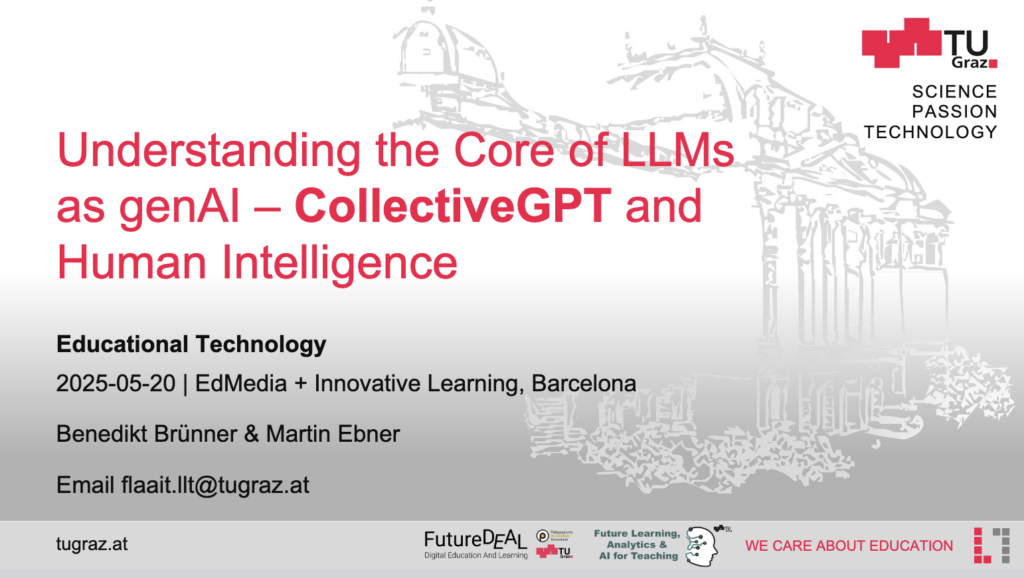
At this year’s ED-Media conference, we also did a workshop on „Understanding the Core of LLMs as genAI -CollectiveGPT and Human Intelligence„. Find a short published summary about it.

Abstract:
This workshop provides an engaging and interactive exploration of Large Language Models (LLMs), with a focus on how they operate at a foundational level. Using CollectiveGPT, an educational chatbot developed by the Ed-Tech Research Community Graz, participants gained firsthand experience understanding the principles behind generative AI (genAI) systems such as ChatGPT. Designed for educators of all disciplines, the workshop demystifies key LLM concepts such as probability-based word prediction, contextual understanding, and the role of training data. Attendees generated texts and compare their results with real-time outputs from ChatGPT, highlighting the differences between human reasoning and AI prediction. Key topics include prompting techniques, context framing, training bias, misinformation, and ethical considerations in AI use. Participants explored system prompt injection techniques and developed advanced prompting skills to optimize responses from AI systems. This workshop empowered educators with the knowledge to critically evaluate and responsibly use AI tools in their teaching. By fostering AI literacy, attendees got clear understanding of how LLMs work and how they can be leveraged to enhance learning experiences across diverse educational settings.

[publication @ conference website]
[draft @ ResearchGate]

Reference: Brünner, B. & Ebner, M. (2025). Understanding the Core of LLMs as genAI – CollectiveGPT and Human Intelligence. In T. Bastiaens (Ed.), Proceedings of EdMedia + Innovate Learning (pp. 153-154). Barcelona, Spain: Association for the Advancement of Computing in Education (AACE). Retrieved June 14, 2025 from https://www.learntechlib.org/primary/p/226329/.

[workshop] Understanding the Core of LLMs as genAI – CollectiveGPT and Human Intelligence #tugraz #edmedia25

It is ED-Media week again, and we had a lot of work: Workshops, presentations, and discussions. Our first activity is a workshop about „Understanding the Core of LLMs as genAI – CollectiveGPT and Human Intelligence„. Find our slides here:

Brünner, B., & Ebner, M. (2025, Mai 20). Presentation: Understanding the Core of LLMs as genAI – CollectiveGPT and Human Intelligence. Graz University of Technology. https://doi.org/10.3217/mznsf-g2047

[workshop] Collective GPT verstehen #tugraz #bildungsinformatik #künstlicheIntelligenz

Benedikt hat einen sehr netten Workshop erstellt um anschaulich die Funktionsweise einer generativen KI zu erklären:

In der Fortbildung Digitale Tools im Unterricht wurde unser kollektiver Chatbot ed-tech.app eingesetzt, hier finden Sie die Fragen und Antworten von ChatGPT 4o-mini zur Nachlese. Dabei wurde von den Teilnehmenden zuerst der Satz vervollständigt, und im Hintergrund ChatGPT 4o-mini parallel angefragt. Sie können die Antworten von ChatGPT hier im Blogeintrag nachlesen.

Sein Workshop ist auf unsere Bildungsinformatik.at Seite zum Nachlesen frei verfügbar – viel Spaß damit 🙂