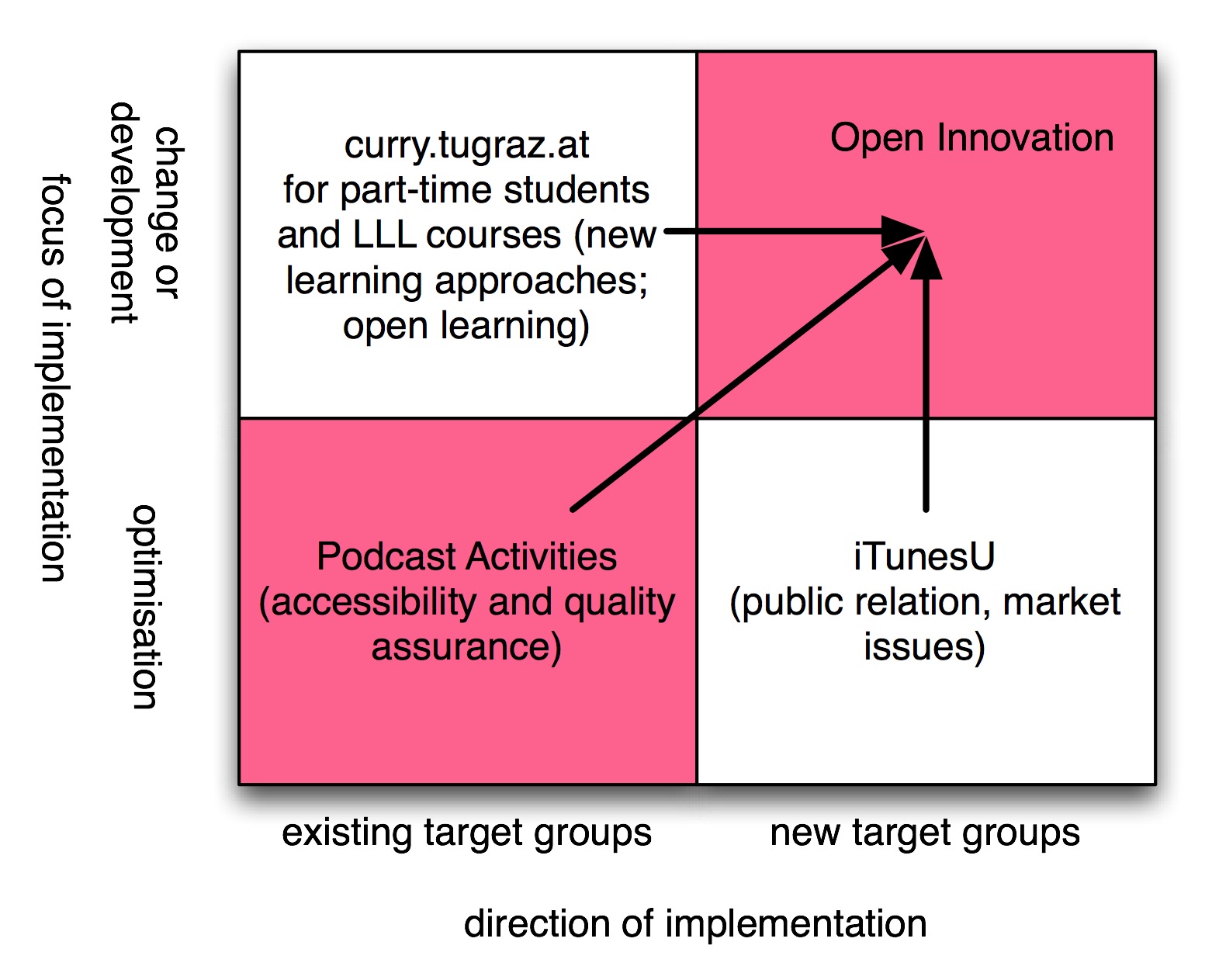
Die Strategie bzgl. Open Content bzw. Open Educational Resources an der TU Graz kann sehr grob durch dieses Schema dargestellt werden. Es ist hieraus gut ersichtlich zu welchem Zweck Lehr- und Lernressourcen freigegeben werden. Die strategische Maßnahme ist eine Adaption einer Analyse von Sandra Schaffert, wie man OER an Universitäten verankern könnte.
Weiters gibt es auch eine Webseite [https://opencontent.tugraz.at] von wo man zu den verschiedensten Inhalten gelangen kann. Wir hoffen damit einen weiteren Schritt in die richtige Richtung gesetzt zu haben und freuen uns, wenn die Angebote auch genutzt werden.
[video] So funktioniert etherpad ….
[video] Johnnie Walker
Gut gemachte Werbung ist unterhaltend – einfach Gratulation zu diesem Werk:
[CfP] 4. Workshop E-Learning 2.0
Im Rahmen der 8. e-Learning Fachtagung Informatik – DeLFI 2010 findet heuer der 4. Workshop zum Thema e-Learning 2.0 statt. Der Call for Papers [CfP] ist soeben auf meinem Schreibtisch gelandet und ich weise natürlich gerne darauf hin:
Social Software und andere Ansätze des Web 2.0 verfügen in Bildungskontexten über sehr hohe Potenziale und werden vermehrt in solchen eingesetzt. Lernen ist in aller Regel und insbesondere auch in informellen Lernsettings ein sozialer Vorgang, welcher durch die das Web prägenden Prinzipien befördert werden kann. Zum einen können typische Nachteile, die dem Erfolg klassischer E-Learning-Szenarien entgegenstehen, gemildert werden, zum anderen ermöglichen mit Social Software ausgestaltete E-Learning-Angebote eine Reihe weitergehender Mehrwerte gegenüber traditionellen Lernkontexten. Insbesondere erleichtern die geringen Partizipationsbarrieren Nutzern den Zugang zu Bildungsangeboten, fördern deren aktive Beteiligung und die Nachvollziehbarkeit und Transparenz von Lern- und Kommunikationsprozessen und erlauben deren Analyse und Auswertung für zukünftige Lernsituationen (Metalernen).
[podcast] Streaming in der Lehre – Relativiert die Erfahrung den Hype?
Mein Vortrag an der TU Wien am dortigen 6. e-Learning Tag über die Pocasting/Streaming Aktivitäten an der TU Graz ist nun online verfügbar. Selbstverständlich findet man ihn auch in der entsprechenden iTunesU Serie [Link iTunesU].
[presentation] e-Learning X.0
Im Rahmen der Vorlesung „Gesellschaftliche Aspekte der Informationstechnologie“ an der TU Graz halte ich heute diesen Vortrag rund um das Thema „e-Learning X.0„. Neben einer Aufarbeitung des derzeitigen Forschungsstand am Gebiet von Technology Enhanced Learning, versuch ich mich auch etwas in zukünftigen Entwicklungen:
e-Learning X.0
View more presentations from Martin Ebner.
Wer mich auch hören möchten, kann dies ab 17.00 Uhr hier [Livestream TU Graz] tun.
[GADI2010] Reputation/Webmonitoring und e-Learning X.0

 Der siebente Termin der heurigen Vorlesung „Gesellschaftliche Aspekte der Informationstechnologie“ an der TU Graz besteht aus folgenden 2 Vorträgen:
- Sandra Schaffert: „Spuren im Web: Reputation und Webmonitoring“ (Facebooklink)
- Martin Ebner: „e-Learning X.0“ (Facebooklink)
Beide Vorträge werden live gestreamt – Link zum Streamingserver
Weitere Vorträge/Abstracts findet man hier auf der Vorlesungshomepage.
[presentation] uLearning? Future of education from a technical perspective
Im Rahmen der 2. Zukunftswerkstätte des Forum Neue Medien Austria halte ich heute diesen Vortrag rund um das Thema uLearning:
Happy Birthday e-Learning Blog
Zu meiner Schande muss ich eigentlich gestehen, dass ich den Geburstag meines Weblogs übersehen habe. Zwar nur um eine paar Tage, aber trotzdem. Also nachträglich alles, alles Gute.
4 Jahre ist es also her, als ich den ersten Beitrag geschrieben habe und jedes Jahr bin ich aufs Neue verwundert, wie er sich entwickelt hat. Eine einfach simple Idee am Anfang und heute ist er fixer Bestandteil meiner Tätigkeit, dient der Reflexion und Darstellung unserer und anderer Aktivitäten.
Der Dank gilt natürlich auch den Lesern, die so eifrig diese Seite aufsuchen und mir oft in einem persönlichen Gespräch Feedback geben. Es ist einfach schön, wieviele Kontakte durch diesen Weblog entstanden sind und wohl auch noch werden.
In diesem Sinne freue ich mich aufs nächste Jahr 🙂 .
[presentation] Streaming in der Lehre – Relativiert die Erfahrung den Hype?
Die Folien meines Vortrages für den 6. e-Learning Tag an der TU Wien sind nun online verfügbar: