[publication] When Learning Analytics Meets MOOCs – a Review on iMooX Case Studies #imoox #LearningAnalytics #MOOC

Our chapter on „When Learning Analytics Meets MOOCs – a Review on iMooX Case Studies“ got published within the book series Communications in Computer and Information Science.

Abstract:

The field of Learning Analytics has proven to provide various solu- tions to online educational environments. Massive Open Online Courses (MOOCs) are considered as one of the most emerging online environments. Its substantial growth attracts researchers from the analytics field to examine the rich repositories of data they provide. The present paper contributes with a brief literature review in both prominent fields. Further, the authors overview their developed Learning Analytics application and show the potential of Learning Analytics in tracking students of MOOCs using empirical data from iMooX.

[Article @ Springer]

[Draft @ ResearchGate]

Reference: Khalil, M. and M. Ebner (2016). When Learning Analytics Meets MOOCs – a Review on iMooX Case Studies. Innovations for Community Services: 16th International Conference, I4CS 2016, Vienna, Austria, June 27-29, 2016, Revised Selected Papers. G. Fahrnberger, G. Eichler and C. Erfurth. Cham, Springer International Publishing: 3-19

[Leitfäden] Aufzeichnung – Lernvideo – Streaming – Webinar #TUGraz

Im Rahmen eines hochschulübergreifenden Projekts zur Stärkung der Infrastruktur in Hörsälen haben wir 4 Leitfäden erstellt für Lehrende um übersichtlich die Möglichkeiten (Aufzeichnung, Lernvideo, Streaming & Webinar) darzustellen. Alle vier sind nun auf Slideshare mit offener Lizenz veröffentlich. Sollte jemand die .pdfs benötigen, kann man sich gerne bei mir melden.
Gedacht ist es so, dass man es doppelseitig ausdruckt und entlang der strichlierten Linie wie eine Zieharmokika faltet 🙂 .

Klicken Sie auf den unteren Button, um den Inhalt von www.slideshare.net zu laden.

Inhalt laden

Klicken Sie auf den unteren Button, um den Inhalt von www.slideshare.net zu laden.

Inhalt laden

Klicken Sie auf den unteren Button, um den Inhalt von www.slideshare.net zu laden.

Inhalt laden

Klicken Sie auf den unteren Button, um den Inhalt von www.slideshare.net zu laden.

Inhalt laden

[workshop] Learning Management System und Open Educational Resources

Im Rahmen des CAS eLearning Zertifikatkurses darf ich das Modul „Learning Managment System und Open Educational Resources“ abhalten. Die dafür notwendigen Unterlagen sind hier nochmals übersichtlich dargestellt.


VORMITTAG: Learning Management Systeme

  • „LMS“: Learning Management Systeme – ohne geht’s auch nicht beschäftigt sich mit Learning Management Systemen. Sowohl technische und didaktische Aspekte kommen zur Sprache und auch wie man solche Systeme in Unternehmen/Bildungsinstitutionen einführt.

    Klicken Sie auf den unteren Button, um den Inhalt von www.slideshare.net zu laden.

    Inhalt laden


NACHMITTAG: Open Educational Resources

  • „OER“: Eine Übersicht zu dem Thema inklusive Übungen.

    Klicken Sie auf den unteren Button, um den Inhalt von www.slideshare.net zu laden.

    Inhalt laden


Als weiterführende Literatur wird das Lehrbuch für Lernen und Lehren mit Technologien empfohlen mit den entsprechenden Kapiteln.
Zur Info für Nicht-Teilnehmer/innen: Es handelt sich um einen ganztägigen Workshop.

[publication] Maker-MOOC – How to Foster STEM Education with an Open Online Course on Creative Digital Development and Construction with Children #making #imoox

Our publication on „Maker-MOOC – How to Foster STEM Education with an Open Online Course on Creative Digital Development and Construction with Children“ at this year ICL conference in publication got published.

Abstract:

The Maker Movement or do-it-yourself culture is a concept uses novel, mostly via digital applications and tools to emphasize the learning- through-doing in the social environment. This culture inspires teachers through learning by construction and is seen as an important driver for education. In this chapter, we introduce the Maker Movement and describe how it contributes to the STEM education. The authors recite their experience through the project “Maker Days for Kids” which after that, was served as a fundamental base for a following Massive Open Online Course (MOOC). This online course brought some of the emerging technologies together with an appropriate didactical pro- ject about “Making activities for classrooms” to the public. It can be concluded that the MOOC assists in fostering the STEM education by rapidly transferring knowledge to the involved teachers.

[Draft version @ ResearchGate]

Reference: Ebner, M., Schön, S., Khalil, M. (2016) Maker-MOOC – How to Foster STEM Education with an Open Online Course on Creative Digital Development and Construction with Children. Conference Proceeding 19th International Conference on Interactive Collaborative Learning (ICL2016), Belfast, pp. 1233-1244

[presentation, master] Making im Unterricht am Beispiel des Raspberry PI #making

Martin Müller hat im Rahmen seiner Diplomarbeit den Einsatz eines Raspberry PI im Sinne von Making an einer Schule untersucht. Die Folien seiner Arbeit findet man hier:

Klicken Sie auf den unteren Button, um den Inhalt von www.slideshare.net zu laden.

Inhalt laden

[imoox] Das war „Gratis Online Lernen“ 2016 :-) #gol16 #Danke #imoox

Wir sagen danke, danke für das Durchhalten in den letzten 9 Wochen – damit ist nun auch der GOL 2016 zu Ende und der vierte Durchlauf des Kurses zu Ende.
Und natürlich freuen wir uns sehr darüber, wenn Ihr uns als Kooperationspartner oder Sponsoren unterstützen möchtet, damit Gratis Online Lernen auf imoox.at wieder „in großem Stil“ angeboten, unterstützt, beworben werden kann.

daswar

[publication] How to foster forum discussions within MOOCs: A case study #imoox #mooc

Our research work titled „How to foster forum discussions within MOOCs: A case study“ got published as part of the International Journal of Academic Research in Education. We introduce some of our experiences concerning discussion forums in MOOCs.
Abstract:

Discussion forums are an essential part to foster interaction among teachers and students, as well as students and students, in virtual learning settings. If interaction can be enhanced, this has a positive influence on motivation and finally also on dropout rates. These days, a special form of online courses, so-called MOOCs (Massive Open Online Courses), are popping up massively. Those courses are characterized by a high number of students. In this paper, we would like to examine discussion forums and their role concerning interaction. Therefore, Gilly Salmon’s well-known Five stage model is taken and adapted to MOOCs based on a case study. As a method, we tracked learners’ data through learning analytics applications and concluded that there is a positive correlation between reading from one side and writing in forums from the other side.

[Link to Full Paper @ IJARE]

[Link to Full Paper @ ResearchGate]

Reference: Lackner, E., Khalil, M. & Ebner, M. (2016). How to foster forum discussions within MOOCs: A case study, International Journal of Academic Research in Education, 2(2), 01‐13. DOI: 10.17985/ijare.31432

[ijet, journal] Journal of Emerging Technologies in Learning Vol. 11 / No. 12 #ijet #research

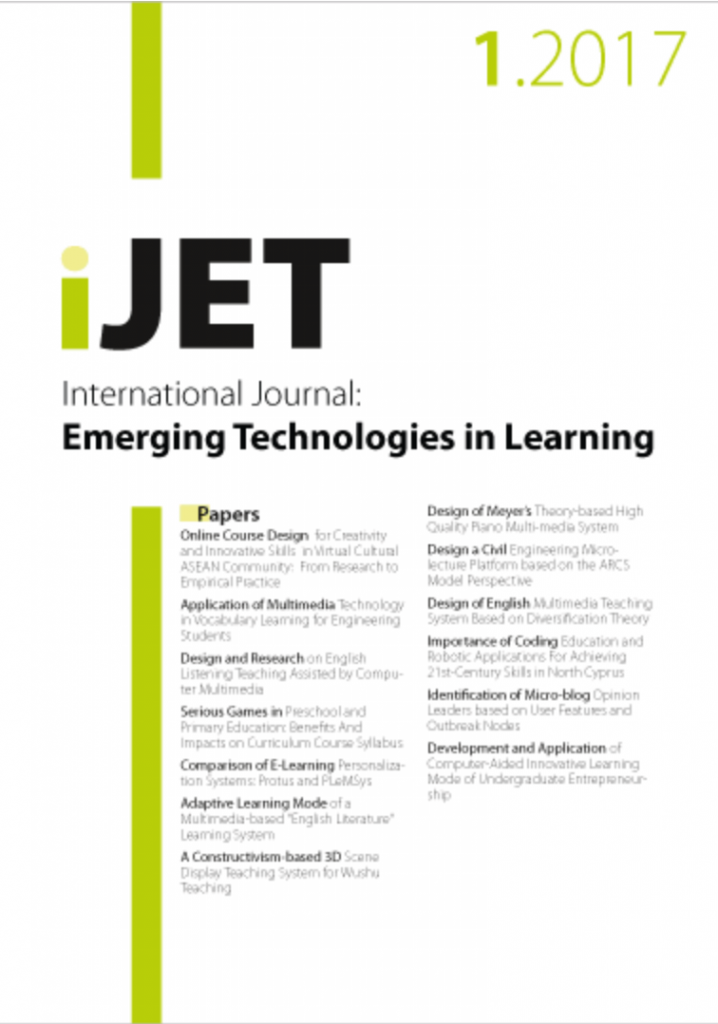
iTEL 11/12Issue 11(12) of our journal on emerging technologies for learning got published. Enjoy the readings as usual for free :-).

Table of Contents:

  • Mobile English Learning: An Empirical Study on an APP, English Fun Dubbing
  • Needs Assessment of Information and Communication Technology Literacy (ICT Literacy) of Students in Secondary Educational Service Area
  • Educational Content Development Process in „CleverUniversity“: Our Dynamic Adaptive Hypermedia Environment
  • The Effect of WeChat-assisted Problem-based Learning on the Critical Thinking Disposition of EFL Learners
  • The Role of Games in Special Preschool Education
  • Multidisciplinary Project Based Learning Within a Collaborative Framework: A Case Study on Urban Drone Conception
  • RoBlock – Web App for Programming Learning
  • Factors Affecting the Acceptability of Online Degrees: Evidence from Two Arab Countries
  • Study of Continuity Trust on Adoption and Design of e-Education and Student Development
  • Empirical Study on the Computer-aided College English Translation Teaching
  • A Study on Computer Teaching Based on Computational Thinking

[Link to Issue 11/12]

Nevertheless, if you are interested to become a reviewer for the journal, please just contact me :-).

[press] So schließt man die Kluft der digitalen Qualifikationen zwischen Schülern

Profil.at hat mich für einen Artikel kurz befragt. Erschienen ist dies jezt unter „So schließt man die Kluft der digitalen Qualifikationen zwischen Schülern“ und man findet mich dort unter anderem mit dem Zitat:

„… verlangt daher eine radikale Aufwertung der Medienerziehung im Unterricht. Sie müsste den gleichen Stellenwert bekommen, den Deutsch hat“

Und ja ich stehe tatsächlich dazu, denn ich möchte damit verdeutlichen, dass digitale Technologien ich mittlerweile öfters nutze als einen Bleistift. Daher ist es wesentlich zu wissen, wie man diese gezielt nutzen kann, wie diese prinzipiell funktionieren und wie man diese gebraucht um die Welt von morgen aktiv zu gestalten ohne dabei gesetztliche Regelungen zu verletzen. Also wieder einmal die Lanze für Medienerziehung gebrochen, die Gesellschaft von morgen braucht das, dringend!