[presentation] Digitale Kompetenzen für und an österreichischen Schulen #TEL17 #tugraz

Im Rahmen meines Seminars „Technology Enhanced Learning“ haben wir diese Woche uns dem Thema „Digitale Kompetenzen an und für österreichische Schulen“ gewidmet. Maria Grandl und ich stellten dabei die Iniativen in Österreich vor um im Anschluss über fächerintegrativen Unterricht zu diskutieren. Hier der Foliensatz:

Klicken Sie auf den unteren Button, um den Inhalt von www.slideshare.net zu laden.

Inhalt laden

Invitation: Workshop at the EdMedia conference in June 2018, Amsterdam #workshop #research

Together with smart colleagues I will host a workshop at the next EdMedia conference: It will take place at 2018-06-25 from 9.30 to 13.00h and is titled with „Making with kids in Europe – to foster digital literacy, to make a better world, and to build a new entrepreneurship education„.
You find details in the DOIT calendar and at the EdMedia conferene Website. Hope to meet you there!

[publication] Ein offenes Unterrichtskonzept für den Einstieg in die Programmierung mit Hilfe von „Pocket Code“#pocketcode #bildungsinformatik

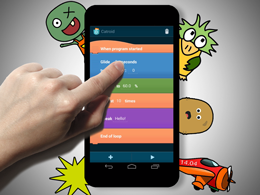
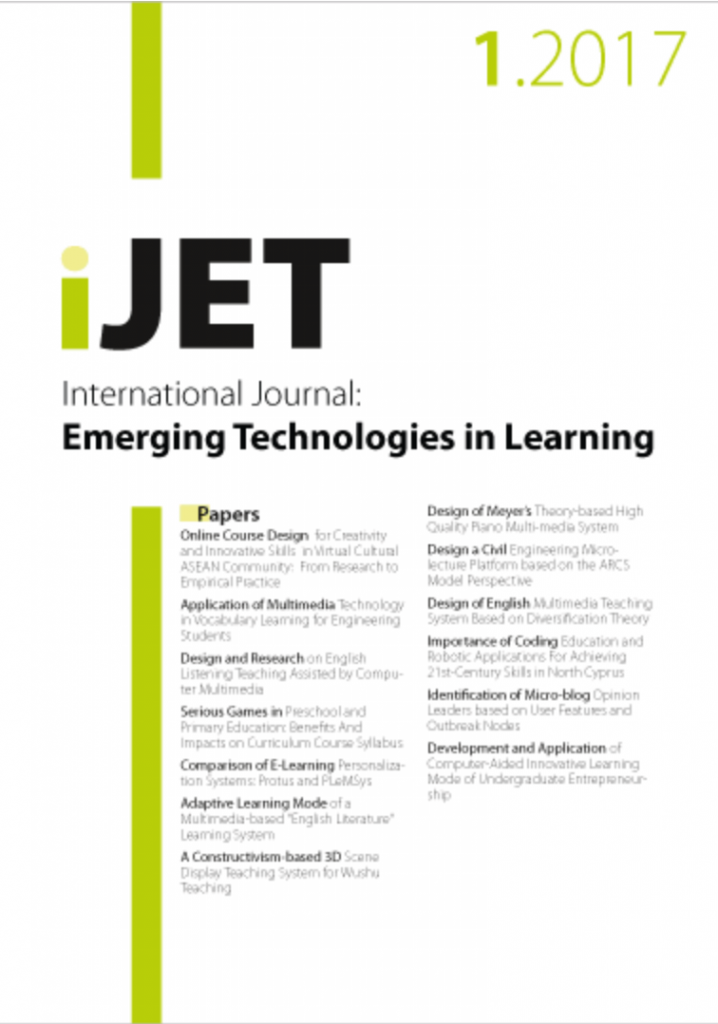
Wir wurden eingeladen für ein Sonderheft rund um das Thema „CODING als Baustein der digitalen Bildung“ einen Beitrag einzureichen und haben hier unsere Arbeiten rund um den Einsatz von PocketCode an Schulen beschrieben. Den Kurs den wir beschreiben findet man übrigens hier.

Abstract:

Pocket Code ist eine im Zuge des Non-Profit-Projektes „Catrobat“ an der Technischen Universität Graz entwickelte mobile App, mit der Programme am Smartphone oder Tablet erstellt werden können (vgl. Slany, 2014). Catrobat bezeichnet auch die gleichnamige blockbasierte Programmiersprache, welche nach dem Vorbild von Scratch entwickelt wurde. Pocket Code erlaubt es den Schülerinnen und Schülern im Gegensatz zu Scratch, jederzeit und jederorts ihre eigenen Smartphones zum Programmieren zu verwenden

[Link zum Beitrag @ ResearchGate]

[Link zum gesamten Sonderheft]

Referenz: Grandl, M., Höllerbauer, B., Ebner, M., Slany, W. (2017) Ein offenes Unterrichtskonzept für den Einstieg in die Programmierung mit Hilfe von „Pocket Code“. Coding als Baustein der digitalen Grundbildung. Schule Aktiv (Sonderheft des BMB). S. 32-37

[publication] How can Gamification Improve MOOC Students Engagement?

Our contribution to this year 11th European Conference on Games Based Learning (ECGBL) is about our Gamifications experiments within MOOCs. The publication is titled „How can Gamification Improve MOOC Students Engagement?

Abstract:

Massive Open Online Courses (MOOCs) require students‘ motivation either intrinsically or extrinsically to complete any of its courses. Even though MOOCs enjoy great popularity and bring many benefits to the educational community, some concerns arise with MOOC advancement. In fact, MOOCs are affected by low completion rate and face issues with respect to interactivity and student engagement along MOOC duration, which may convert student excitement to boredom and then drop out at any stage. A key result of research in the past couple of years has proved that students‘ engagement in MOOCs is strongly related to their activities online. These activities are related to the interaction between student and logging in the MOOC, reading and writing in the MOOC discussion forum, watching videos and doing quizzes. In this research paper, we present our research in deploying a gamification mechanic in MOOCs to increase student engagement. The gamification approach relies on weekly feedback to drive student intrinsic and extrinsic motivation. Following learning analytics on students‘ data from a MOOC offered in 2014, 2015, and 2016, the outcome of this approach showed an obvious increase in students‘ activity and engagement in discussion forums, login frequency and quiz trials. The active students‘ cohort allotment has increased in comparison with previous versions of the same MOOC as well as the completion rate has incremented up to 26% of the total number of participants.

[Full article @ ResearchGate]

Reference: Khalil, M., Ebner, M., & Admiraal, W. (2017). How can Gamification Improve MOOC Students Engagement?. In proceedings of the European Conference on Game Based Learning, Graz, Austria, (pp. 819-828

[publication] Digitalisierung ist konsequent eingesetzt ein pädagogischer Mehrwert für das Studium: Thesen zur Verschmelzung von analogem und digitalem Lernen auf der Grundlage von neun Fallstudien #gmw17 #tugraz

Im Rahmen der 25. Jahrestagung der Gesellschaft für Medien in der Wissenschaft (GMW) haben wir einen Beitrag zu „Digitalisierung ist konsequent eingesetzt ein pädagogischer Mehrwert für das Studium: Thesen zur Verschmelzung von analogem und digitalem Lernen auf der Grundlage von neun Fallstudien“ verfasst.

Zusammenfassung:

Viele Jahre war der Einsatz von computergestütztem Lehren und Lernen an (tragbare) Computer gebunden. Ob digitale Hilfsmittel, z. B. Laptop und Video-Projektor, zum Einsatz kamen war deutlich erkennbar. Spätestens mit dem ubiquitären Internet und den Smartphones in den Taschen der Studierenden ist diese Grenzziehung zwischen sog. „analoger“ d. h. herkömmlicher Präsenzlehre sowie dem „digitalen“, d. h. dem computergestützten Lehren und Lernen, vermutlich sogar obsolet. Die Digitalisierung verändert auf unterschiedliche Weise die Lehre. Im Papier wird die These aufgestellt, dass dabei digitale und sogenannte analoge Aspekte immer mehr miteinander verschmelzen. Besonderheiten von verschmolzenen Lern- und Lehrformaten wurden in einem Arbeitspapier, das für das Hochschulforum Digitalisierung erstellt wurde, herausgearbeitet. Im Beitrag werden neun Fallstudien skizziert und ihre Besonderheiten verglichen. Daraus abgeleitet werden Thesen über die Charakteristik von verschmolzenen Lern- und Lehrformaten.

[Beitrag @ ResearchGate]

Zitation: Schön, S., Ebner, M., Schön, M., Haas, M. (2017) Digitalisierung ist konsequent eingesetzt ein pädagogischer Mehrwert für das Studium: Thesen zur Verschmelzung von analogem und digitalem Lernen auf der Grundlage von neun Fallstudien. In: Bildungsräume, Igel, C. (Hrsg.), Proceedings der 25. Jahrestagung der Gesellschaft für Medien in der Wissenschaft, Waxmann, S. 11-19

[publication] Development of a Dashboard for Learning Analytics in Higher Education #STELA #LearningAnalytics

Our first publication at this year HCII 2017 conference was about „Development of a Dashboard for Learning Analytics in Higher Education“.
Abstract:

In this paper, we discuss the design, development, and implementation of a Learning Analytics (LA) dashboard in the area of Higher Education (HE). The dashboard meets the demands of the different stakeholders, maximizes the mainstreaming potential and transferability to other contexts, and is developed in the path of Open Source. The research concentrates on developing an appropriate concept to fulfil its objectives and finding a suitable technology stack. Therefore, we determine the capabilities and functionalities of the dashboard for the different stakeholders. This is of significant importance as it identifies which data can be collected, which feedback can be given, and which functionalities are provided. A key approach in the development of the dashboard is the modularity. This leads us to a design with three modules: the data collection, the search and information processing, and the data presentation. Based on these modules, we present the steps of finding a fitting Open Source technology stack for our concept and discuss pros and cons trough out the process.

[Publication @ Springer]

[Draft @ ResearchGate]

Reference: Leitner P., Ebner M. (2017) Development of a Dashboard for Learning Analytics in Higher Education. In: Zaphiris P., Ioannou A. (eds) Learning and Collabo- ration Technologies. Technology in Education. LCT 2017. Lecture Notes in Computer Science, vol 10296. pp. 293-301 Springer, Cham

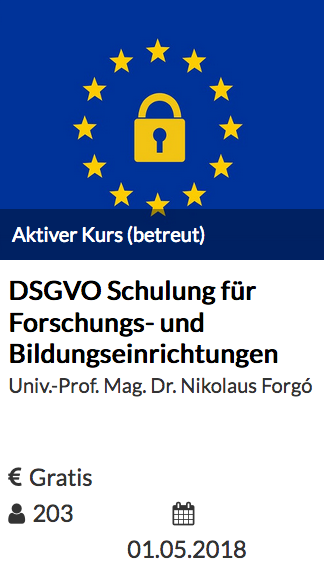
[imoox, pocketcode] Learning To Code – Woche 2 #imoox #pcode17

Pocket CodeSo schnell vergeht die Zeit und wir sind schon mitten in Woche 2 beim Online-Kurs: Learning To Code! Programmieren mit PocketCode. Diese Woche geht es in die Unendlichkeit, denn das Thema sind Schleifen:

In diesem Kapitel wird es noch spannender! Wir lernen wie wir Animationen mithilfe von Schleifen machen können und wie Objekte miteinander kommunizieren! Zu guter Letzt tauchen wir noch in die Welt der Sensoren ein. Wir schauen uns an wie wir Objekte mit der Neigung unseres Smartphones steueren können
Drei Aufgabenstellungen dienen zum Üben der vorgestellten Konzepte.

Also: Bis zur Unendlichkeit und noch viel weiter….!

Man kann jederzeit noch mitmachen – einfach hier anmelden und in den Kurs einsteigen. Wir freuen uns über alle Teilnehmerinnen und Teilnehmer 🙂

[publication] The Multiplication Table as an innovative Learning Analytics Application #LearningAnalytics #tugraz

Another publication at this year ED-Media conference is about „The Multiplication Table as an innovative Learning Analytics Application„. The presentation has been recorded and can be find here.
Abstract:

The main topic of this paper is the development of a web-based application that helps children to learn the one-digit multiplication table. The developed application supports individual learning process of the pupils and also provides the teachers with the possibility to intervene according to the analysis of users’ answers. The application uses modern technologies in order to offer high performance and availability to the users. The system also provides an interface for mobile clients, which present the questions and the processed data in different forms. The answers of the pupils, as well as other gathered data from the application show interesting results related to the participation and learning improvement.

[Draft version @ ResearchGate]

Reference: Kraja, E., Taraghi, B. & Ebner, M. (2017). The Multiplication Table as an innovative Learning Analytics Application. In J. Johnston (Ed.), Proceedings of EdMedia: World Conference on Educational Media and Technology 2017 (pp. 810-820). Association for the Advancement of Computing in Education (AACE).