[presentation] German Language Training App for Primary School Children #tugraz #LearningAnalytics #edil18 #InnovateLearning

At this year ED-Media conference in Amsterdam we present our publication „German Language Training App for Primary School Children“ and describe our research about an iphone application to assist the IDeRblog-project. Here you can find the slides:

Klicken Sie auf den unteren Button, um den Inhalt von www.slideshare.net zu laden.

Inhalt laden

[workshop] Making With Kids in Europe – To Foster Digital Literacy, to Make a Better World, and to Build a New Entrepreneurship Education #making #edmedia #InnovateLearning

At this year ED-Media conference in Amsterdam we start with a workshop on „Making With Kids in Europe – To Foster Digital Literacy, to Make a Better World, and to Build a New Entrepreneurship Education“ where we like to introduce to our activities.

Description:

Some of Europe’s leading experts on making with children will share their experiences and different approaches within this joint workshop The workshop will include presentations about teacher education within makerspaces at the University of Technologies Graz (AT), about inspiring social innovation and educational projects at the Waag Society (NL) and about the European initiative DOIT, which sees making as a good base for an early entrepreneurship education. Participants will work with a set of tools and smaller maker projects. For example, they can program educational games in Scratch, build a dough piano (which will do music!) with a MaKeyMaKey set, or sew some “smart gloves”. Interactive discussions will be the base to develop own future implementations.

Find here the slides and workshop hand-outs at our partner’s website DoIT.

[publication] Learning analytics to improve writing skills for young children – an holistic approach #LearningAnalytics #iderblog

Our publication about „Learning analytics to improve writing skills for young children – an holistic approach“ has been published in the Journal of Research in Innovative Teaching & Learning.

Abstract:

Purpose
Due to the important role of orthography in society, the project called IDeRBlog presented in this paper created a web-based tool to motivate pupils to write text as well as to read and to comment on texts written by fellow students. In addition, IDeRBlog aims to improve student’s German orthography skills and supports teachers and parents with training materials for their students. The paper aims to discuss these issues.

Design/methodology/approach
With the aid of learning analytics, the submitted text is analyzed and special feedback is given to the students so that they can try to correct the misspelled words themselves. The teachers as well as the parents are benefiting from the analysis and exercises suggested by the system.

Findings
A recent study showed the efficiency of the system in form of an improvement of the students’ orthographic skills. Over a period of four months 70 percent of the students achieved a significant reduction of their spelling mistakes.

Originality/value
IDeRBlog is an innovative approach to improving orthography skills combining blogging and new media with writing and practice.

[Article @ Journal’s Website]

[Article @ ResearchGate]

Reference: Nina Steinhauer, Michael Gros, Martin Ebner, Markus Ebner, Anneliese Huppertz, Mike Cormann, Susanne Biermeier, Lena Burk, Konstanze Edtstadler, Sonja Gabriel, Martina Wintschnig, Christian Aspalter, Susanne Martich, (2017) Learning analytics to improve writing skills for young children – an holistic approach, Journal of Research in Innovative Teaching & Learning, Vol. 10 Issue: 2, pp.143-159, https://doi.org/10.1108/JRIT-07-2017-0013

[conference] Freie Bildungsmaterialien in der Hochschullehre #OER #tugraz

Es freut mich, dass ich zu einer OER-Konferenz in Karlsruhe mit dem Titel „OER-KA: Freie Bildungsmaterialien in der Hochschullehre“ eingeladen worden bin. Ich möchte dort die letzten Entwicklungen aus Österreich überblicksmäßig darstellen, insbesondere die letzten Arbeiten auf nationalem Level vorstellen.

Ich freue mich auf viele TeilnehmerInnen und spannende Diskussionen 🙂 .

[publication] Mobile Seamless Learning – Die nahtlose Integration mobiler Geräte beim Lernen und im Unterricht #mlearning #research

Unser Beitrag zu „Mobile Seamless Learning – Die nahtlose Integration mobiler Geräte beim Lernen und im Unterricht“ im Handbuch Mobile Learning ist nun erschienen.

Zusammenfassung:

Mobile Geräte möglichst nahtlos beim Lernen und im Unterricht zu integrieren, ist eine Zielsetzung des Mobile Seamless Learning. Genau genommen soll das Lernen in unterschiedlichen Räumen – inner- und außerhalb des Klassenzimmers, im physischen wie auch im virtuellen Raum, möglichst einfach gelingen. In diesem Beitrag wird die Entwicklung des Mobile Seamless Learning-Ansatzes sowie seine Bedeutung skizziert. Fünf konkrete Einsätze, die dem Mobile Seamless Learning-Ansatz zugeordnet werden, geben Einblick in die praktische Realisierung in unterschiedlichen Lernkontexten. Schließlich werden wichtige Erfahrungen zusammengefasst und Empfehlungen für eigene Umsetzungen gegeben.

[Original-Beitrag @ Springer]

[Draft @ ResearchGate]

Zitation: Schön, S., Ebner, M. (2018) Mobile Seamless Learning – Die nahtlose Integration mobiler Geräte beim Lernen und im Unterricht. In: Handbuch Mobile Learning. de Witt, C. & Gloerfeld, C. (Ed.). S. 283 – 302. Springer. https://doi.org/10.1007/978-3-658-19123-8_15

[publication] Gamification in MOOCs: A Review of the State of the Art #tugraz #MOOC #research

Our contribution at this year EDUCON conference is about „Gamification in MOOCs: A Review of the State of the Art„. We took a close look to current research studies about game elements in MOOCs and summarized the result.

Abstract:

A Massive Open Online Course (MOOC) is a type of online learning environment that has the potential to increase students‘ access to education. However, the low completion rates in MOOCs suggest that student engagement and progression in the courses are problematic. Following the increasing adoption of gamification in education, it is possible that gamification can also be effectively adopted in MOOCs to enhance students‘ motivation and increase completion rates. Yet at present, the extent to which gamification has been examined in MOOCs is not known. Considering the myriad gamification elements that can be adopted in MOOCs (e.g., leaderboards and digital badges), this theoretical research study reviews scholarly publications examining gamification of MOOCs. The main purpose is to provide an overview of studies on gamification in MOOCs, types of research studies, theories applied, gamification elements implemented, methods of implementation, the overall impact of gamification in MOOCs, and the challenges faced by researchers and practitioners when implementing gamification in MOOCs. The results of the literature study indicate that research on gamification in MOOCs is in its early stages. While there are only a handful of empirical research studies, results of the experiments generally showed a positive relation between gamification and student motivation and engagement. It is concluded that there is a need for further studies using educational theories to account for the effects of employing gamification in MOOCs.

[Draft version @ ResearchGate]

Reference: Khalil, M., Wong, J., de Koning, B. B., Ebner, M., & Paas, F. (2018). Gamification in MOOCs: A Review of the State of the Art. In proceedings of the 2018 IEEE Global Engineering Education Conference (pp. 1635-1644). Santa Cruz de Tenerife, Canary Islands, Spain

[publication] It’s in your pocket: A MOOC about programming for kids and the role of OER in teaching and learning contexts #imoox #mooc #tugraz

Our publication about „It’s in your pocket: A MOOC about programming for kids and the role of OER in teaching and learning contexts“ at this year Open Education Global Conference in Delft got published right now.

Abstract:

Programming is considered as an essential skill in the 21st century. Visual programming languages and age-appropriate development environments allow an easy entry into this field. Nevertheless, it is very challenging to bring those skills in a very short time frame to schools, to their teachers, and to school children themselves. Therefore, Graz University of Technology started a Massive Open Online Course named “Learning to code: Programming with Pocket Code” which is intended to teach coding skills to school children as well as teachers in a very fast, flexible and effective way. The learning content within the course is published under an open license to allow the reuse, modification and dissemination of the materials in different teaching and learning contexts. In this research work, we will present structure and concept of the MOOC. A special emphasis will be given on how the MOOC can be used in school and on the fact, that the content can be disseminated in a variety of ways.

[Link to article @ ResearchGate]

[Link to article @ Conference Proceeding Database]

Reference: Grandl, M., Ebner, M., Slany, W., Janisch, S. (2018) It’s in your pocket: A MOOC about programming for kids and the role of OER in teaching and learning contexts.In: Conference Proceeding Open Educational Global Conference 2018. p. 9. Delft, Netherlands

[publication] Transferring learning dashboards to new contexts: experiences from three case studies #LearningAnalytics #STELA

Our publication about „Transferring learning dashboards to new contexts: experiences from three case studies“ at this year Open Education Global Conference in Delft got published right now.

Abstract:

This papers focuses on the use of learning dashboards in higher education to foster self-regulated learning and open education. Students in higher education have to evolve to independent and lifelong learners. Actionable feedback during learning that evokes critical self-reflection, helps to set learning goals, and strengthens self-regulation will be supportive in the process. Therefore, this paper presents three case studies of learning analytics in higher education and the experiences in transferring them from one higher education institute than the other. The learning dashboard from the three case studies is based on two common underlying principles. First, they focus on the inherent scalability and transferability of the dashboard: both considering the underlying data and the technology involved. Second, the dashboard use as underlying theoretical principles Actionable Feedback and the Social Comparison Theory. The learning dashboards from the case studies are not considered as the contribution of this paper, as they have been presented elsewhere. This paper however describes the three learning dashboards using the general framework of Greller and Drachsler (2012) to enhance understanding and comparability. For each of the case study, the actual experiences of transferability obtained within a European collaboration project (STELA, 2017) are reported. This transferability and scalability is the first-step of creating truly effective Open Educational Resources from the Learning Analtyics Feedback dashboards. The paper discusses how this collaboration impacted and transformed the institutes involved and beyond. The use of open education technology versus proprietary solutions is described, discussed, and translated in recommendations. As such the research work provides insight on how learning analytics resources could be transformed into open educational resources, freely usable in other higher education institutes.

[Link to article @ ResearchGate]

[Link to article @ Conference Proceeding Database]

Reference: De Laet, T., Broos, T., van Staalduinen, J.-P., Ebner, M., Leitner, P. (2018)Transferring learning dashboards to new contexts: experiences from three case studies. In: Conference Proceeding Open Educational Global Conference 2018. p. 14. Delft, Netherlands

[publication] Orthography Training with IDeRBlog-an Open Educational Resources Practice #iderblog #oer #learninganalytics

Our publication about „Orthography Training with IDeRBlog-an Open Educational Resources Practice“ at this year Open Education Global Conference in Delft got published right now.

Abstract:

The article depicts the blogging platform IDeRBlog as an example of an Open Educational Resources Practice. The exercise databases of IDeRBlog are focussed in the context of orthography training. After briefly outlining Open Educational Resources an overview on how the exercises were researched and reviewed according to an established quality framework is given. This is followed by the Analysis of missing exercises and the creation of IDeRBlog exercises by the project team.

[Link to article @ ResearchGate]

[Link to article @ Conference Proceeding Database]

Reference: Gros, M., Aspalter, C., Ebner, M., Ebner, M., Steinhauer, N., Adolph, H., Ankner, L., Biermeier, S., Cormann, M., Edtstadler, K., Ernst, S., Gabriel, S., Goor, G., Huppertz, A., Irmag, K., Leitner, P., Martich, S., Taraghi, B., Ullmann, M. & Wintschnig, M. (2018) Orthography Training with IDeRBlog-an Open Educational Resources Practice. In: Open Education Global Conference 2018: OEGlobal2018. Van Valkenburg, W. & Schuwer, R. (Hrsg.). Delft University of Technology, 5 S.
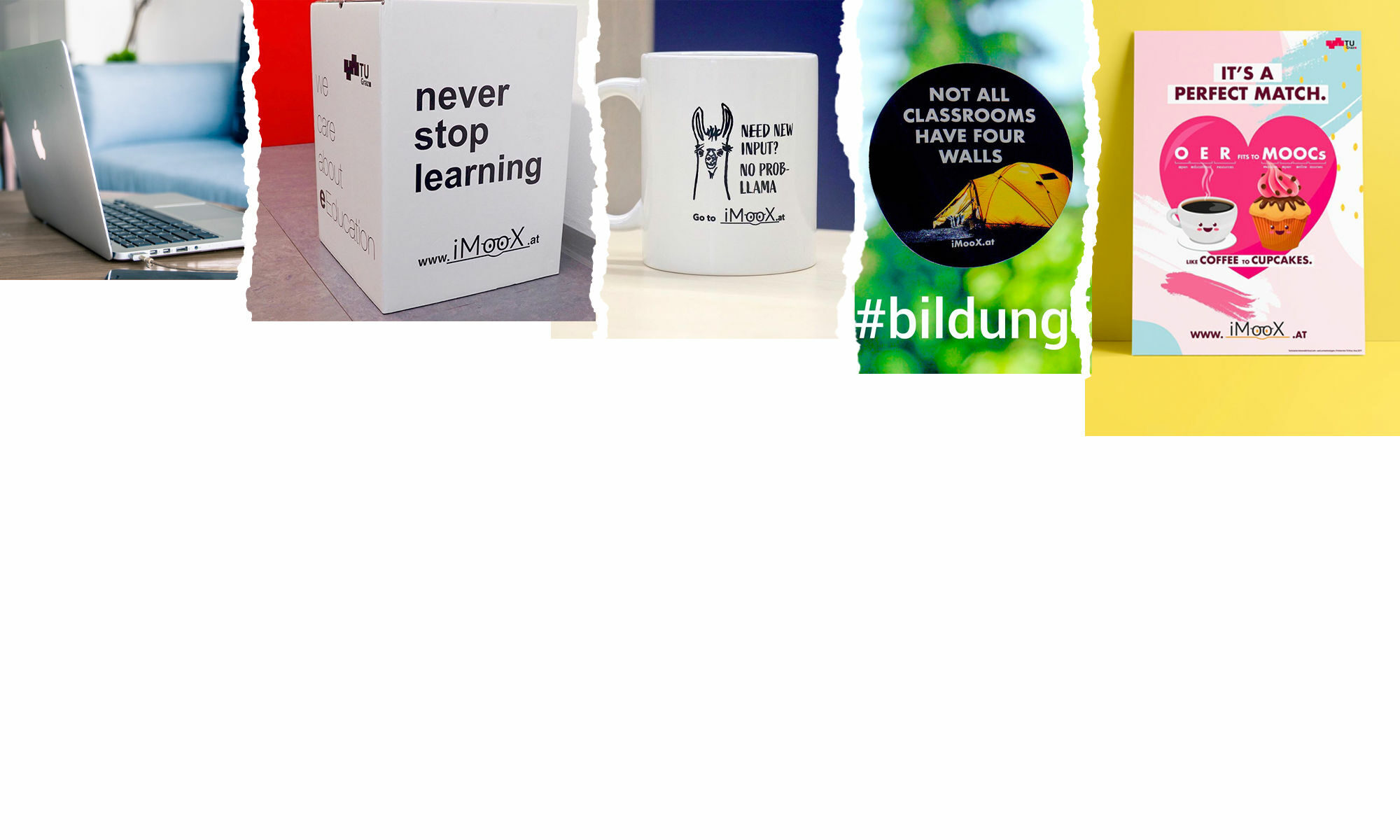

[publication] Massive Open Online Courses: Offene Online-Kurse für Viele gestalten und umsetzen #imoox #mooc #tugraz

Im Rahmen des Handbuch E-Learning haben Sandra und ich einen Beitrag zu „Massive Open Online Courses: Offene Online-Kurse für Viele gestalten und umsetzen“ geschrieben mit der Idee unsere Erfahrungen damit weiterzugeben.

Zusammenfassung:

Dieser Beitrag beschreibt die Merkmale, didaktischen Designformen (Konzepte) und Bestandteile von MOOCs, die Umsetzungsalternativen, Zielgruppen, Zielsetzungen Maßnahmen zur Erhöhung der Teilnehmer(innen)-Aktivität bei der Durchführung von MOOCs sowie die in Betracht kommenden Auszeichnungen/Bescheinigungen für die Kursteilnahme. Außerdem werden die Erarbeitung eines MOOC-Projektplans in sieben Schritten beschrieben und die fünf Phasen eines MOOC-Projekts aufgezeigt.

[Vorabzug auf ResearchGate]

Referenz: Schön, Sandra & Ebner, Martin (2018). Massive Open Online Courses. In K. Wilbers & A. Hohenstein (Hrsg.), Handbuch E-Learning. Expertenwissen aus Wissenschaft und Praxis – Strategien, Instrumente, Fallstudien. 73. Erg.-Lfg. des Handbuchs E-Learning, 9.8, S. 1-21.