[publication] aicast: Combining AI-Generated and Instructor-Defined Content in Educational Podcasts #research #tugraz

At this year’s ED-Media conference, we introduced a new AI-based concept for educational podcasts: „aicast: Combining AI-Generated and Instructor-Defined Content in Educational Podcasts„.

Abstract:
Generative AI is transforming educational content. In this poster, we present aicast.fyi, an open-source platform for producing personalized educational podcasts that combine AI-generated and instructor-defined content. Each track contains dynamic and fixed segments. Instructors define guiding questions during track design, ensuring alignment with learning objectives. This hybrid approach addresses concerns about maintaining instructional integrity with automation and personalization. The poster provides an architectural overview and demonstrates how the system integrates text generation and voice synthesis to produce audio-based learning experiences. Instructional designers must play an active role in shaping AI-assisted educational tools. This poster invites educators, designers, and researchers to engage with aicast and collaborate on developing high-quality, responsible, and learner-centered audio content. By allowing learners to control content sequences and personalize segments based on their own inputs, aicast.fyi also supports self-regulated learning (SRL), empowering users to take ownership of their educational journey.

[draft @ ResearchGate]
[full article @ conference website]

Reference: Brünner, B., Leitner, P., Geier, G. & Ebner, M. (2025). aicast: Combining AI-Generated and Instructor-Defined Content in Educational Podcasts. In T. Bastiaens (Ed.), Proceedings of EdMedia + Innovate Learning (pp. 148-152). Barcelona, Spain: Association for the Advancement of Computing in Education (AACE). Retrieved June 4, 2025 from https://www.learntechlib.org/primary/p/226139/

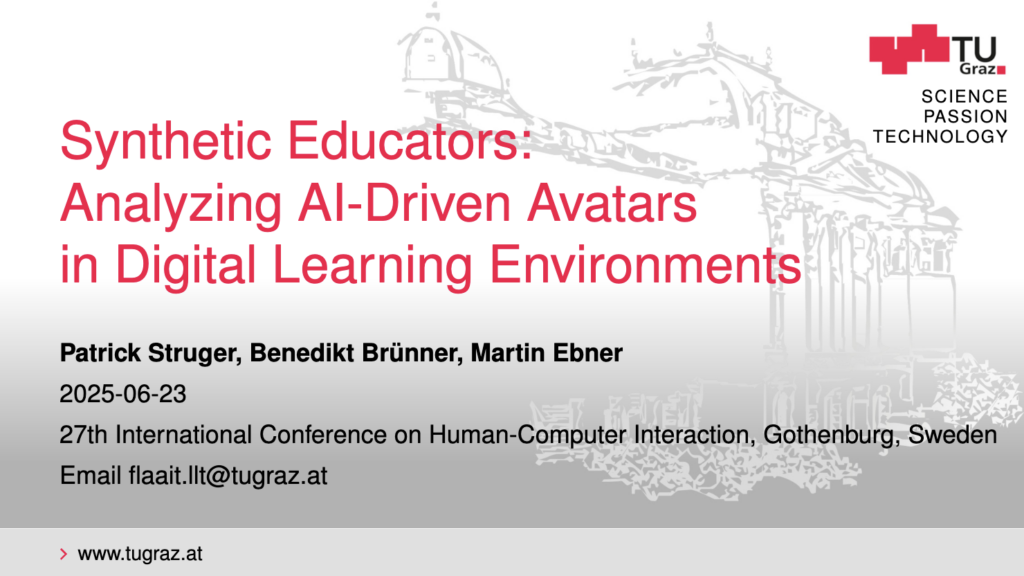
[presentation] Synthetic Educators: Analyzing AI-Driven Avatars in Digital Learning Environments #HCII25

Our research about AI-Driven Avatars was presented at 27th International Conference on Human-Computer Interaction, Gothenburg, Sweden.

Struger, P., Brünner, B., & Ebner, M. (2025, Juni 23). Presentation: Synthetic Educators: Analyzing AI-Driven Avatars in Digital Learning Environments. Graz University of Technology. https://doi.org/10.3217/bngt5-p2053

[publication] Workshop for Special Interest Group Emerging Technologies for Learning and Teaching: Exploring Educational Podcasts with AI #tugraz #research

We also did workshops at this year’s ED-Media conference. One of them was titled „Workshop for Special Interest Group Emerging Technologies for Learning and Teaching: Exploring Educational Podcasts with AI“ and followed the idea of open discussions.

Abstract:
How can educators unleash the power of AI without losing control over core educational strategies? In this workshop, we introduced aicast, an open-source platform for educational podcasts that combines the best of both worlds: AI-generated elements for personalization and flexibility, and fixed elements, with instructor-defined content to ensure pedagogical accuracy. This hybrid approach reduces the risks associated with AI-generated materials like hallucinations. Attendees experienced how the platform utilizes LLMs like ChatGPT for personalized content authoring and ElevenLabs for high-quality voice synthesis, enabling real-time creation of educational audio content. After a short demo and hands-on session, participants engaged in a guided discussion: What is the core of an educational podcast? Most importantly from the perspective of an instructional designer, how must an educational podcast be? This session was part of the Special Interest Group on Emerging Technologies for Learning and Teaching at the ED-Media 2025 conference.

[draft @ ResearchGate]
[full article @ conference website]

Reference: Ebner, M. & Brünner, B. (2025). Workshop for Special Interest Group Emerging Technologies for Learning and Teaching: Exploring Educational Podcasts with AI. In T. Bastiaens (Ed.), Proceedings of EdMedia + Innovate Learning (pp. 1375-1376). Barcelona, Spain: Association for the Advancement of Computing in Education (AACE). Retrieved June 4, 2025 from https://www.learntechlib.org/primary/p/226347/.

[video] Digitale Bildung #avatar #ki #tugraz

Wir haben wieder etwas mit „meinem“ Avatar herumgespielt und ein Video erstellt rund um das Thema „Digitale Bildung“. Das gibt es nun in zwei Versionen – deutsch und englisch. Vielleicht ist es ja auch in anderen Kontexten hilfreich, freu mich wie immer auf Rückmeldungen.

YouTube

Mit dem Laden des Videos akzeptieren Sie die Datenschutzerklärung von YouTube.
Mehr erfahren

Video laden

Version in deutscher Sprache
YouTube

Mit dem Laden des Videos akzeptieren Sie die Datenschutzerklärung von YouTube.
Mehr erfahren

Video laden

Version in englischer Sprache

[presentation] Rapid Multilingual Video Production (RMVPro) utilizing Artificial Intelligence #tugraz #ai #video

Our next talk at this year’s ED-Media conference is about „Rapid Multilingual Video Production (RMVPro) utilizing Artificial Intelligence“. Find the slides right here:

Brünner, B. & Ebner, M., (2025). Rapid Multilingual Video Production (RMVPro) utilizing Artificial Intelligence. ED-Media 2025 conference, presentation, Barcelona [slides]

[workshop] Special Interest Group on Emerging Technologies: Exploring Educational Podcasts with AI #tugraz #research

For many years, we have also been organising an annual workshop as part of the ED-Media conference, known as the ‘Special Interest Group on Emerging Technologies’. The aim is always to show and discuss a new innovative technology for education. This year it was our newly developed AI Cast.
Here are the slides:

Ebner, M. & Brünner, B. (2025) Special Interest Group on Emerging Technologies: Exploring Educational Podcasts with AI. ED-Media conference 2025, Barcelona [slides]

[publication] Chatbots in Education: A Systematic Rapid Literature Review #AIinEdu #tugraz #research

Our contribution to this year’s SITE conference in Orlando titled „Chatbots in Education: A Systematic Rapid Literature Review“ is published.

Abstract:
This review explores the role of chatbots in education through a detailed literature review of 60 records. As chatbots become increasingly embedded in students‘ daily lives, their presence in primary, secondary, and tertiary education is expanding rapidly. By analyzing the selected papers, this review highlights both the opportunities and challenges faced by educators and students when using chatbots. The findings indicate that the integration of AI in education offers significant potential but requires careful consideration. In particular, the study emphasizes the need for improved teacher and student training, updated policies, and effective assessments to maintain academic integrity and enhance learning outcomes.

[publication @ ResearchGate]

Reference: Gregorac, A., Brünner, B. & Ebner, M. (2025). Chatbots in Education: A Systematic Rapid Literature Review. In Proceedings of SITE 2025 (pp. 588-593). Waynesville, NC USA: Association for the Advancement of Computing in Education (AACE). Retrieved March 24, 2025 from https://www.learntechlib.org/primary/p/225579/.

[workshop] Exploring Educational Podcasts with AI #edmedia25

We are delighted that we can offer another workshop for our „SIG“ at this year’s EDMedia conference in Barcelona titled „Exploring Educational Podcasts with AI

Abstract:
How can educators unleash the power of AI without losing control over core educational strategies? In this workshop, we will introduce aicast, an open source platform for educational podcasts that combines the best of both worlds: AI-generated elements for personalization and flexibility, and fixed elements, with instructor-defined content to ensure pedagogical accuracy. This hybrid approach reduces the risks associated with AI-generated materials like hallucinations. Attendees will learn how the platform utilizes LLMs like ChatGPT for personalized content authoring and ElevenLabs for high-quality voice synthesis, enabling real-time creation of educational audio content. After a short demo and hands-on session, participants will engage in a guided discussion: What is the core of an educational podcast? How do structure, tone, and repetition affect learning? Most importantly from the perspective of an instructional designer, how must an educational podcast be? This session is part of the Special Interest Group on Emerging Technologies for Learning and Teaching and invites participants to think critically about the role of AI in educational podcasting. Even more we invite instructional designer to collaborate with us to bring educational podcast to a next level
.

We would love to meet you in Barcelona, even more, if you can join our workshop – cu there 🙂

[Link to conference’s website]