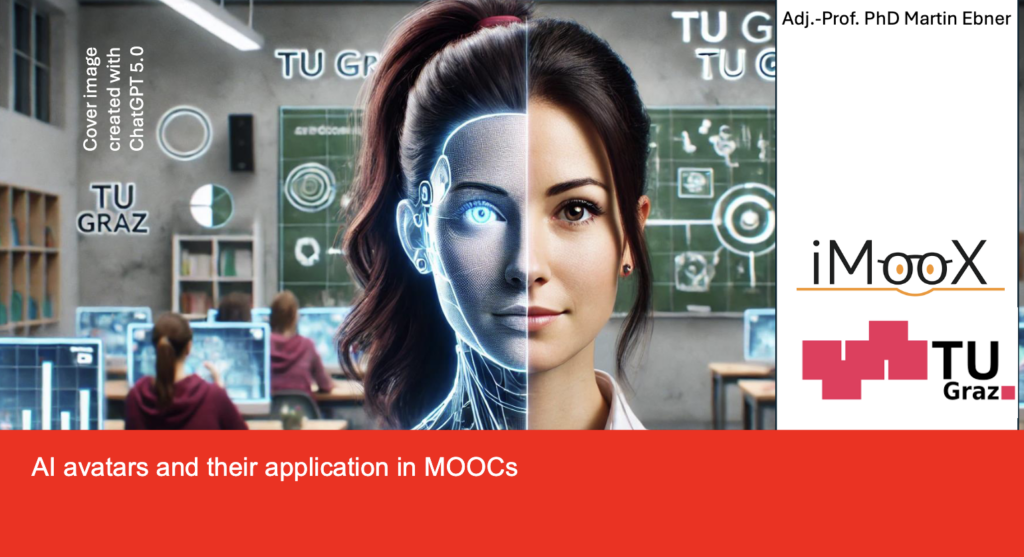
[presentation] Rapid Multilingual Video Production (RMVPro) utilizing Artificial Intelligence #tugraz #ai #video

Our next talk at this year’s ED-Media conference is about „Rapid Multilingual Video Production (RMVPro) utilizing Artificial Intelligence“. Find the slides right here:

Brünner, B. & Ebner, M., (2025). Rapid Multilingual Video Production (RMVPro) utilizing Artificial Intelligence. ED-Media 2025 conference, presentation, Barcelona [slides]

[workshop] Special Interest Group on Emerging Technologies: Exploring Educational Podcasts with AI #tugraz #research

For many years, we have also been organising an annual workshop as part of the ED-Media conference, known as the ‘Special Interest Group on Emerging Technologies’. The aim is always to show and discuss a new innovative technology for education. This year it was our newly developed AI Cast.
Here are the slides:

Ebner, M. & Brünner, B. (2025) Special Interest Group on Emerging Technologies: Exploring Educational Podcasts with AI. ED-Media conference 2025, Barcelona [slides]

[publication] Chatbots in Education: A Systematic Rapid Literature Review #AIinEdu #tugraz #research

Our contribution to this year’s SITE conference in Orlando titled „Chatbots in Education: A Systematic Rapid Literature Review“ is published.

Abstract:
This review explores the role of chatbots in education through a detailed literature review of 60 records. As chatbots become increasingly embedded in students‘ daily lives, their presence in primary, secondary, and tertiary education is expanding rapidly. By analyzing the selected papers, this review highlights both the opportunities and challenges faced by educators and students when using chatbots. The findings indicate that the integration of AI in education offers significant potential but requires careful consideration. In particular, the study emphasizes the need for improved teacher and student training, updated policies, and effective assessments to maintain academic integrity and enhance learning outcomes.

[publication @ ResearchGate]

Reference: Gregorac, A., Brünner, B. & Ebner, M. (2025). Chatbots in Education: A Systematic Rapid Literature Review. In Proceedings of SITE 2025 (pp. 588-593). Waynesville, NC USA: Association for the Advancement of Computing in Education (AACE). Retrieved March 24, 2025 from https://www.learntechlib.org/primary/p/225579/.

[workshop] Exploring Educational Podcasts with AI #edmedia25

We are delighted that we can offer another workshop for our „SIG“ at this year’s EDMedia conference in Barcelona titled „Exploring Educational Podcasts with AI

Abstract:
How can educators unleash the power of AI without losing control over core educational strategies? In this workshop, we will introduce aicast, an open source platform for educational podcasts that combines the best of both worlds: AI-generated elements for personalization and flexibility, and fixed elements, with instructor-defined content to ensure pedagogical accuracy. This hybrid approach reduces the risks associated with AI-generated materials like hallucinations. Attendees will learn how the platform utilizes LLMs like ChatGPT for personalized content authoring and ElevenLabs for high-quality voice synthesis, enabling real-time creation of educational audio content. After a short demo and hands-on session, participants will engage in a guided discussion: What is the core of an educational podcast? How do structure, tone, and repetition affect learning? Most importantly from the perspective of an instructional designer, how must an educational podcast be? This session is part of the Special Interest Group on Emerging Technologies for Learning and Teaching and invites participants to think critically about the role of AI in educational podcasting. Even more we invite instructional designer to collaborate with us to bring educational podcast to a next level
.

We would love to meet you in Barcelona, even more, if you can join our workshop – cu there 🙂

[Link to conference’s website]

[publication] Selbstlernphasen mit KI Chatbots – kann das gelingen? #tugraz #AI

Benedikt und ich haben eine kurze Zusammenfassung über die derzeit laufenden Forschungsarbeiten für das fnma magazin verfasst mit dem Titel „Selbstlernphasen mit KI Chatbots – kann das gelingen?

Zusammenfassung:
Unsere Hochschule ist ein Ort der Vielfalt und Heterogenität. Bezüglich der Diversität beim Vorwissen unserer Studienanfänger:innen spielen Individualisierung und gezielte Förderung eine wichtige Rolle. In diesem Beitrag geben wir Einblick in die Implementierung eines generativen KI (genKI) Chatbots für Studienanfänger:innen im Fachbereich Informatik an der TU Graz.

[Artikel @ ResearchGate]
[fnma magazin 01/2025]

Referenz: Brünner, B., Ebner, M. (2025) Selbstlernphasen mit KI Chatbots – kann das gelingen? fnma magazin 01/2025. S. 11-13. https://www.fnma.at/content/download/3179/20735?version=3

[conference] University:Future Festival 2025 an der TU Graz #AIStage #tugraz

Es freut uns sehr, dass wir die erste österreichische Präsenzbühne beim University Future Festival sein dürfen und das auch noch mit dem Thema KI-Anwendungen für Hochschulen. Das 3-tägige Programm ist digital komplett zugänglich und auch unsere Bühne am 13.5.2025 wird live in den D-A-CH Raum gestreamt, dennoch freuen wir uns wenn viele auch vor Ort mit uns diskutieren wollen. Zwei spannende Keynotes, Vorträge, Workshops und auch künstlerische Darbietungen erwarten euch.

Hier findet ihr das gesamte Programm: https://festival.hfd.digital/de/programm-2025/
Hier können sich Teilnehmer:innen KOSTENLOS anmelden: https://festival.hfd.digital/de/tickets/
Hier geht es direkt zu den Präsenzbühnen: https://festival.hfd.digital/de/unsere-praesenzbuehnen-2025/


Damit darf ich mich in die Osterferien 2025 verabschieden und allen frohe Ostern wünschen 🙂

[publication] From Gretel to Strudelcity: Empowering Teachers Regarding Generative AI for Enhanced AI Literacy with CollectiveGPT #AIinEducation #research #edtech

Congratulations to Benedikt, who did a great job developing a successful workshop for school teachers. We summarized his results in the publication „From Gretel to Strudelcity: Empowering Teachers Regarding Generative AI for Enhanced AI Literacy with CollectiveGPT.“

Abstract:
In the era of transformative technologies, generative artificial intelligence (genAI) offers profound opportunities and challenges for education. This study explores the development and execution of an interactive workshop designed to equip educators with foundational genAI literacy. Using a design-based research (DBR) framework, the workshop leverages interactivity and contextual relevance to introduce genAI concepts, prompting strategies and ethical considerations. Participants engaged in a scripted learning workshop design, comparing human and AI responses, exploring genAI’s probabilistic foundations, context dependency, and vulnerability to manipulation. Conducted across 12 workshops with 191 participants in Austria, this study revealed significant improvements in self-perceived genAI understanding, with 70% of participants reporting better grades in post-assessment evaluations. Feedback emphasized the workshop’s strengths in interactivity and relevance, alongside recommendations for deeper school-specific applications. Scalability analysis showed that workshop duration remained consistent regardless of group size, suggesting potential for broader implementation. The findings highlight the effectiveness of scripted learning workshop design in fostering critical AI literacy, preparing educators to critically evaluate and ethically integrate genAI into pedagogical practices. This adaptable model contributes to the discourse on professional development in AI-enhanced education.

[full paper @ publisher’s Homepage]
[full paper @ ResearchGate]

Reference: Brünner, B., Schön, S., & Ebner, M. (2025). From Gretel to Strudelcity: Empowering Teachers Regarding Generative AI for Enhanced AI Literacy with CollectiveGPT. Education Sciences15(2), 206. https://doi.org/10.3390/educsci15020206

[publication] How to Plan and Manage a Blended Learning Course Module Using Generative Artificial Intelligence? #ai #research

Our contribution about „How to Plan and Manage a Blended Learning Course Module Using Generative Artificial Intelligence?“ got published.

Abstract:
Artificial intelligence (AI) is rapidly transforming the educational landscape, playing a crucial role in the transition to blended learning environments. As generative AI gains momentum, educators now have access to a growing repository of AI tools that can facilitate the shift from face-to-face instruction to more virtual learning experiences. This chapter provides a practical guideline for integrating and using AI tools to support educators in transitioning their courses to blended learning. The approach is structured around four key pillars: teacher practice support, online classroom support, evaluation and feedback, and student support. Following this guideline, we explore a curated list of AI-powered tools categorized based on their functions within these four pillars. To illustrate the application of these guidelines, we present a case study demonstrating a transition of a selected module of a traditional face-to-face machine learning course and make it accessible to students online, thus enabling blended learning experience. This chapter can empower future educators interested in AI to structure engaging blended learning courses and underscore the significant role of AI in enhancing the planning, management, implementation, and assessment of new blended learning courses.

[final publication @ publisher’s homepage]
[draft @ ResearchGate]

Reference: Khalil, M., Shakya, R., Liu, Q., Ebner, M. (2024). How to Plan and Manage a Blended Learning Course Module Using Generative Artificial Intelligence?. In: Panda, S., Mishra, S., Misra, P.K. (eds) Case Studies on Blended Learning in Higher Education. Springer, Singapore. https://doi.org/10.1007/978-981-97-9388-4_4