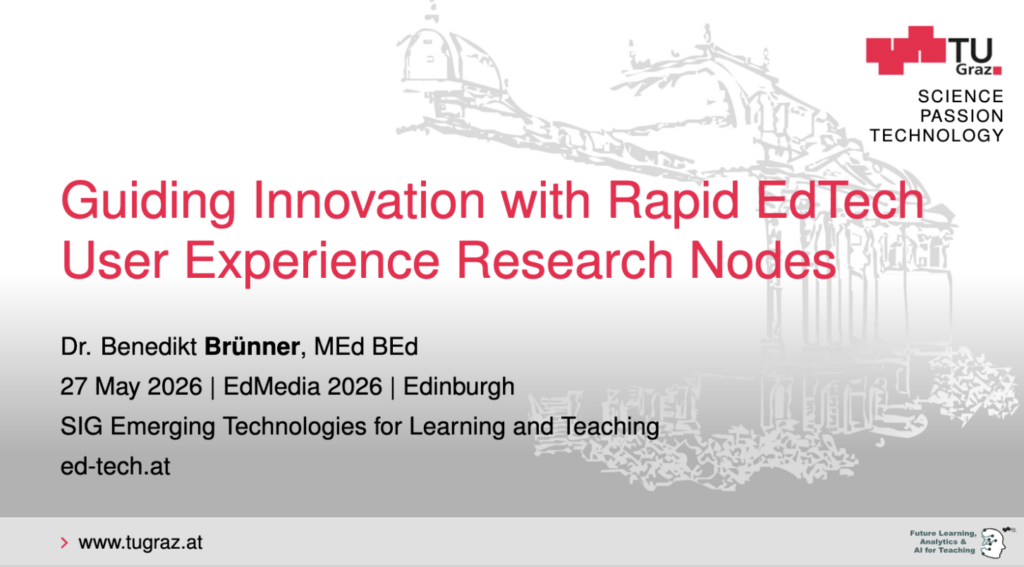
This presentation is from the Special Interest Group Emerging Technologies for Learning and Teaching from EdMedia 2026 conference workshop on Guiding Innovation with Rapid EdTech User Experience Research Nodes (RETURN). It includes supporting resources for the RETURN Manifesto, selected EdTech case examples, and documentation related to rapid user experience research in educational technology contexts.
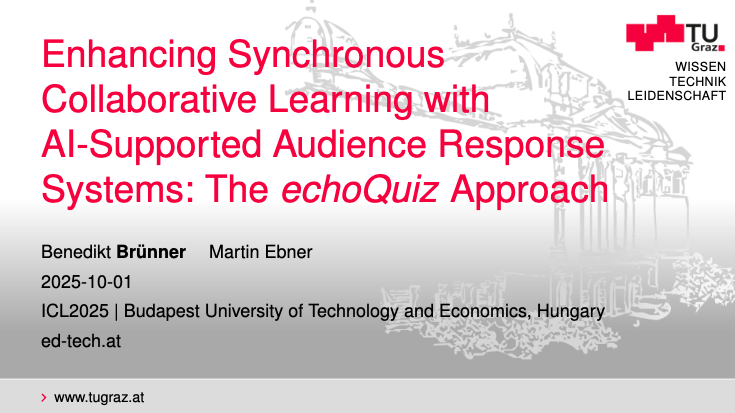
Our publication about „Enhancing Synchronous Collaborative Learning with AI-Supported Audience Response Systems: The EchoQuiz Approach“ is now online available.
Abstract: This paper introduces echoQuiz, an open-source, AI-supported Audience Response System (ARS) designed for synchronous university (online) teaching with open-ended questions. The system follows a two-phase interaction model: In the quiz phase, students/learners submit their responses and then rate their peers’ responses. In the echo phase, the instructor highlights one response for group reflection, with all responses remaining anonymous. To ease the interpretation of open responses, the lecturer can be assisted by an AI system during live sessions. Developed with an Educational Design Research (EDR) approach, echoQuiz was piloted in synchronous university courses with a total of 62 participants. Survey results show high motivation and moderate perceived learning gains. The findings suggest that free-text interaction, supported by AI, can enhance engagement and adaptability in digital classrooms.
Wir freuen uns, dass wir einen kleinen Beitrag zur digitalen Souveränität leisten können indem wir Handlungsanleitungen für praktische Anwendungsfälle als OER zur Verfügung stellen im Rahmen der TU Austria. Die ersten beiden sind nun online.
Die TU Austria ist bemüht Angehörige der Universitäten aktiv beim Einsatz von KI zu unterstützen und hat daher eine Serie an Beschreibungen gestartet wie KI-Applikationen für alltägliche Arbeiten eingesetzt werden können. Dabeiwerden Lösungen aufgezeigt die die digitale Souveränität der Universitäten unterstützen, indem wir auf lokal installierbare KI-Lösungen zurückgreifen, damit z.B. Daten das eigene Endgerät nicht verlassen.
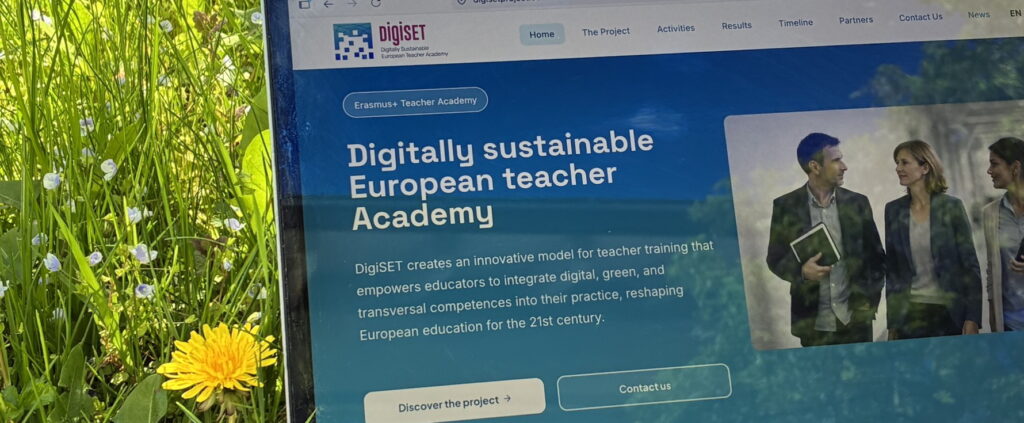
Im März hatten wir unsere Kick-Off Veranstaltung für die neue DigiSET-Initative die Themen Nachhaltigkeit, digitalen Unterricht, KI und OER zusammenzubringen. Wir freuen uns natürlich sehr, dieses Vorhaben unterstützen zu können: Denn genau diese Themen gehören zusammen – aktueller geht es kaum.
Damit wir nicht irgendetwas machen, möchten wir ein klares Bild vom Status Quo, insbesondere zu den bisherigen Erfahrungen und Kompetenzen von (angehenden) Lehrkräften gewinnen. Wir sind natürlich auch schon sehr gespannt, ob die langjährigen Initiativen in Österreich rund um Bildung für Nachhaltige Entwicklung, digitalen Unterricht, insb. die Einführung des Schulfachs Digitale Grundbildung, und seit einigen Jahren verstärkte (biildungs-)politische Initiativen zu Künstlicher Intelligenz und Offenen Bildungsressourcen im Unterricht sich auch im europäischen Vergleich der Daten zeigen werden.
Aufruf an alle (angehenden) Lehrkräfte in Österreich!
Gestalten Sie die Zukunft der Lehrer:innenbildung mit, indem Sie Ihre Sicht auf nachhaltigen, digitalen Unterricht teilen. Auf Grundlage Ihrer Rückmeldung gestalten wir mit Partnern aus 8 Ländern im Projekt DigiSET Materialien und Trainings zur Nutzung digitaler Technologien – insbesondere von AI – zur Gestaltung von offenen Bildungsressourcen für nachhaltigen Unterricht und Bildung für Nachhaltige Entwicklung. Dabei wird u.a. auch der ressourcenschonenden Einsatz von IT, der Gender-Bias von AI und Möglichkeiten für inklusiven Unterricht adressiert.
Vielen Dank für Ihre/Eure Unterstützung! – Teilen ist natürlich sehr erwünscht
Über Kontaktaufnahme von bestehenden Gruppen und ähnlichen Initiativen in Österreich freuen wir uns natürlich ebenso, damit das Ganze dann auch gut passt und umgesetzt werden kann.
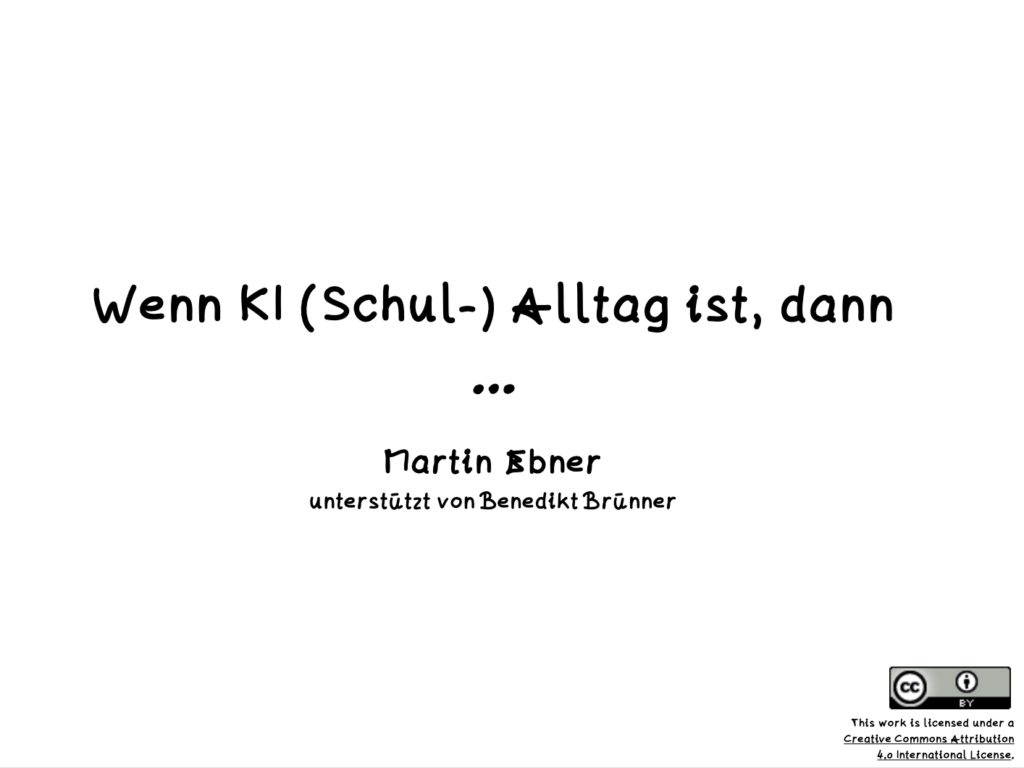
Im Rahmen der Tagung für Schulleiter*innen durfte ich eine Keynote halten zum Thema „Wenn KI (Schul-) Alltag ist, dann …“ – die Folien sind nun auch online verfügbar:
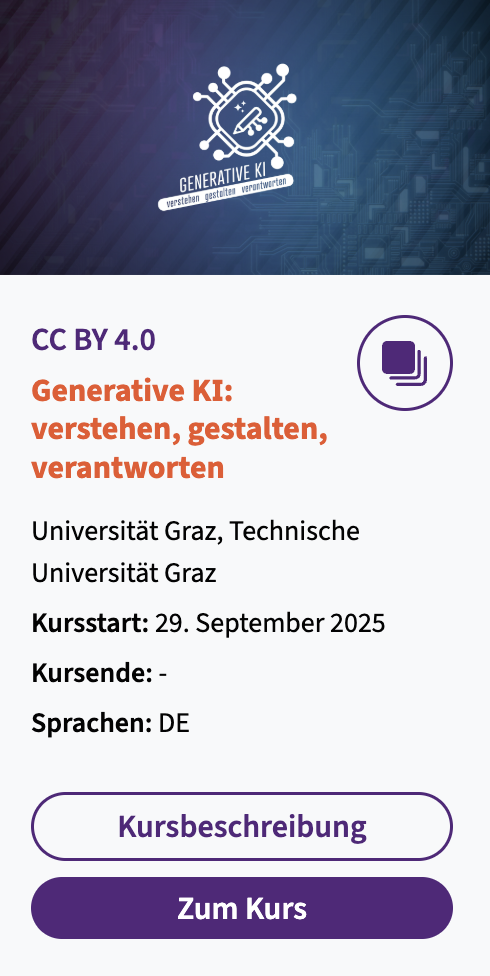
Zusammen mit der Universität Graz haben wir einen MOOC gestaltet zum Thema „Generative KI: verstehen, gestalten, verantworten„. Nachdem ich selbst im Projekt involviert bin, kann ich nur soviel sagen es zahlt sich aus reinzuschauen – ich glaub es ist uns etwas Gutes gelungen und wir hoffen danach versteht man besser was hier auf uns zurollt.
Der MOOC „Generative KI: verstehen, gestalten, verantworten“ bietet eine fundierte und zugleich praxisorientierte Einführung in das Themenfeld der generativen Künstlichen Intelligenz (genKI). In vier inhaltlich aufeinander abgestimmten Lerneinheiten und zwei optionalen Vertiefungs-Lektionen erwerben Teilnehmer:innen sowohl theoretische Grundlagen als auch anwendungsbezogene Kompetenzen, um generative KI-Technologien reflektiert und verantwortungsvoll im eigenen (Arbeits-)Kontext einsetzen zu können.
Hier nochmals der Trailer zum MOOC:
Mit dem Laden des Videos akzeptieren Sie die Datenschutzerklärung von YouTube. Mehr erfahren
Abstract: With the rise of generative AI models, such as large language models (LLMs), in educational settings, there is a growing demand to ensure the quality of AI-generated multiple-choice questions (MCQs) used in higher education. Traditional quiz development methods fall short in addressing the unique challenges posed by AI-generated content, such as consistency, cognitive demand, and question uniqueness. This paper presents the QUEST framework, a structured approach designed specifically to evaluate the quality of LLM-generated MCQs across five dimensions: Quality, Uniqueness, Effort, Structure, and Transparency. Following an iterative research process, AI-generated questions were assessed and refined using QUEST, revealing that the framework effectively improves question clarity, relevance, and educational value. The findings suggest that QUEST is a viable tool for educators to maintain high-quality standards in AI-generated assessments, ensuring these resources meet the pedagogical needs of diverse learners in higher education.
Reference: Ebner, M., Brünner, B., Forjan, N., Schön, S. (2025). Ensuring Quality in AI-Generated Multiple-Choice Questions for Higher Education with the QUEST Framework. In: Tomczyk, Ł. (eds) New Media Pedagogy: Research Trends, Methodological Challenges, and Successful Implementations. NMP 2024. Communications in Computer and Information Science, vol 2537. Springer, Cham. https://doi.org/10.1007/978-3-031-95627-0_20
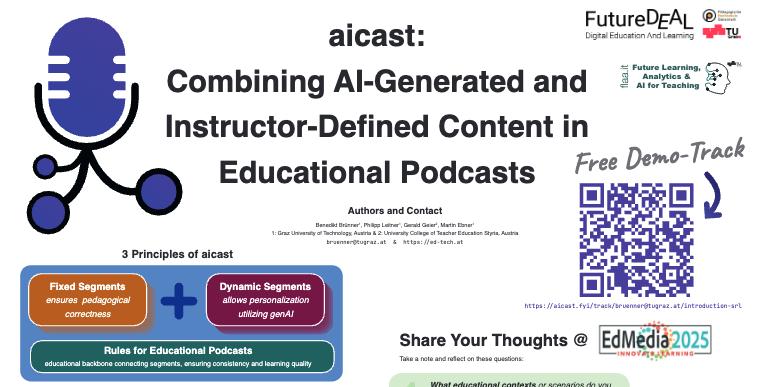
Abstract: How can educators unleash the power of AI without losing control over core educational strategies? In this workshop, we introduced aicast, an open-source platform for educational podcasts that combines the best of both worlds: AI-generated elements for personalization and flexibility, and fixed elements, with instructor-defined content to ensure pedagogical accuracy. This hybrid approach reduces the risks associated with AI-generated materials like hallucinations. Attendees experienced how the platform utilizes LLMs like ChatGPT for personalized content authoring and ElevenLabs for high-quality voice synthesis, enabling real-time creation of educational audio content. After a short demo and hands-on session, participants engaged in a guided discussion: What is the core of an educational podcast? Most importantly from the perspective of an instructional designer, how must an educational podcast be? This session was part of the Special Interest Group on Emerging Technologies for Learning and Teaching at the ED-Media 2025 conference.
Reference: Ebner, M. & Brünner, B. (2025). Workshop for Special Interest Group Emerging Technologies for Learning and Teaching: Exploring Educational Podcasts with AI. In T. Bastiaens (Ed.), Proceedings of EdMedia + Innovate Learning (pp. 1375-1376). Barcelona, Spain: Association for the Advancement of Computing in Education (AACE). Retrieved June 4, 2025 from https://www.learntechlib.org/primary/p/226347/.