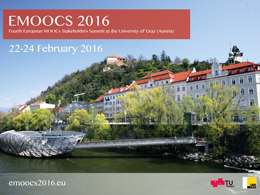
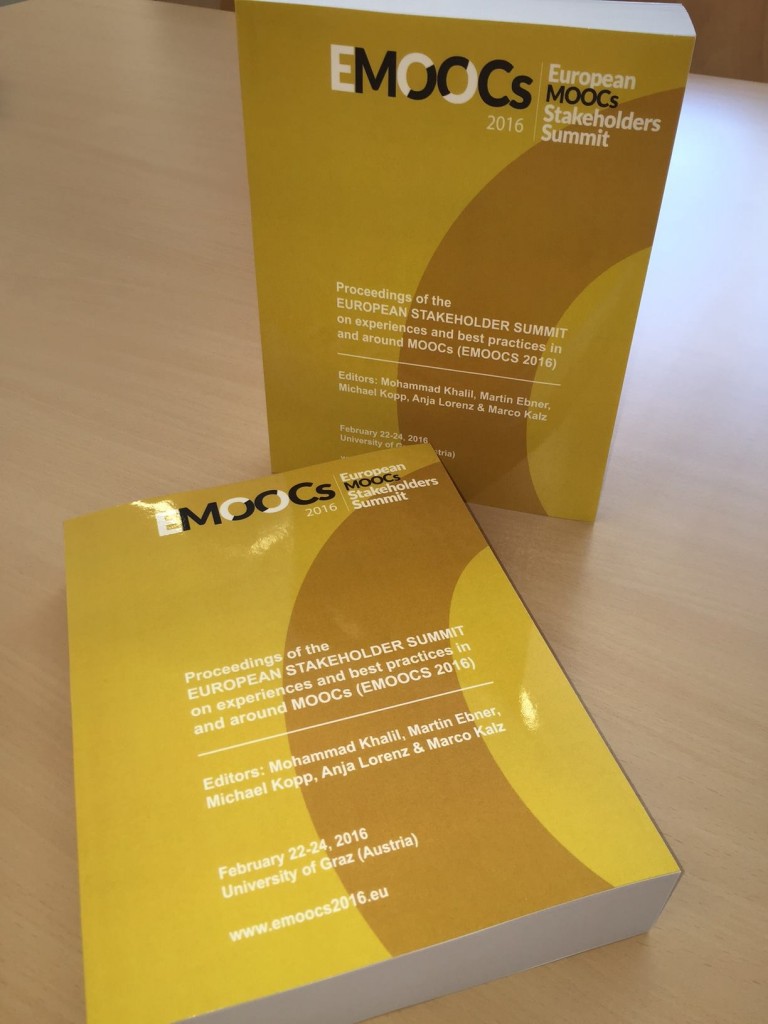
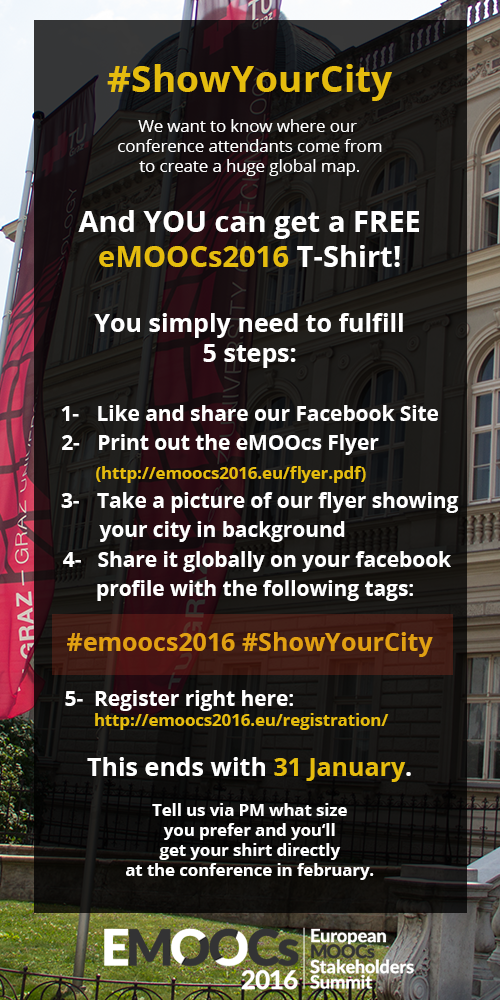
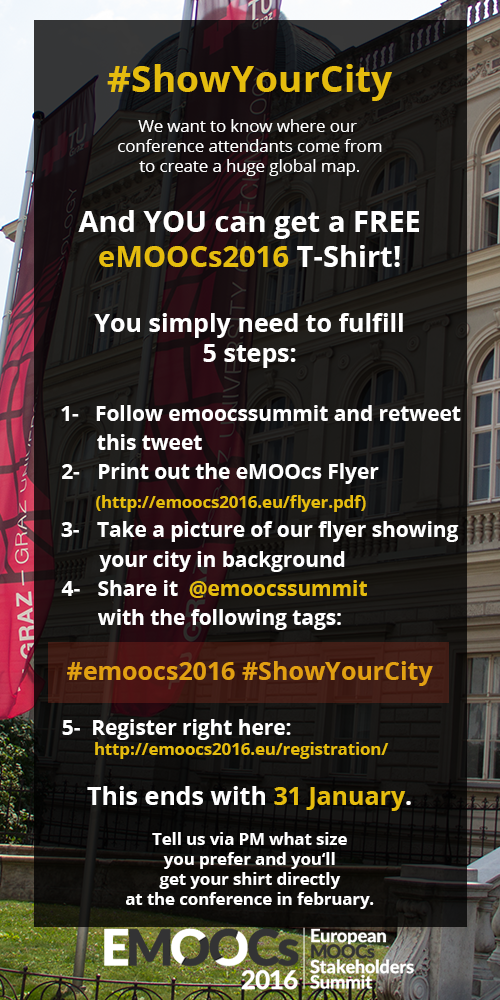
The registration for the forthcoming Fourth European MOOCs Stakeholders Summit – the EMOOCs 2016 Conference – in Graz is open. We would love to welcome you in Graz, it’s just one click away đ
Finally see how beautiful our universities are:

Digitale Lehre an und rund um der Technischen UniversitÀt Graz
The registration for the forthcoming Fourth European MOOCs Stakeholders Summit – the EMOOCs 2016 Conference – in Graz is open. We would love to welcome you in Graz, it’s just one click away đ
Finally see how beautiful our universities are:
Our presentation about „iMooX – Experiences with the Austrian wide platform“ at this year 11th European Computer Science Summit is now online available.
Klicken Sie auf den unteren Button, um den Inhalt von de.slideshare.net zu laden.
Am 8. und 9. September 2016 wird wieder ein iUNIG-Symposium stattfinden in Graz. Dieses Mal zum Thema „Seamless Learning„. Wir wollten auch unsere erfolgreiche Kooperation mit der ZFHE fortsetzen und deswegen gibt es dort auch wieder den Call for Papers. Wir freuen uns auf zahlreiche Einreichungen:
Das Lernen und Lehren wird im 21. Jahrhundert immer stĂ€rker von neuen (multi-)medialen Inhalten und EndgerĂ€ten geprĂ€gt, und dieser Prozess wird sich in den nĂ€chsten Jahren weiter verstĂ€rken und das Lernumfeld und damit den Themenkomplex „Bildung“ weitreichend verĂ€ndern. Virale Kommunikation und Erreichbarkeit ĂŒber (soziale) MedienkanĂ€le sind mittlerweile aus dem Alltag der Lernenden nicht mehr wegzudenken. Mobile EndgerĂ€te sind Bestandteil des tĂ€glichen Lebens und werden zunehmend in Lehr- und Lernprozessen verwendet, jedoch teilweise unzureichend in diese integriert.
Der Themenschwerpunkt folgt dem Konzept des von WONG & LOOI (2011) definierten (Mobile Assisted) Seamless Learning und soll dessen Integration und Möglichkeiten im Unterricht bzw. Selbststudium nÀher beleuchten und erarbeiten. Dabei versucht man durch Seamless Learning entsprechende Lernszenarien zu schaffen, die ein durchgÀngiges Lernen in den folgenden vier Situationen ermöglichen:
- Formales Lernen innerhalb des Unterrichts
- Formales Lernen auĂerhalb des Unterrichts
- Informelles Lernen innerhalb des Unterrichts
- Informelles Lernen auĂerhalb des Unterrichts
I got an invitation for a keynote talk at eduhub days 2016. So I choose a provoking title „When Learning Analytics meets MOOCs“ and hope that I will be able to give an overview about our research activities in this field. Furthermore, I would be happy if many people will join for a great discussion.
Im Rahmen der eMOOCs Konferenz hatte ich die Gelegenheit mit Andreas Wittke zu reden und das hat man dann gleich auf Video gebannt und veröffentlicht – hier also unser kurzes GesprĂ€ch und nicht vergessen, bald kommt die eMOOCs 2016. Wir freuen uns euch in Graz begrĂŒĂen zu dĂŒrfen:

The Call for Paper for next year eMOOCs summit at Graz is now online available. We are asking for research or experience studies concerning the phenomena of Massive Open Online Courses. The deadline for submissions will be the 28th of September 2015. Furthermore also a Institutional and Corporate track will be offered to bring all stakeholders together.
Please spread the world, we would love to welcome you next year in Graz.
[Homepage]
Our publication at this year ED-Media 2015 conference „Learning Analytics: Principles and Constraints“ is now online available.
Abstract:
Within the evolution of technology in education, Learning Analytics has reserved its position as a robust technological field that promises to empower instructors and learners in different educational fields. The 2014 horizon report (Johnson et al., 2014), expects it to be adopted by educational institutions in the near future. However, the processes and phases as well as constraints are still not deeply debated. In this research study, the authors talk about the essence, objectives and methodologies of Learning Analytics and propose a first prototype life cycle that describes its entire process. Furthermore, the authors raise substantial questions related to challenges such as security, policy and ethics issues that limit the beneficial appliances of Learning Analytics processes.
Reference: Khalil, M. & Ebner, M. (2015). Learning Analytics: Principles and Constraints. In Proceedings of World Conference on Educational Multimedia, Hypermedia and Telecommunications 2015. pp. 1326-1336. Chesapeake, VA: AACE
Finally we feel very honored that we get an „Outstanding Paper Award“ for this research work:

Our publication about „Visualizing Collaborations and Online Social Interactions at Scientific Conferences for Scholarly Networking“ at this year World Wide Web Conference is now online available.
Abstract:
The various ways of interacting with social media, web collaboration tools, co-authorship and citation networks for scientific and research purposes remain distinct. In this paper, we propose a solution to align such information. We particularly developed an exploratory visualization of research networks. The result is a scholar centered, multi-perspective view of conferences and people based on their collaborations and online interactions. We measured the relevance and user acceptance of this type of interactive visualization. Preliminary results indicate a high precision both for recognized people and conferences. The majority in a group of test-users responded positively to a set of statements about the acceptance.
Reference: De Vocht, L.; Selver, S.; Anastasia, D.; Verborgh, R. .; Mannens, E.; Ebner, M.; Van de Walle, R. (2015) Visualizing Collaborations and Online Social Interactions at Scientific Conferences for Scholarly Networking. – in: WWW 2015 Companion (2015), pp. 1053 – 1054, International World Wide Web Conference
We would like to invite you to the eMOOCs conference 2016, which will be from 22nd to 24th of February 2016. It will be hosted in cooperationy by the University of Graz and the University of Technology Graz.
The official website is already online and the Call for Paper will follow in the end of june. You are warmly welcomed to a beautiful place as well as a great event – stay tuned.
Our publication about „What do we know about typical MOOC participants? First insights from the field“ at this year eMOOCs 2015 conference, Mons (Belgium) is now online available.
Abstract:
Massive Open Online Courses became a worldwide phenomenon. Especially in Central Europe it is a subject of debates whether universities should invest more money or not. This research study likes to give first answers about typical MOOC participants based on data from different field studies of the Austrian MOOC-platform iMooX.
It can be pointed out that the typical learner is a student or an adult learner, strongly interested in the course topic or just interested in learning with media and finally with self- contained learning competencies. The research work concludes that MOOCs broaden the educational field for universities and are a possibility to educate the public in a long run.
[Link to the conference proceeding]
Reference: Neuböck, K., Kopp, M., Ebner, M. (2015) What do we know about typical MOOC participants? First insights from the field, In: Proceedings of eMOOCs 2015 conference, Lebrun, M., de Waard, I., Ebner, M., Gaebel, M., Mons, Belgium, pp. 183-190