
[publication] Whitepaper on Evaluating GenAI Innovation in Higher Education #tugraz #research #AIinEducation

Our publication, „Whitepaper on Evaluating GenAI Innovation in Higher Education,“ is included in the proceedings of the EDMedia 2026 conference.

Abstract:
Generative artificial intelligence (genAI) is increasingly shaping higher education by enabling new forms of content creation, assessment, learner support, personalization, and synthetic media. However, its value cannot be determined solely by technical performance, novelty, or efficiency. This paper presents an evaluation framework for quality genAI applications in higher education. This paper presents a practice-derived framework developed through a cross-case synthesis of nine diverse GenAI implementations at Graz University of Technology. Analyzing projects ranging from AI-generated content to RAG-based chatbots, we identified recurring decision points and risk patterns to formulate a five-phase, non-linear evaluation model. The framework guides institutions through specifying context, assessing feasibility, selecting implementation strategies, conducting multi-layered pilots, and performing data-informed analysis. A defining feature is the integration of explicit „Sustain-or-Discontinue“ decision gates at each stage, ensuring resources are committed only to viable applications while providing a structured pathway to terminate initiatives that fail to meet pedagogical or ethical standards. We argue that the core institutional capability lies not in rapid adoption, but in the discipline to evaluate responsibly, balancing experimentation with the rigor to govern and discontinue when necessary.

[publication @ conference’s homepage]
[preview @ ResearchGate]

Reference: Schön, S., Brünner, B., Ebner, M. & Leitner, P. (2026). Whitepaper on Evaluating GenAI Innovation in Higher Education. In Proceedings of EdMedia 2026 Edinburgh (pp. 697-703). Waynesville, NC: Association for the Advancement of Computing in Education (AACE). Retrieved June 15, 2026 from https://www.learntechlib.org/primary/p/2129693/.

This is an impactful contributions, methodological rigor, and exceptional novelty in the research field of AI in education.

[publication] Exploring the Use of Generative AI in Education: Broadening the Scope #tugraz #AI #research

Our publication „Exploring the Use of Generative AI in Education: Broadening the Scope“ was published in the Lecture Notes in Computer Science.

Abstract:
Artificial Intelligence (AI) already plays a significant role in education and society altogether. With the rapid and largely impactful development in the field of generative AI, we must consider the potential changes and shifts of the new normal. Generative models like ChatGPT, Google Bard, Bing Chat, DALL-E, and many others, are proving to be powerful allies and assistants in practically every branch and aspect of life. Given their proficiency in language and their technical capabilities, we must acknowledge their significance and ensure they are not overlooked. In this work, we focus on their impact on education and what is the feedback from the educational community. We want to determine exactly how generative AI is used and how it can be used in education. Our goal is to review more, and new papers, to classify the papers based on the subject the paper has covered, the type of the study, the educational level it concerns, and how is generative AI generally perceived. After the analysis, we conclude that it is perceived as generally positive, with most papers focusing on higher education, and STEM subjects while mostly using qualitative research methods.

[article @ publisher’s homepage]
[draft @ ResearchGate]

Reference: Jahić, I., Ebner, M., Schön, S., Edelsbrunner, S. (2024). Exploring the Use of Generative AI in Education: Broadening the Scope. In: Zaphiris, P., Ioannou, A. (eds) Learning and Collaboration Technologies. HCII 2024. Lecture Notes in Computer Science, vol 14724. Springer, Cham. https://doi.org/10.1007/978-3-031-61691-4_19

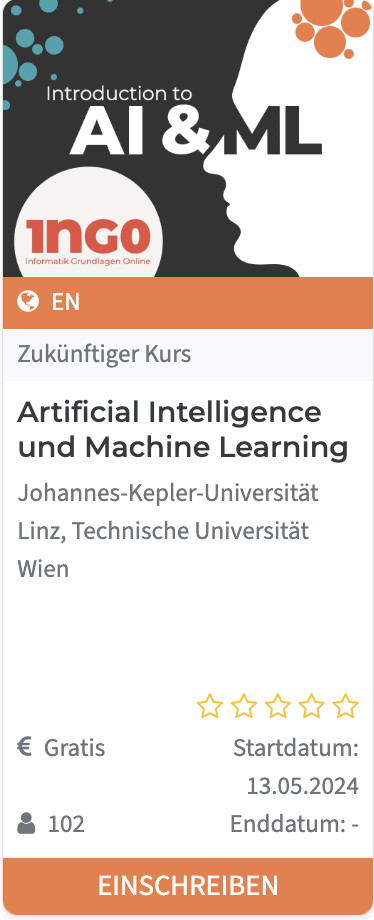
[mooc] Artificial Intelligence und Machine Learning #ai #ingo #imoox

Die Universität Linz zusammen mit der Technischen Universität Wien hat einen neuen MOOC zu „Artificial Intelligence und Machine Learning“ gestartet im Rahmen Ihrer MOOC-Serie INGO. Danke für die tollen Inhalte für alle Informatik-Begeisterten:

In diesem Kurs werden wir uns mit den Begriffen der Künstlichen Intelligenz und Machine Learning auseinandersetzen und etwas tiefer in die Materie einsteigen. Wir beginnen mit einer Einführung in die Thematik und erläutern, was sich hinter den einzelnen Begriffen Artificial Intelligence, Machine Learning und Deep Learning versteckt, und worin sie sich unterscheiden. Du wirst alle notwendigen Grundlagen im Bereich Datenverarbeitung, Machine Learning und Evaluierung lernen. Außerdem erläutern wir dir eine Liste an „intelligenten“ Algorithmen für verschiedene Problemstellungen.
Im Zuge dieses Kurses wirst du deine eigenen Machine Learning Projekte umsetzen, beginnend bei der Datenanalyse und -verarbeitung bis hin zur Evaluierung deines eigenen Machine Learning Modells. 
Bist du immer noch interessiert oder denkst dir „warum eigentlich nicht“? Dann starte den Kurs und los geht’s!

[Link zur kostenlosen Registrierung]

[publicaton] Harnessing the power of artificial intelligence and ChatGPT in education – a first rapid literature review #ai #chatgpt #tugraz #research

We did a first rapid literature review about chatGPT is used in education settings. Our paper titled „Harnessing the power of artificial intelligence and ChatGPT in education – a first rapid literature review“ for the EDMedia and Innovative 2023 conference in Vienna is now online available.

Abstract: The usage of AI, more precisely ChatGPT, is almost embedded in our everyday routine. It reduces the time, effort, and cost of performing boring and now also very delicate tasks. It appears that ChatGPT knows everything and knows how to explain everything in a personalized and peculiar way, adjusted to the user’s preferences. In this paper, we will explore how ChatGPT can be used in higher education and what its limitations are, if any at all. We shall endeavor to examine both the advantages and disadvantages of ChatGPT in education and state of the art. We will use a literature review as our research method to explore and find the necessary answers. We will explore and use various scientific articles, newspaper articles, blog posts, and other relevant literature from many authors. Our results and conclusion will show how to use ChatGPT in the best way in education and what to look out for now that ChatGPT is still available to everyone.

[draft @ ResearchGate]
[publication @ AACE]

Reference: Jahic, I., Ebner, M. & Schön, S. (2023). Harnessing the power of artificial intelligence and ChatGPT in education – a first rapid literature review. In T. Bastiaens (Ed.), Proceedings of EdMedia + Innovate Learning (pp. 1462-1470). Vienna, Austria: Association for the Advancement of Computing in Education (AACE). Retrieved July 13, 2023 from https://www.learntechlib.org/primary/p/222670/


With this post, I get to end the 2022/23 academic year and say goodbye to summer vacation. I will recover on the mountains and who wants to know where I’m just hanging around, can look at my tours: [My Homepage @ Alpenverein]
Will be back with end of August – cu 🙂

[mooc] Woche 7 im MOOC Societech: Umweltauswirkungen der digitalen Technologie #imoox #AI #künstliche Intelligenz

Und wir sind bereits in der siebten Woche unseres KI-generierten MOOCs und diesesmal geht es um das Thema „Umweltauswirkungen der digitalen Technologie“

Diesesmal gibt es englischsprachiges Video mit deutschen Untertitel und auch ohne Sprecherin – schauen wir einmal wie das so wirkt:

YouTube

Mit dem Laden des Videos akzeptieren Sie die Datenschutzerklärung von YouTube.
Mehr erfahren

Video laden

Die Diskussionen, Prompts, die verwendete KI-Software gibt es alles im MOOC und natürlich ist die Teilnahme kostenlos: [Anmeldung zum MOOC Societech]

[interview] MOOC about AI by AI: An Interview with Martin Ebner on the Transformative Potential of Artificial Intelligence #imoox #mooc #AI #artificialintelligence

I did an interview with Stefanie Panke from AACE about our forthcoming AI-generated MOOC (in german). You can find the whole video right here:

MOOC about AI by AI: An Interview with Martin Ebner on the Transformative Potential of Artificial Intelligence

YouTube

Mit dem Laden des Videos akzeptieren Sie die Datenschutzerklärung von YouTube.
Mehr erfahren

Video laden

Thanks very much for the possibility and join our MOOC for free: [registration page of the MOOC]