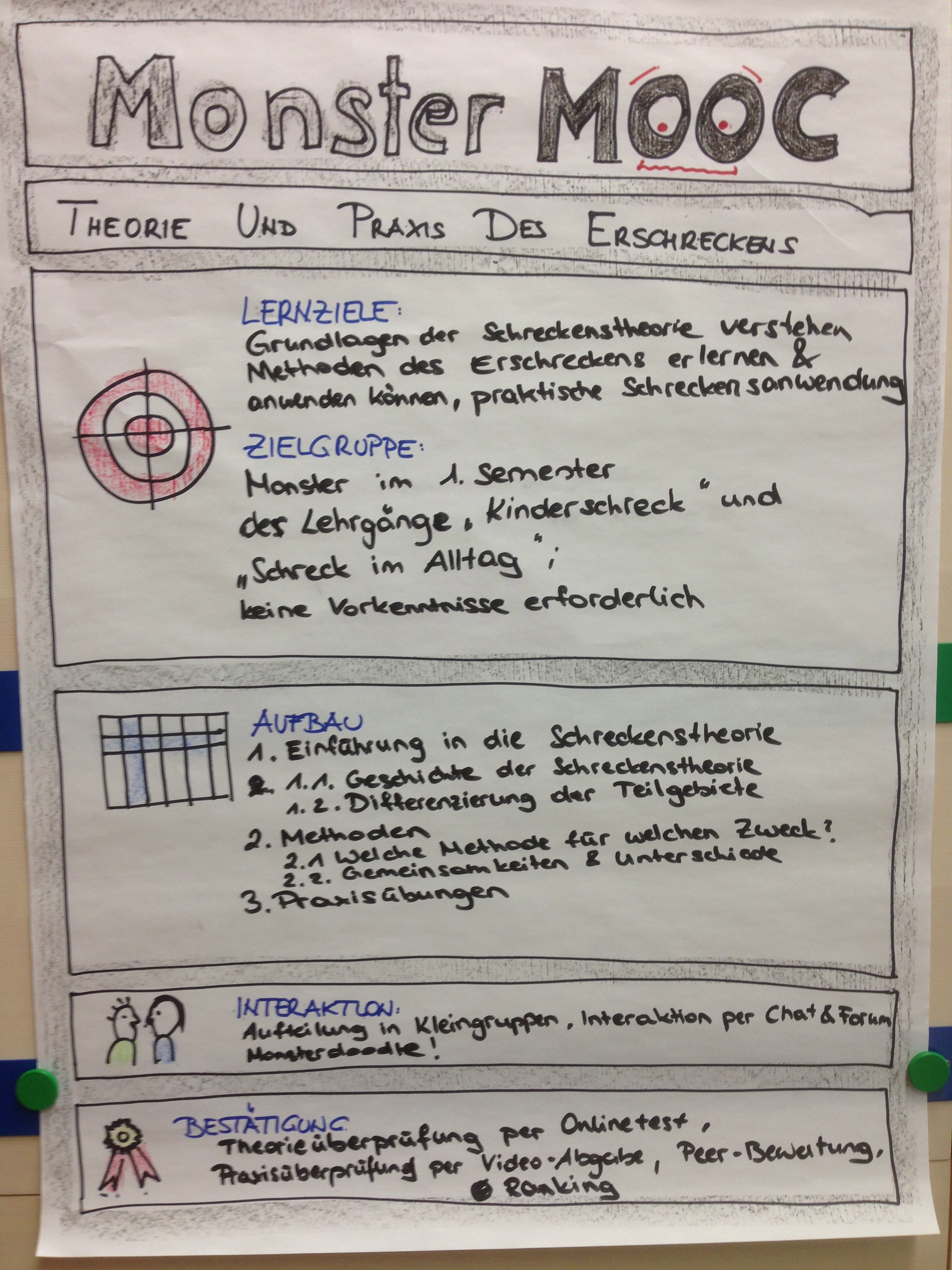
In der 3. Einheit meines Seminars ging es um „Offene und partizipative Lernformen„. Nach dem Input von Thomas war die Aufgabe diesesmal die Erstellung eines Massive Open Online Course (MOOC). Aber nicht irgendeinen, nein die Aufgabe war einen MOOC zum Thema „Theorie und Praxis des Erschreckens„. Kurzum ich denke es hat Spaß gemacht an einem ernsten Thema so zu arbeiten.
Klicken Sie auf den unteren Button, um den Inhalt von www.slideshare.net zu laden.
Im Rahmen eines längeren Interviews durfte ich mich kurz über den MOOC-Hype äußern. Was herausgekommen ist, steht im neuen „Durst“ für das Wintersemester ab S. 28 unter dem Titel „Havard für alle„.
We are feeling very honored that our contribution „How Useful Is Twitter for Learning in Massive Communities? An Analysis of Two MOOCs“ is part of the book Twitter & Society. Abstract:
In this chapter we concentrate on an analysis of Twitter usage surrounding a German-language MOOC that could indicate future trends in technology-enhanced learning. Our research focuses on the Twitter stream accompanying the course and ask how Twitter is used and for what purposes by the heavy twitter users, by the educators / organisers / guestspeakers in the course and if tweets from “outside” get into to the stream.
Reference: van Treeck, T., Ebner, M. (2013) How Useful Is Twitter for Learning in Massive Communities? An Analysis of Two MOOCs. In: Twitter & Society, Weller, K., Bruns, A., Burgess, J., Mahrt, M., Puschmann, C. (eds.), Peter Lang, p. 411-424

Im Rahmen der hochschuldidaktischen Ausbildung der Universität Passau habe ich zusammen mit Sandra einen ganztägigen Workshop zum Thema MOOC abgehalten mit dem Titel „Offene Online-Kurse für Massen (MOOC) – was verbirgt sich hinter diesem Trend?„. Die Dokumentation des Workshops mit allen Folien und Arbeitsergebnissen finder man hier:
Klicken Sie auf den unteren Button, um den Inhalt von www.slideshare.net zu laden.
Einladung für Mitarbeiter/innen der Uni Passau (26.10.13): Offene Online-Kurse für Massen (MOOC) – was verbirgt sich hinter diesem Trend?
Zusammen mit Sandra Schön werde ich am Samstag, den 26. Oktober im Rahmen des hochschuldidaktischens Angebots der Universität Passau eine Veranstaltung rund um MOOCs durchführen. Den aller (!) ersten Sketch dazu findet ihr unten – mal schauen, wie das Konzept dann am Ende aussieht.
In einem kurzen Beitrag rund um das Thema MOOCs mit dem Titel „Verderben Videos die Lehre?“ werden auch unsere Arbeiten hierzu erwähnt (die Infobox am Ende des Beitrags).
Our presentation at this year SocialMedia 2013 conference about „Discussing Public Voting in the Web as a Measure to Democratize Award Decisions“ is now online available:
Klicken Sie auf den unteren Button, um den Inhalt von www.slideshare.net zu laden.
EMOOCs 2014, LausanneIt’s a great pleasure to announce the EMOOCs 2014, the „Second MOOC European Stakeholders Summit“ in Lausanne, February 12-14 2014. Due to the fact that I am a member of the program committee of the Research Track I also like to point you on the Call for Papers (deadline 20th september 2013):
EMOOCs 2014, the Second MOOC European Stakeholders Summit, will be held on February 10-12, 2014 in Lausanne (Switzerland).
Organised by the École Polytechnique Fédérale de Lausanne (EPFL) and P.A.U. Education the event aims to be an opportunity to gather European actors involved in the Massive Open Online Courses (MOOCs) phenomenon, from policy makers to practitioners and researchers. This conference is the follow-up of the MOOC Summit 2013.
The goal of the summit is to develop synergies among European universities around themes such as student assessment, MOOC accreditation, platform interoperability or joint research initiatives.
The conference will include four tracks (Policy, Experience, Research and Business), with 5 sessions of 90 minutes and a keynote speaker. EMOOCs 2014 will also offer a series of workshops, meetings and the tutorial “All you need to know about MOOCs”.
Our publication at this year ED-Media Conference in Victoria, Canada about „“How satisfied are you with your MOOC?” – A Research Study on Interaction in Huge Online Courses“ is now online available. Abstract:
This research work investigates the importance and satisfaction on the level of interaction in MOOCs (Massive Open Online Courses) as perceived by learners and instructors. The study is based on data from online students and instructors of MOOCs. Two web-based surveys were used to collect data. The theoretical basis of the two surveys is the five-step model for interactivity developed by Salmon (2001). Salmon’s model proposed effective e-moderating in five discrete steps (Access and Motivation, Online Socialization, Information Exchange, Knowledge Construction and Development). Findings of the survey revealed that students rated the importance of interactions in MOOCs as highly important. However, they reported negatively the availability of many criteria suggested by Salmon. On the other hand, instructors rated nearly half of Salmon criteria as less important, and consequently did not offer them in their MOOCs. In addition, the study revealed that students and instructors rated a high level of satisfaction in MOOCs. In contrast, some students expressed their less satisfaction of interaction in MOOCs. They revealed their dissatisfaction to that lack of instructor interaction. Instructors suggested that it is impossible for instructor to interact with this huge number of students in MOOCs. As result, some strategies were suggested to enhance instructor interaction with students of MOOCs.
Reference: Khalil, H. & Ebner, M. (2013). “How satisfied are you with your MOOC?” – A Research Study on Interaction in Huge Online Courses. In Proceedings of World Conference on Educational Multimedia, Hypermedia and Telecommunications 2013 (pp. 830-839). Chesapeake, VA: AACE.
Our presentation about „“How satisfied are you with your MOOC?” – A Research Study on Interaction in Huge Online Courses“ at this year ED-Media Conference is now online available:
Klicken Sie auf den unteren Button, um den Inhalt von de.slideshare.net zu laden.