Markus presented our research results titled „360 Degree Videos Within a Climbing MOOC“ at this year CELDA conference in Portugal. Here are his slides:
Klicken Sie auf den unteren Button, um den Inhalt von www.slideshare.net zu laden.
Digitale Lehre an und rund um der Technischen Universität Graz
Markus presented our research results titled „360 Degree Videos Within a Climbing MOOC“ at this year CELDA conference in Portugal. Here are his slides:
Klicken Sie auf den unteren Button, um den Inhalt von www.slideshare.net zu laden.
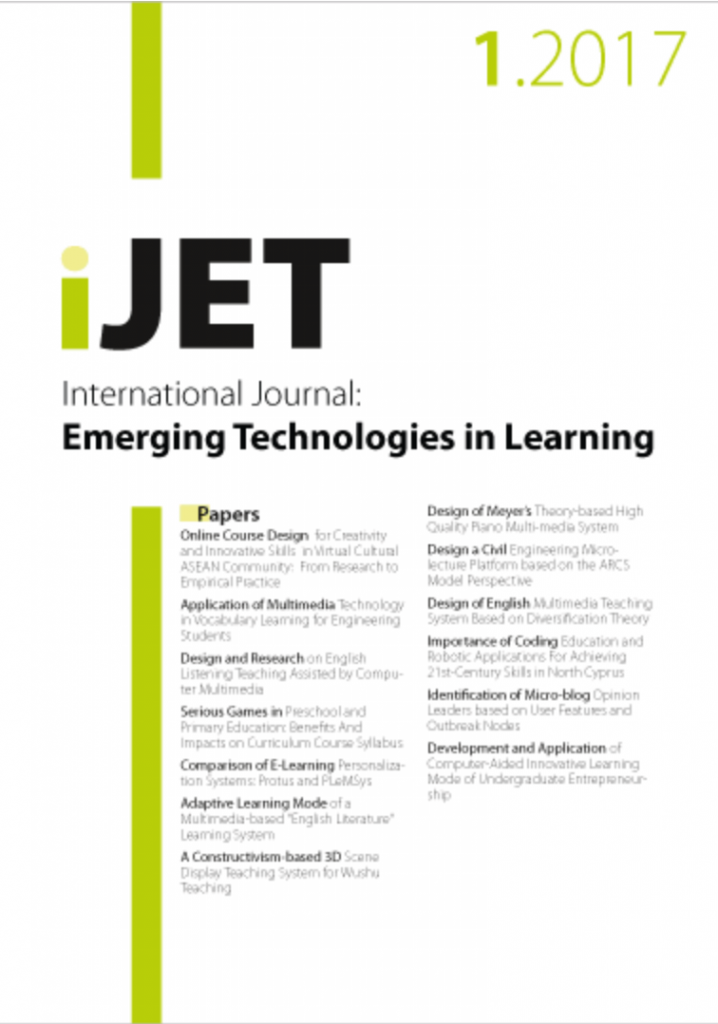 Issue 12(07) of our journal on emerging technologies for learning got published. Enjoy the readings as usual for free :-).
Table of Contents:
Nevertheless, if you are interested to become a reviewer for the journal, please just contact me :-).
Because we are not able to attend the ED-Media conference 2017 in Washington this year, we are doing our presentations virtually. The last of four talks is about „On Using Interactivity to Monitor the Attendance of Students at Learning-Videos„:

Mit dem Laden des Videos akzeptieren Sie die Datenschutzerklärung von YouTube.
Mehr erfahren
Klicken Sie auf den unteren Button, um den Inhalt von www.slideshare.net zu laden.
Because we are not able to attend the ED-Media conference 2017 in Washington this year, we are doing our presentations virtually. The third of four talks is about „From the Idea to a Finished LEGO® Technic Artifact, Assembled by Using Smart Glasses„:
Mit dem Laden des Videos akzeptieren Sie die Datenschutzerklärung von YouTube.
Mehr erfahren
Because we are not able to attend the ED-Media conference 2017 in Washington this year, we are doing our presentations virtually. The first of four talks is about „Mobile, Social, Smart and Media Driven – The Way Academic Net-Generation Has Changed Within Ten Years„:
Mit dem Laden des Videos akzeptieren Sie die Datenschutzerklärung von YouTube.
Mehr erfahren
Klicken Sie auf den unteren Button, um den Inhalt von www.slideshare.net zu laden.
Our publication about „A case study on narrative structures in instructional MOOC designs“ has been published in the Journal of Research in Innovative Teaching & Learning.
Abstract:
Purpose
The purpose of this paper is to share the lessons learned in implementing specific design patterns within the “Dr Internet” massive open online course (MOOC).Design/methodology/approach
MOOCs are boasting considerable participant numbers, but also suffer from declining participant activity and low completion rates. Learning analytics results from earlier xMOOCs indicate that this might be alleviated by certain instructional design patterns – critical aspects include shorter course duration, narrative structures with suspense peaks, and a course schedule that is diversified and stimulating. To evaluate their impact on retention, the authors have tried to implement these patterns in the design of the “Dr Internet” MOOC.Findings
Statistical results from the first run of the case study MOOC do not indicate any strong influences of these design patterns on the retention rate.Research limitations/implications
With inconclusive statistical results from this case study, more research with higher participant numbers is needed to gain insight on the effectiveness of these design patterns in MOOCs. When interpreting retention outcomes, other influencing factors (course content, pacing, timing, etc.) need to be taken into account.Originality/value
This publication reports about a case study MOOC and gives practical hints for further research.
[Link to final publication @ Journal Homepage]
[Link to final publication @ ResearchGate]
Reference: Elke Höfler, Claudia Zimmermann, Martin Ebner, (2017) „A case study on narrative structures in instructional MOOC designs“, Journal of Research in Innovative Teaching & Learning, Vol. 10 Iss: 1, pp.48 – 62
 Together with my colleague I like to call for submissions on the topic „Learning Analytics„. The contributions will appear as Special Issue of the Journal of Research in Innovative Teaching & Learning that is an open access journal published by Emerald Publishing Services.
Please consider to send us a scientific contribution on 28th April 2017 at latest, if the following sounds interesting and meet your research interests as well:
This special issue focuses on these research dimensions and aims to foster discussion on both individual impact of these dimensions and the interdependencies. Suggested topics will include, but are not limited to, the following concerning learning analytics in primary and secondary education (K-12):
- Big data learning analytics
- Learning process analytics
- Learning analytics in institutional effectiveness
- Semantic technologies in learning analytics
- Learning analytics in mobile and/or ubiquitous learning
- Learning analytics with the help of virtual reality/wearable technologies
- Visualizations in learning analytics
- Learning analytics in schools and beyond
- Dashboards for self-regulated learning
- Use of open badges for certification
- Formative assessment
- Educational data mining
- Process mining
Here you will find the detailed Call for Paper (CfP).
Our publication about „ResXplorer: Revealing relations between resources for researchers in the Web of Data“ is now online available – enjoy the results of a very increasing research field.
Abstract:
Recent developments on sharing research results and ideas on the Web, such as research collaboration platforms like Mendeley or ResearchGate, enable novel ways to explore research information. Current search interfaces in this field focus mostly on narrowing down the search scope through faceted search, keyword matching, or filtering. The interactive visual aspect and the focus on exploring relationships between items in the results has not sufficiently been addressed before. To facilitate this exploration, we developed ResXplorer, a search interface that interactively visualizes linked data of research-related sources. By visualizing resources such as conferences, publications and proceedings, we reveal relationships between researchers and those resources. We evaluate our search interface by measuring how it affects the search productivity of targeted lean users. Furthermore, expert users reviewed its information retrieval potential and compared it against both popular academic search engines and highly specialized academic search interfaces. The results indicate how well lean users perceive the system and expert users rate it for its main goal: revealing relationships between resources for researchers.
[Link to full arcticle @ Journal Homepage]
[Link to full article @ ResearchGate]
Reference: De Vocht, L., Softic, S., Verborgh, R., Mannens, E., Ebner, M. (2016) ResXplorer: Revealing relations between resources for researchers in the Web of Data. Computer Science and Information Systems. (doi:10.2298/CSIS151028031D)
Our publication about „Engaging Learning Analytics in MOOCS: the good, the bad, and the ugly“ at this year END Conference in Lubijana is now online available. The presentation slides have already been published here.
Abstract:
Learning Analytics is an emerging field in the vast areas of Educational Technology and Technology Enhanced Learning (TEL). It provides tools and techniques that offer researchers the ability to analyze, study, and benchmark institutions, learners and teachers as well as online learning environments such as MOOCs. Massive Open Online Courses (MOOCs) are considered to be a very active and an innovative form of bringing educational content to a broad community. Due to the reasons of being free and accessible to the public, MOOCs attracted a large number of heterogeneous learners who differ in education level, gender, and age. However, there are pressing demands to adjust the quality of the hosted courses, as well as controlling the high dropout ratio and the lack of interaction. With the help of Learning Analytics, it is possible to contain such issues. In this publication, we discuss the principles of engaging Learning Analytics in MOOCs learning environments and review its potential and capabilities (the good), constraints (the bad), and fallacy analytics (the ugly) based on our experience in last year’s.
[Full arcticle @ ResearchGate]
Reference: Khalil, M., Taraghi, B. & Ebner, M. (2016) Engaging Learning Analytics in MOOCS: the good, the bad, and the ugly. In:International Conference on Education and New Developments. Ljubljana, Slovenia, p. 3-7
Our chapter about „What Massive Open Online Course (MOOC) Stakeholders Can Learn from Learning Analytics?“ got published as part of the International Compendium of Theory, Research, Practice, and Policy of Learning, Design and Technology.
Abstract:
Massive open online courses (MOOCs) are the road that led to a revolution and a new era of learning environments. Educational institutions have come under pressure to adopt new models that assure openness in their education distribution. Nonetheless, there is still altercation about the pedagogical approach and the absolute information delivery to the students. On the other side with the use of Learning Analytics, powerful tools become available which mainly aim to enhance learning and improve learners’ performance. In this chapter, the development phases of a Learning Analytics prototype and the experiment of integrating it into a MOOC platform, called iMooX will be presented. This chapter explores how MOOC stakeholders may benefit from Learning Analytics as well as it reports an exploratory analysis of some of the offered courses and demonstrates use cases as a typical evaluation of this prototype in order to discover hidden patterns, overture future proper decisions, and to optimize learning with applicable and convenient interventions.
[Draft Version @ ResearchGate]
Reference: Khalil, M., Ebner, M. (2016) What Massive Open Online Course (MOOC) Stakeholders Can Learn from Learning Analytics? In: Spector, M., Lockee, B., Childress, M. (Ed.), Learning, Design, and Technology: An International Compendium of Theory, Research, Practice, and Policy, Springer International Publishing, pp. 1-30