
+++ English version below +++
Postgenerativ.at – wir starten eine Webseite. Nein es ist keine Webseite, es soll eine Diskussionsbasis werden zu einem Thema welches uns sehr am Herzen liegt. Dabei gehen wir von einer zentralen Frage aus: „Wie schaut eine Welt aus, die von generativer KI komplett durchdrungen ist?
Dazu haben wir auch versucht „Postgenerativ“ zu definieren:
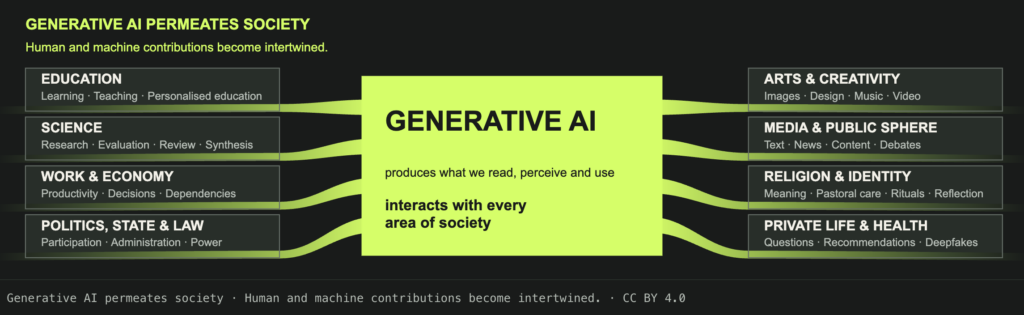
„PostGenerativ bezeichnet einen gesellschaftlichen Zustand, in dem generative künstliche Intelligenz das alltägliche Leben durchdringt. Sie prägt, wie Menschen arbeiten, lernen, kommunizieren, gestalten und Wissen hervorbringen. Ihre Erzeugnisse fließen in Informationen, Werkzeuge und Umgebungen unseres Alltags ein und wirken so auch auf Menschen, die KI nicht bewusst nutzen. [1] Menschliche und maschinelle Beiträge verschränken sich und sind immer schwerer zu unterscheiden. KI-Ergebnisse werden zunehmend ungeprüft übernommen oder weitergereicht. Umfang und Geschwindigkeit der Generierung können die menschliche Kontrolle überfordern. Zugleich entstehen neue Abhängigkeiten: Wer KI-Systeme kontrolliert, beeinflusst den Zugang zu Wissen und Teilhabe. In Anlehnung an das Postdigitale [2] beschreibt das PostGenerative eine von generativer KI bereits veränderte Lebenswelt, deren Möglichkeiten, Erwartungen und Konflikte sie mitprägt.“
Ziel ist, dass wir eine Möglichkeit geben um über Wirkungen, Folgen von generativer KI nachzudenken um vielleicht die notwendigen Handlungen der nahen Zukunft besser einordnen zu können. Wie auch immer wir freuen uns wenn man uns weitere Indizien schickt, Wortmeldungen schreibt, Kommentare hinterlässt oder einfach auch nur die Webseite verbreitet: KI geht uns alle an – davon bin ich felsenfest überzeugt.
+++
Postgenerative.at – we’re launching a website. No, it’s not just a website; it’s intended to be a forum for discussion on a topic that’s very close to our hearts. We’re starting with one central question: ‘What would a world look like that is completely permeated by generative AI?’
To this end, we’ve also tried to define ‘Postgenerativ’:
„Post-generative describes a societal condition in which generative artificial intelligence permeates everyday life. It shapes how people work, learn, communicate, design and produce knowledge. Its outputs enter the information, tools and environments we encounter every day, affecting even those who do not consciously use it. [1] Human and machine contributions become intertwined and increasingly difficult to distinguish. AI outputs are increasingly adopted or passed on without people reviewing them individually. The volume and speed of generation can overwhelm human oversight. At the same time, new dependencies emerge: whoever controls AI systems shapes access to knowledge and participation. Drawing on the idea of the post-digital [2], the post-generative describes a world already transformed by generative AI, whose possibilities, expectations and conflicts it helps to shape.“
The aim is to provide an opportunity to reflect on the effects and consequences of generative AI, so that we might be better able to contextualise the necessary actions in the near future. In any case, we’d be delighted if you could send us further evidence, write a personal note, leave comments or simply share the website: AI concerns us all – of that I am absolutely convinced.
This is an impactful contributions, and exceptional novelty in the research field of AI in education and beyond