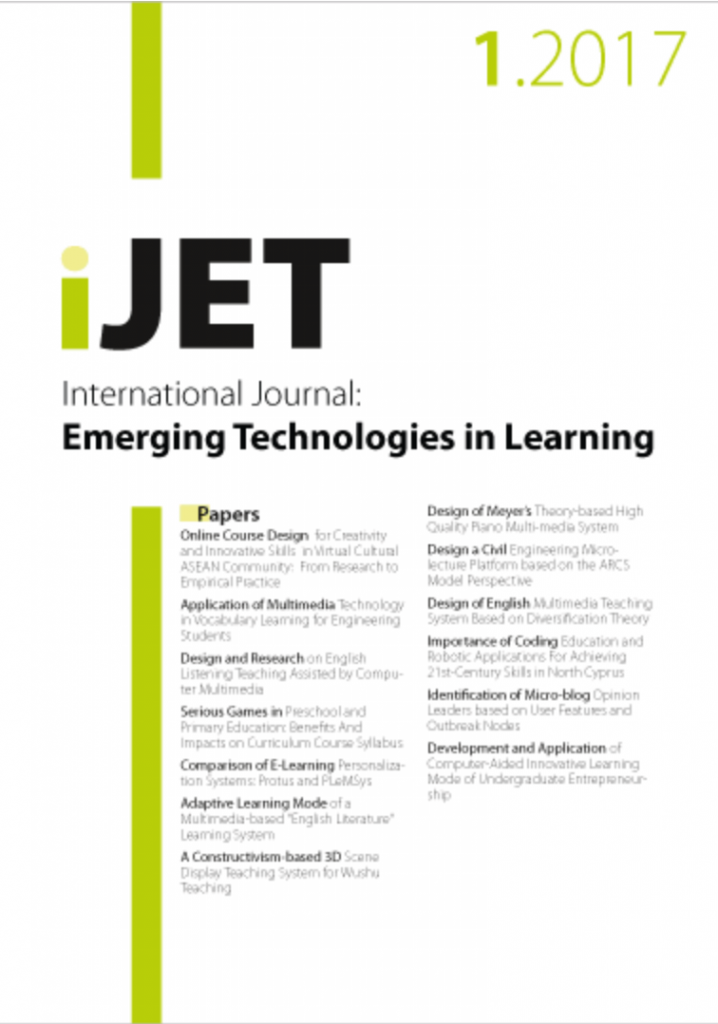
[ijet, journal] Journal of Emerging Technologies in Learning Vol. 14 / No. 6 #ijet #research

Issue 14(6) of our journal on emerging technologies for learning got published. Enjoy the readings as usual for free :-).

Table of Contents:

  • Setting Up and Implementation of the Parallel Computing Cluster in Higher Education
  • Design and Implementation of Web-Based English Autonomous Learning System
  • A Semantic Distances-Based Approach for a Deeply Indexing of Learning Objects
  • Design of Students’ Spoken English Pronunciation Training System Based on Computer VB Platform
  • Application of 3D Visualization in Landscape Design Teaching
  • Application of Artificial Intelligence in Autonomous English Learning among College Students
  • Application of Computer Data Analysis Technology in the Development of a Physical Education Examination Platform
  • Data Mining-based Design and Implementation of College Physical Education Performance Management and Analysis System
  • A Novel Machine Translation Method based on Stochastic Finite Automata Model for Spoken English
  • Accelerating Qurán Reading Fluency through Learning Using QURÁNI Application for Students with Hearing Impairments
  • The Effect of Presenting Anomalous Data on Improving Student’s Critical Thinking Ability
  • Highly Efficient English MOOC Teaching Model Based on Frontline Education Analysis
  • The Development of Digital Book of European History to Shape the Students’ Democratic Values

[Link to Issue 14/6]

Nevertheless, if you are interested to become a reviewer for the journal, please just contact me :-).

[publication] Inverse Blended Learning – a didactical concept for MOOCs and its positive effects on dropout-rates #mooc #imoox

We are very happy to announce that our chapter on „Inverse Blended Learning – a didactical concept for MOOCs and its positive effects on dropout-rates“ is published 🙂

Abstract:

Massive Open Online Courses, shortly MOOS, are one important trend of technology-enhanced learning of the last years. In this contribution we introduce a new didactical approach that we call „inverse blended learning“ (IBL). Whereas „blended learning“ is the enrichment of traditional learning settings through online inputs or phases, the IBL approach aims to enhance a pure online course with additional offline meetings for exchange and practising. Within two case studies the concept was tested and evaluated. The research study points out that the typical high dropout rate for MOOCs decreased arbitrarily. Therefore we recommend introducing the didactical approach of inverse blended learning in future MOOCs, if applicable.

[Link to the book]

[Link to draft @ ResearchGate]

Reference: Ebner, M., Schön, S. (2019) Inverse Blended Learning – a didactical concept for MOOCs and ist positive effects on dropout-rates. In: The Impact of MOOCs on Distance Education in Malaysia and Beyond. Ally, M., Amin Embi, M., Norman, H. (eds.). Routledge. ISBN 9780367026615

[mooc, imoox] Woche 4: Medienrecht, Medienwirkung, Mediennutzung und OER #lul19 #tugraz #imoox

Und wir sind bereits in Woche 4 beim MOOC zu „Lehren und Lernen mit digitalen Medien I„. Diese Woche streifen wir die Themen Medienrecht (insbesondere Urheberrecht), Open Educational Resources und Medienwirkung bzw. -nutzung.

Viel Spaß mit den Inhalten – hier z. B. das Video meines Kollegen Michael Lanzinger rund um das Urheberrecht:

YouTube

Mit dem Laden des Videos akzeptieren Sie die Datenschutzerklärung von YouTube.
Mehr erfahren

Video laden

Mitmachen ist natürlich jederzeit noch möglich, einfach hier anmelden: [Link zum Kurs]

[gadi, imoox] Woche 4: Big Data und Netzpolitik #gadi19 #imoox

Prof. Gersch Thomas Lohninger Der MOOC „Gesellschaftliche Aspekte der Informationstechnologie“ auf iMooX geht schon in die vierte Woche. Diesesmal sind die Experten Martin Gersch bzw. Hannes Rothe und Thomas Lohninger die uns in ihren Fachbereichen Einblicke geben werden.

Die Themen Geschäftsmodelle rund um Big Data und Netzpolitik beschäftigen uns bereits heute, aber werden wohl zukünftig noch viel wichtiger werden.
Also unbedingt vorbei schauen und mitdiskutieren – der Einstieg in den MOOC ist ebenso jederzeit möglich.
[Link zum Kurs]

[gesucht] Programmierer/in für LMS der TU Graz #job #tugraz

Wir, also die Abteilung Lehr- und Lerntechnologien, suchen gerade Verstärkung im Technik-Team. Wir brauchen nämlich dringend Unterstützung bei der Weiterentwicklung unserer Moodle-Systeme. Wer also Lust hätte bei iMooX & Co technisch mitzuwirken und Bildung zugänglich zu machen ist herzlich eingeladen bis 30.4.2019 sich zu bewerben.

GESUCHT: Programmierer/in zur Weiterentwicklung der Learning-Management-Systeme der TU Graz

Es gibt zwar einen Nachteil, man muss mich – Martin Ebner – als Leiter aushalten, dafür hoffen wir ein tolles Umfeld mit tollen Kolleg/innen bieten zu können. Alle höchst engagiert die Bildung unserer Studierenden und der Gesellschaft aktiv zu unterstützen. Interesse? – dann gibt es hier mehr Details zur Ausschreibung:

[Ausschreibung Programmierer/in LMSe an der TU Graz]

Achja, Graz ist auch eine wunderschöne Stadt 🙂

[workshop] Making with Kids to Foster STEAM Education #edil19 #edmedia

I am happy that I can announce a workshop on „Making with Kids to Foster STEAM Education“ at this year EdMedia + Innovate Learning conference in Amsterdam.

Description:

Some of Europe’s leading experts on making with children will share their experiences and different approaches within this joint workshop. The workshop will include presentations about teacher education within makerspaces at Graz University of Technologies (AT) as well as a short introduction about the first Maker Days for Kids in August 2018 for children aged 10-14 years. Participants will work with a set of tools and smaller maker projects. For example they can work with an BBC:MicroBit or an Ozobot for educational purposes. The examples shown were especially prepared for an open learning setting within a huge maker space environment. Interactive discussions will be the base to develop own future implementations.

So we would love to welcome you there. Here you can find all details about the workshop [Link to conference website]

[mooc] Coding und Making im Unterricht #imoox

Es freut uns, dass ein weiterer MOOC auf iMoox.at startet zu „Coding und Making im Unterricht„. In Kooperation mit der Universität Osnabrück wird nun ein sehr zeitgemäßes Thema aufgegriffen:

Der MOOC „Coding und Making im Unterricht“ vermittelt Lehrkräften mit und ohne Vorkenntnissen zeitgemäße Digitalkompetenzen: Ziel der Fortbildung ist, schülerorientierte Projekte im eigenen Unterricht zu entwerfen und durchführen zu können.
In den Projekten werden „leichte Werkzeuge“ aus den Bereichen Coding und Making eingesetzt: Einplatinencomputer (Calliope mini und BBC micro:bit), Sensoren und Aktoren, visuelle Programmiersprachen und Bastelmaterial wie Kupferklebeband und Wellpappe.
„Coding und Making im Unterricht“ ist schulformübergreifend konzipiert und richtet sich an Grundschullehrkräfte wie Lehrkräfte an weiterführenden Schulen gleichermaßen. Die Teilnahme von Lehramtsstudierenden, Referendarinnen und Referendaren ist ausdrücklich erwünscht.

Die Teilnahme ist wie immer kostenlos und man kann sich jederzeit gerne hier anmelden: [Link zum MOOC]

[mooc, imoox] Computational Thinking und Mediendidaktik #lul19 #imoox

Und wir sind bereits in Woche 3 beim MOOC zu „Lehren und Lernen mit digitalen Medien I“. Diese Woche geht es weiter mit Computational Thinking und dem Einsatz von Medien im Unterricht aus didaktischer Sicht.

Viel Spaß mit den Inhalten – hier z. B. das Video meiner Kollegin Simone Adams zum didaktischen Einsatz von Technologien im Unterricht:

YouTube

Mit dem Laden des Videos akzeptieren Sie die Datenschutzerklärung von YouTube.
Mehr erfahren

Video laden

Mitmachen ist natürlich jederzeit noch möglich, einfach hier anmelden: [Link zum Kurs]

[imoox, gadi] Woche 3 zu Sexroboter, Maschinenethik und Robotics #gadi19 #imoox

Der MOOC „Gesellschaftliche Aspekte der Informationstechnologie“ auf iMooX geht in die dritte Woche. Diesesmal sind die Experten Oliver Bendel und Martin Kandlhofer dran, die beide sehr stark im Themenbereich Robotics forschen. Spannend nur wie sie sich dem annähern, während Martin Kandlhofer es technisch beleuchtet, addressiert Oliver Bendel den Bereich der Maschinenethik und bringt dabei gänzlich neue Fragestellungen auf.

Also unbedingt vorbei schauen und mitdiskutieren – der Einstieg in den MOOC ist jederzeit möglich.
[Link zum Kurs]

[ijet, journal] Journal of Emerging Technologies in Learning Vol. 14 / No. 5 #ijet #research

Issue 14(5) of our journal on emerging technologies for learning got published. Enjoy the readings as usual for free :-).

Table of Contents:

  • Students’ Identities and its Relationships with their Engagement in an Online Learning Community
  • Understanding the Generation Z Behavior on D-Learning: A Unified Theory of Acceptance and Use of Technology (UTAUT) Approach
  • Learners’ Experience Towards E-Assessment Tools: A Comparative Study on Virtual Reality and Moodle Quiz
  • Adaptive Recommender System for an Intelligent Classroom Teaching Model
  • Predictors of Academic Achievement in Blended Learning: the Case of Data Science Minor
  • The Flexible Scheduling Paradigm: The Prototype School
  • Automatic Profiling of Open-Ended Survey Data on Medical Workplace Teaching
  • Social Media Usage Patterns in Higher Education Institutions – An Empirical Study
  • ICTs For Emotional and Social Skills Development for Children with ADHD And ASD Co-existence
  • The Influence of Group Size in the Asynchronous Online Discussions on the Development of Critical Thinking Skills, and on Improving Students’ Performance in Online Discussion Forum
  • Evaluating M-Learning System Adoption by Faculty Members in Saudi Arabia Using Concern Based Adoption Model (CBAM) Stages of Concern
  • Study on the Network-Based English Phonetics Teaching Mode for English-Major Students
  • Interactive Teaching of Digital Electronics in Agricultural Universities in China
  • Implementation of a Blended Learning Model in Content- Based EFL Curriculum
  • Exploring New Ways of eTandem and Telecollaboration Through the WebRTC Protocol: Students’ Engagement and Perceptions

[Link to Issue 14/5]

Nevertheless, if you are interested to become a reviewer for the journal, please just contact me :-).