[publication] Learning Analytics in MOOCs: Can Data Improve Students Retention and Learning? #LearningAnalytics

Our publication about „Learning Analytics in MOOCs: Can Data Improve Students Retention and Learning?“ at this year ED-Media conference is now online available. The presentation slides have been published right here.

Abstract:

In order to study learners’ behaviors and activities in online learning environments such as MOOCs, the demanding for a framework of practices and procedures to collect, analyze and optimize their data emerged in the educational learning horizon. Learning Analytics is the field that arose to comply with such needs and was denominated as a “technological fix to the long-standing problems” of online learning platforms (Knox, 2014). This paper discusses the significance of applying Learning Analytics in MOOCs to overcome some of its issues. We will mainly focus on improving students’ retention and learning using an algorithm prototype based on divergent MOOC indicators, and propose a scheme to reflect the results on MOOC students

[Full publication @ ResearchGate]

Reference: Khalil, M. & Ebner, M. (2016). Learning Analytics in MOOCs: Can Data Improve Students Retention and Learning?. In Proceedings of EdMedia: World Conference on Educational Media and Technology 2016 (pp. 569-576). Association for the Advancement of Computing in Education (AACE).

[publication] How to integrate and automatically issue Open Badges in MOOC platforms #imoox #badge

Our last publication at this year European MOOC Stakeholder Summit 2016 in Graz about „How to integrate and automatically issue Open Badges in MOOC platforms“ is now online available.
Abstract:

Though MOOC platforms offer quite good online learning opportunities, thereby gained skills and knowledge is not recognized appropriately. Also, they fail in main-taining the initial learner’s motivation to complete the course.
Mozilla’s Open Badges, which are digital artifacts with embedded meta-data, could help to solve these problems. An Open Badge contains, beside its visual component, data to trustworthy verify its receipt. In addition, badges of different granularity cannot just certify successful course completion, but also help to steer the learning process of learners through formative feedback during the course.
Therefore, a web application was developed that enabled iMooX to issue Open Badges for formative feedback as well as summative evaluation. A course about Open Educa-tional Resources served as prototype evaluation, which confirmed its aptitude to be also used in other courses.

[Full text @ ResearchGate]

Reference: Wüster, M., Ebner, M. (2016) How to integrate and automatically issue Open Badges in MOOC platforms. In: Proceedings of the European MOOC Stakeholder Summit 2016. Khalil, M., Ebner, M., Kopp, M., Lorenz, A., Kalz, M. (ed.). Book On Demand. Norderstedt. pp.279-286

[Full text of Conference Proceeding]

[presentation] Open Science #tugraz

Die Arbeit von Andreas zu „Open Science – Potentiale eines neuen Wissenschaftsansatzes“ haben wir bereits hier veröffentlicht. Jetzt darf ich noch die Folien seiner Defense nachholen:

Klicken Sie auf den unteren Button, um den Inhalt von www.slideshare.net zu laden.

Inhalt laden

[publication] Academic domains as political battlegrounds: A global enquiry by 99 academics in the fields of education and technology #CrowdAuthoring #research

It happened – a crazy study – and it becomes true. I just wrote a small article already a couple of months ago. I together with 98 coauthors wrote an article, following consequently the idea of Abdul Al Lily and now the publication got published. The title is rather promising „Academic domains as political battlegrounds: A global enquiry by 99 academics in the fields of education and technology“ and so I guess it is worth to read.
Abstract:

This article theorizes the functional relationship between the human components (i.e., scholars) and non- human components (i.e., structural configurations) of academic domains. It is organized around the following question: in what ways have scholars formed and been formed by the structural configurations of their academic domain? The article uses as a case study the academic domain of education and technology to examine this question. Its authorship approach is innovative, with a worldwide collection of academics (99 authors) collaborating to address the proposed question based on their reflections on daily social and academic practices. This collaboration followed a three-round process of contributions via email. Analysis of these scholars’ reflective accounts was carried out, and a theoretical proposition was established from this analysis. The proposition is of a mutual (yet not necessarily balanced) power (and therefore political) relationship between the human and non-human constituents of an academic realm, with the two shaping one another. One implication of this proposition is that these non-human elements exist as political ‘actors’, just like their human counterparts, having ‘agency’ – which they exercise over humans. This turns academic domains into political (functional or dysfunctional) ‘battlefields’ wherein both humans and non-humans engage in political activities and actions that form the identity of the academic domain.
For more information about the authorship approach, please see Al Lily AEA (2015) A crowd-authoring project on the scholarship of educational technology. Information Development. doi: 10.1177/0266666915622044.

[Link to Full Article @ ResearchGate]

[Link to Full Article @ Journal Homepage]

Reference: Al Lily, A., Foland, J., Stoloff, D., Gogus, A., Erguvan, I., Awshar, M., Tondeur, J., Hammond, M., Venter, I., Jerry, P., Vlachopoulos, D., Oni, A., Liu, Y., Badosek, R., López de la Madrid, M., Mazzoni, E., Lee, H., Kinley, K., Kalz, M., Sambuu, U., Bushnaq, T., Pinkwart, N., Adedokun-Shittu, N., Zander, P., Oliver, K., Pombo, L., Sali, J., Gregory, S., Tobgay, S., Joy, M., Elen, J., Jwaifell, M., Said, M., Al-Saggaf, Y., Naaji, A., White, J., Jordan, K., Gerstein, J., Yapici, İ., Sanga, C., Nleya, P., Sbihi, B., Lucas, M., Mbarika, V., Reiners, T., Schön, S., Sujo-Montes, L., Santally, M., Häkkinen, P., Al Saif, A., Gegenfurtner, A., Schatz, S., Vigil, V., Tannahill, C., Partida, S., Zhang, Z., Charalambous, K., Moreira, A., Coto, M., Laxman, K., Farley, H., Gumbo, M., Simsek, A., Ramganesh, E., Birzina, R., Player-Koro, C., Dumbraveanu, R., Ziphorah, M., Mohamudally, N., Thomas, S., Romero, M., Nirmala, M., Cifuentes, L., Osaily, R., Omoogun, A., Seferoglu, S., Elçi, A., Edyburn, D., Moudgalya, K., Ebner, M., Bottino , R., Khoo, E., Pedro, L., Buarki, H., Román-Odio, C., Qureshi, I., Khan, M., Thornthwaite, C., Kerimkulova, S., Downes, T., Malmi, L., Bardakci, S., Itmazi, J., Rogers, J., Rughooputh, S., Akour, M., Henderson, J., de Freitas, S. and Schrader, P. (2016). Academic domains as political battlegrounds: A global enquiry by 99 academics in the fields of education and technology. Information Development. doi:10.1177/0266666916646415.

[iphone, app] CatchApp #AppDevelopment

CatchUpIm Rahmen unserer Vorlesung „Mobile Applications 2016“ wurde eine App entwickelt die die Möglichkeit bietet Clubs in Graz zu besuchen und dies auch anzuzeigen:

App description: With our mobile application users can see clubs and their population in their near field area. Users can see the total population of a club, friends who are visiting this club and the proportion of single-girls and single-boys in there in form of a number, in percentage and a diagramm. There is a ‚Let’s go Out‘ button. By hitting this button, the user tells the system that he/she is out right now. When he/she is in a range of 30m to a club, he/she gets signed in and his/her friends will see it. This will be possible only during the clubs opening hours. When the user opens the app and is no longer in range of the club he has signed into, he/she gets automatically signed out. He/she get’s also signed out, when the club closes. The Friends-UI contains out of a list of the users friends. He/she can also see who of his/her friends is currently out. We want keep the possibility of adding friends simple, so this can be done by reading another users QR code.

[Link zur App]

[workshop] Erstellung und Einsatz von Lernvideos

Workshop Lernvideos Chur
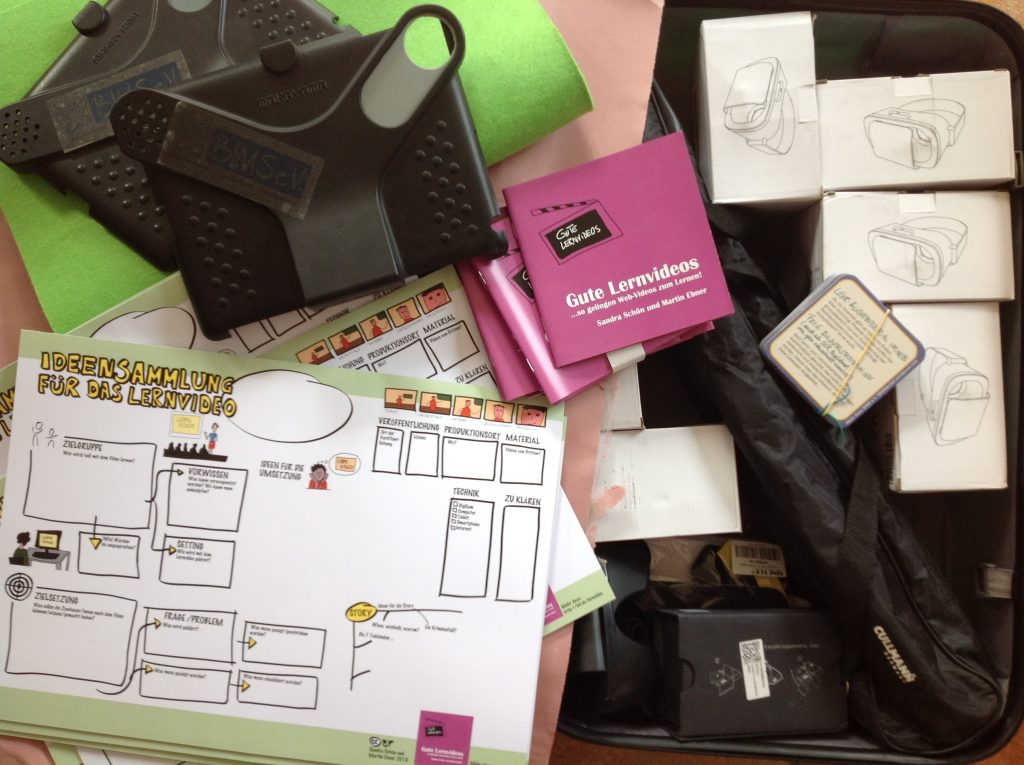
Sandra und ich sind heute in Chur zu Gast zu einem Workshop rund um Lernvideos. Wir berichten über Möglichkeiten, unseren Erfahrungen und wie man möglichst einfach auch selbst tatsächlich kurze Videos erstellen kann. Damit das ganze auch tatsächlich dann ein Lernvideo wird haben wir eine Vorlage für Ideensammlung entwickelt die möglichst alle Aspekte abdeckt.
Hier noch die Präsentationsfolien:

Klicken Sie auf den unteren Button, um den Inhalt von www.slideshare.net zu laden.

Inhalt laden

[publication] Kollaboratives Zeichnen zur Kreativitätsunterstützung #making

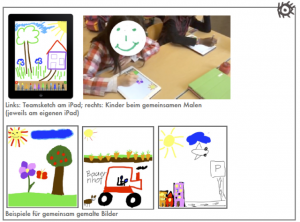
Wir haben einen Beitrag für das Buch „Making-Aktivitäten mit Kindern und Jugendlichen. Handbuch zum kreativen digitalen Gestalten“ beigesteuert und dabei die von uns entwickelte App Teamsketch vorgestellt. Damit kann man kollaborativ Zeichnungen erstellen und in weiterer Folge die Kreativität bei der Erstellung fördern, da Kinder neue Strategien entwickeln müssen um zu einer finalen Zeichnung gemeinsam zu kommen.

Zeichnen an sich ist natürlich ein hoch kreativer Prozess, der durch die Gruppenarbeit eine gänzlich neue Perspektive bekommt. Gemeinsames kreatives Arbeiten ist sicher eine gute Schulung für zukünftige Tätigkeiten.

[Weitere Hinweise zum Ablauf findet man am Medienpädagogik Praxis Blog]

[Buchkapitel auf ResearchGate]

[Link zum Buch „Making-Aktiväten mit Kindern und Jugendlichen“ auf ResearchGate]

[Link zum Buch „Making-Aktiväten mit Kindern und Jugendlichen“ auf Amazon]

Referenz: Ebner, M., Spitzer, M., Aureli, S. (2016) Kollaboratives Zeichnen zur Kreativitätsunterstützung. In: Making-Aktivitäten mit Kindern und Jugendlichen. Handbuch zum kreativen digitalen Gestalten. Schön, S., Ebner, M., Narr, K. (Ed.) Book on Demand, Nordersted, S. 108-112

Teamsketcg

[master] Making an Schulen #making

Markus Peißl hat sich in seiner Diplomarbeit mit Making an Schulen beschäftigt und hier auch selbsständig einen Workshop abgehalten. Seine Erfahrungen und Ergebnisse schilderte in seiner abschließenden Präsentation:

Klicken Sie auf den unteren Button, um den Inhalt von www.slideshare.net zu laden.

Inhalt laden

Lehr-/Lernräume an der TU Graz

Tim hat mir ein Blogstöckchen zugeworfen, etwas das ich noch aus den Anfängen des Web 2.0 gekannt und geschätzt habe. Schön, wenn man also alte Traditionen ab und zu wieder aufgreift. Es geht also darum, dass wir etws über Lehr- und Lernräume (also tatsächlich physikalische Räume) schreiben, unsere Erfahrungen teilen.

Ich kann dazu kurz berichten, dass wir 2013 das große Glück hatten, einen Raum zu bekommen, mit dem Auftrag: „Macht doch einmal etwas Innovatives, Anderes als wir es auf der Universität gewohnt sind.“ Nun, das war nicht einfach, zumal viele Ideen sofort am Tisch waren, wenig strukturiert und abgestimmt. Vielleicht weil ich auch im Herzen zu sehr Wissenschaftler bin, hab ich mir das Vorgehen dann doch anders vorgestellt – wir haben im Prinzip es dann so gemacht:

  1. Zu Beginn stand die Rechereche – was machen andere, wo gibt es bereits gute Ansätze?
  2. Danach machten wir Workshops mit 3 Gruppen – Stakeholder, Lehrenden und Studierenden
  3. Schlussendlich haben wir das zusammengetragen und dann den Raum eingerichtet

Über das Ergebnis habe ich seinerzeit bereits hier berichtet (im Anschluss an den Bericht gibt es auch Fotos) und wir haben gute Erfahrungen im Betrieb gemacht (unter anderem mit dem Projekt L3T 2.0).
Was hat sich für mich persönlich sehr bewährt:

  • Die fahrbaren Stromschienen kann man sehr empfehlen, die sind im Dauereinsatz rund um die Uhr.
  • Die umlaufenden Magnetleisten helfen sehr, wenn man Gruppenarbeiten mit Plakaten macht. Man kann zwischendurch etwas aufhängen, spontan präsentieren.
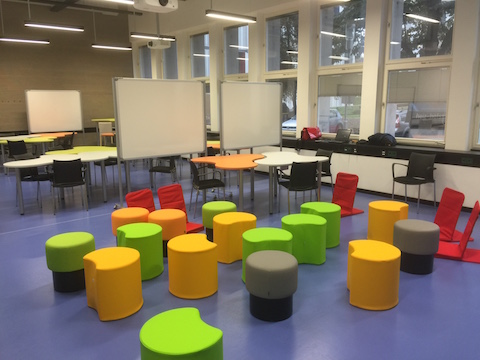
  • Besonders toll sind auch die unterschiedlichen Sitzmöglichkeiten und die schnelle Möglichkeit die Tische umzubauen um damit in andere Settings zu wechseln.
  • Die Farben führen automatisch zu einer generellen frohen Grundstimmung – ein Professor meinte, das sieht für ihn ja aus wie Kindergarten. Auf meine Frage hin, ob dies schlecht sei, verneinte er gleich 🙂
  • Die gute technische Ausstattung (WLAN, Projektor, Aufnahmemöglichkeiten, … geht zunehmends in den Hintergrund und wird einfach genutzt.

Das ganze hat so gut geklappt, dass man uns einen zweiten Raum gegeben hat, mit doppelter Grundfläche (ca. 80m2). Das Ergebnis sieht man hier auf dem Foto und ja, auch dieser Raum wird zunehmends genutzt und erfreut sich großer Beliebtheit. Und ein interessantes Detail zum Schluss: Die Ausstattung hat im Wesentlichen nicht mehr gekostet, also die übliche Ausstattung unserer Seminarräume.

Lehrraum an der TU Graz

[master, presentation] Einsatz von Open Educational Resources mittels Flipped Classroom im Mathematikunterricht #tugraz

Helmut hat sich in seiner Masterarbeit mit einem sehr interessanten Thema beschäftigt, dem Einsatz von OER mittels dem didaktischen Ansatz flipped classroom. Hier die Folien der Verteidigung seiner Masterarbeit:

Klicken Sie auf den unteren Button, um den Inhalt von www.slideshare.net zu laden.

Inhalt laden