Unsere E-Book Software hat nun ein großes Update hinter sich und gleichzeitig ebenso ein Redesign. Nachdem es grundsätzlich frei verwendbar ist, freut es uns wenn es noch viele Personen verwenden und damit E-Books erstellen 🙂

Digitale Lehre an und rund um der Technischen Universität Graz
Unsere E-Book Software hat nun ein großes Update hinter sich und gleichzeitig ebenso ein Redesign. Nachdem es grundsätzlich frei verwendbar ist, freut es uns wenn es noch viele Personen verwenden und damit E-Books erstellen 🙂
Our publication about „Automatic System for Producing and Distributing Lecture Recordings and Livestreams Using Opencast Matterhorn“ got published in the Journal of Educational Issues.
Abstract:
Lectures of courses at universities are increasingly being recorded and offered through various distribution channels to support students’ learning activities. This research work aims to create an automatic system for producing and distributing high quality lecture recordings. Opencast Matterhorn is an open source platform for automated video capturing and distribution and will be integrated fully in the introduced system. Beside lecture recordings livestreams of events in lecture halls are also being distributed, so that students have access to lecture content anywhere. In this publication we describe the technical implementation as well as discuss the strength and the weakness of such solution.
[Link to full article @ ResearchGate]
Reference: Jonach, R., Ebner, M., Grigoriadis, Y. (2015) Automatic System for Producing and Distributing Lecture Recordings and Livestreams Using Opencast Matterhorn. Journal of Educational Issues 1(2). pp. 149-158
My today’s keynote at the eduhub days 2016 (program) is about Learning Analytics with a special focus to MOOCs. Especially I am talking about our experiences we gathered in the last month and give an overview about our research studies. Enjoy the slides:
Klicken Sie auf den unteren Button, um den Inhalt von www.slideshare.net zu laden.
 Im Rahmen des edidactics-Moduls Multimediaproduktion halte ich heute den Input. Ich versuche dabei die immer vielfältigeren Einsatzmöglichkeiten von Medien darzustellen. Dazu findet man hier die Folien, im zweiten Teil des Moduls werden dann vor allem die Erstellung von E-Books und Videos praktisch erprobt:
Klicken Sie auf den unteren Button, um den Inhalt von www.slideshare.net zu laden.
Die gesamten Workshopunterlagen sind hier online frei zugänglich.
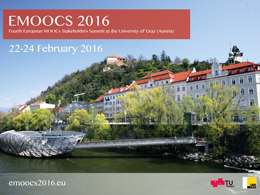 We are getting closer and closer to the conference date – EMOOCS 2016 will happen from 22th – 24th of February. Don’t forget to register for the conference.
In our preconference MOOC another two videos will be presented this week. This time there will be one about Learning Analytics and MOOC and another one about completion rate. So two hot topics, don’t miss them.
 Fast schon traditionell findet auch heuer der Tag der Informatik Fachdidaktik an der PH Steiermark statt und wird topaktuell sich dem Thema Making widmen. Als Keynotes konnten wir Sandra Schön und Gregor Lütolf gewinnen. Darüberhinaus biete ich zusammen mit meinem Masterstudenten und meinem PhD-Kandidaten zwei spannende Workshops an:
Ich habe für die letzte Ausgabe des L.A.multimedia Magazin einen Kurzbeitrag zu „Wozu Learning-Analytics-Applikationen im Mathematikunterricht?“ verfasst, der nun hier erschienen ist.
Zusammenfassung:
Learning Analytics ist noch ein sehr junges Forschungsgebiet, da es erst seit wenigen Jahren infolge des Internets möglich ist, Daten zentral zu sammeln. Die Interpretation solcher Daten kann Lehrende nun dabei unterstützen den Unterricht individueller zu gestalten und Lernende gezielt zu fördern. Am Beispiel des Einmaleins- Trainer wird gezeigt welche Aussagen getroffen werden können und welche Potentiale Datenanalyse für den Lehr- und Lernbereich haben kann.
Zitation: Ebner, M. (2015) Wozu Learning-Analytics-Applikationen im Mathematikunterricht?. L.A. multimedia, 3-2015, S. 40-41
Erst sehr spät nach dem Projekt – nämlich im Rahmen der Preisverleihung – ist uns aufgefallen, dass wir das Arbeitsheft zum Kurs „Gratis Online Lernen“ nie zum Durchblättern bei Slideshare hochgeladen haben. Jetzt aber:
Klicken Sie auf den unteren Button, um den Inhalt von de.slideshare.net zu laden.
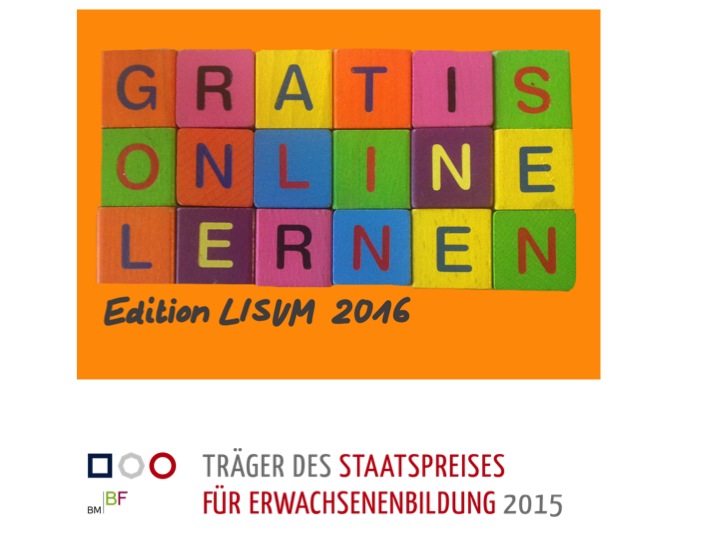
Der kostenlose Online-Kurs „Gratis Online Lernen“ wird gerade herausgeputzt – dank einer Kooperation mit LISUM wird das Arbeitsheft überarbeitet, gedruckt und eine neue Einheit erstellt. Das Wesentliche am erprobten und inzwischen mit einem Staatspreis ausgezeichnetem Konzept bleibt gleich und Anmeldungen sind bereits möglich.
Wir freuen uns sehr, wenn auch Sie oder Ihre Bildungseinrichtung den Kurs unterstützen möchte – v.a. sind wieder Ausgabestellen und Begleitangebote rund um den Kurs gefragt. Über Computerclubs, Stammtische, Lernertreffen und andere, die gleich einen Satz Hefte benötigen, freuen wir uns auch! Mehr Informationen finden Interessierte in diesem Dokument.
We are very happy to announce that today the preconference MOOC for the EMOOCs 2016 conference in Graz is starting. You can register for the MOOC right here and for the conference follow this link.
Mohammad Khalil gives a short introduction to the MOOC, which will offer the top-paper of the researach and experience track of this year:

Mit dem Laden des Videos akzeptieren Sie die Datenschutzerklärung von YouTube.
Mehr erfahren