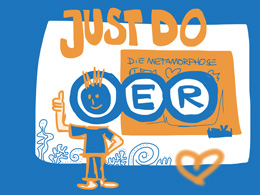
 Der MOOC zu Open Educational Resources – kurz coer15 – ist in der Woche 5 angelangt. Diesesmal dreht es sich ums Geld, denn wenn auch die Materialien frei zugänglich sind, heißt das ja nicht, dass sie auch ohne Kosten erstellt werden. Mit anderen Worten: „Wie man soll man denn das alles finanzieren?“. Das Businessmodell, das es so eigentlich noch gar nicht gibt, steht also im Zentrum dieser Woche. Ich selbst versuche, dabei die Möglichkeiten darzustellen und zeige was wohl machbar ist.
Also schnell anmelden, der Einstieg ist noch jederzeit möglich.
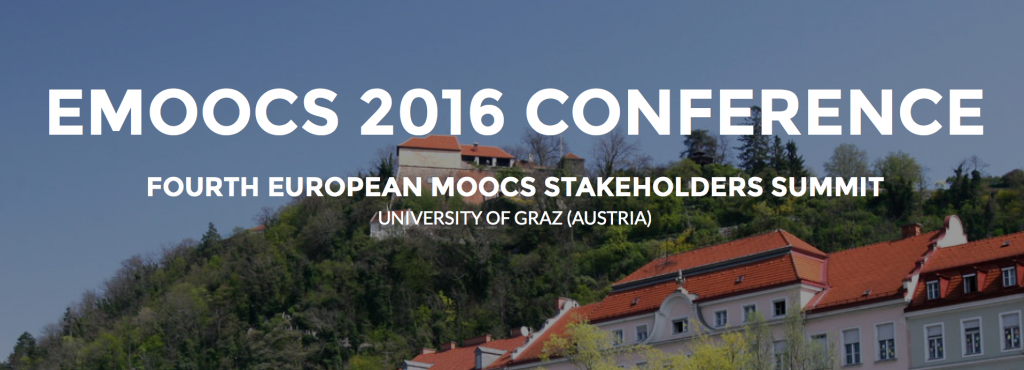
[conference] eMOOCs 2016 #emoos2016
 We would like to invite you to the eMOOCs conference 2016, which will be from 22nd to 24th of February 2016. It will be hosted in cooperationy by the University of Graz and the University of Technology Graz.
The official website is already online and the Call for Paper will follow in the end of june. You are warmly welcomed to a beautiful place as well as a great event – stay tuned.
[publication] COLINDA: Modeling, Representing and Using Scientific Events in the Web of Data
Our publicaton about „COLINDA: Modeling, Representing and Using Scientific Events in the Web of Data“ at this year „DeRiVE 2015-Detection, Representation, and Exploitation of Events in the Semantic Web“ conference is now online available.
Abstract:
Conference Linked Data (COLINDA)3, a recent addition to the LOD (Linked Open Data) Cloud4, exposes information about scientific events (confer- ences and workshops) for the period from 2002 up to 2015. Beside title, descrip- tion and time COLINDA includes venue information of scientific events which is interlinked with Linked Data sets of GeoNames5, and DBPedia6. Additionally in- formation about events is enhanced with links to corresponding proceedings from DBLP (L3S)7 and Semantic Web Dog Food 8 repositories. The main sources of COLINDA are WikiCfP9 and Eventseer10. The research questions addressed by this work in particular are: how scientific events can be extracted and summa- rized from the Web, how to model them in Semantic Web to be useful for mining and adapting of research related social media content in particular micro blogs, and finally how they can be interlinked with other scientific information from the Linked Data Cloud to be used as base for explorative search for researchers
Reference: Softic, S., de Vocht, L., Mannens, E., Ebner, M., Van de Walle, R. (2015) COLINDA: Modeling, Representing and Using Scientific Events in the Web of Data, In: Proceedings of the 4th International Workshop on Detection, Representation, and Exploitation of Events in the Semantic Web (DeRiVE 2015), van Erp, M., Troncy, R., Rospocher, M., van Hage, W. R., Shamma, D. A. (Ed.), pp. 12-23
[publication] What do we know about typical MOOC participants? First insights from the field
Our publication about „What do we know about typical MOOC participants? First insights from the field“ at this year eMOOCs 2015 conference, Mons (Belgium) is now online available.
Abstract:
Massive Open Online Courses became a worldwide phenomenon. Especially in Central Europe it is a subject of debates whether universities should invest more money or not. This research study likes to give first answers about typical MOOC participants based on data from different field studies of the Austrian MOOC-platform iMooX.
It can be pointed out that the typical learner is a student or an adult learner, strongly interested in the course topic or just interested in learning with media and finally with self- contained learning competencies. The research work concludes that MOOCs broaden the educational field for universities and are a possibility to educate the public in a long run.
[Link to the conference proceeding]
Reference: Neuböck, K., Kopp, M., Ebner, M. (2015) What do we know about typical MOOC participants? First insights from the field, In: Proceedings of eMOOCs 2015 conference, Lebrun, M., de Waard, I., Ebner, M., Gaebel, M., Mons, Belgium, pp. 183-190
[coer, imoox] OER Einsatzszenarien #coer15 #imoox
Der MOOC zu Open Educational Resources – kurz coer15 – ruft zur Woche 4 auf. Diesesmal geht es darum wie OER eingesetzt wird bzw. wie es erfahrene Personen machen. Freuen Sie sich mit mir auf Interviews u.a. mit Thomas Narosy (E-Learning 1*1), Michael Kopp (iMooX), Karl Kirst (ZUM-Wiki), Hermann Maurer (Austria Forum) und auch Andreas Wittke (mooin). Sie alle haben viel zu erzählen und ich denke, man kann von diesen Pionieren nur lernen, warum sie OER einfachen machen. Zusätzlich erzählt Maria Haas als Lehramtsstudierende ihre ersten Erfahrungsschritte mit OER.
Also schnell anmelden, der Einstieg ist noch jederzeit möglich.
[poster] iMooX #imoox
Im Rahmen des Symposium Hochschuldidaktik haben wir iMooX auch mit einem Poster vorgestellt. Dieses kann man sich hier ansehen bzw. auch runterladen.
Klicken Sie auf den unteren Button, um den Inhalt von de.slideshare.net zu laden.
Plakat iMooX from Martin Ebner
[coer, imoox] OER erstellen #coer15
Der MOOC zu Open Educational Resources – kurz coer15 – ist nun bereits in der dritten Woche. Nachdem OER erklärt wurde, ebenso die CC-Lizenzen und in der zweiten Woche OER gesucht und gefunden wurde, steht nun die Vorstellung von Werkzeugen an der Reihe, die es ermöglicht eigenes Material anzubieten.
Wie das geht wird in einem Video erklärt, darum also schnell noch anmelden, der Einstieg ist noch jederzeit möglich.
[presentation] #iMooX – eine Plattform für Online-Kurse der Uni Graz und der TU Graz
Im Rahmen des Symposiums Hochschuldidaktik an der Universität Graz darf ich heute die MOOC-Plattform iMooX vorstellen und über unsere ersten Erfahrungen berichten. Hier gibt es nochmals die Folien dazu:
Klicken Sie auf den unteren Button, um den Inhalt von de.slideshare.net zu laden.
[imoox, gadi] Technologiefolgenabschätzung und Privatssphäre #imoox #gadi15

 Der MOOC „Gesellschaftliche Aspekte der Informationstechnologie“ auf iMooX geht leider in die letzte und 10te Woche. Zum Abschluss kommen zwei sehr erfahrene Experten zu Wort: Prof. Hermann Maurer und Dr. Schinagl. Beide waren seit Anbeginn des Internets dabei und haben die rasante bisherige Entwicklung auch maßgeblich mitgesteuert. Trotzdem rufen sie auf, den kritischen Blick nicht zu verlieren? Warum? Nun dazu muss man beim MOOC vorbeisschauen 🙂 .
Also unbedingt noch mitdiskutieren – der Einstieg in den MOOC ist jederzeit noch möglich.
[Link zum Kurs]
Die Maker Days for Kids im MAKE Magazin #makerdays
Uns allen haben die Maker Days for Kids, die erste offene digitale Werkstatt für Kinder in Bad Reichenhall richtig gut gefallen. Toll, dass uns Mathias Wunderlich unterstützte – und nun einen feinen Beitrag im MAKE Magazin geschrieben hat. YIPPIEH!
