Mein Vortrag an der Universität Wien zu „MOOC und OER – wozu an österreichischen Hochschulen?“ ist nun als Aufzeichnung auf YouTube veröffentlicht worden. Viel Spaß beim Nachhören und Fragen bitte gerne 🙂
[presentation] Mining and Visualizing Usage of Educational Systems Using Linked Data
Our presentation about „Mining and Visualizing Usage of Educational Systems Using Linked Data“ at this year 4th European Immersive Education Summit is now online available. Here are the slides:
Klicken Sie auf den unteren Button, um den Inhalt von www.slideshare.net zu laden.
Einheit 6: Selber Lernen heisst nicht alleine Lernen! #gol14 #imoox
Im Kurs „Gratis Online Lernen“ begann gestern bereits die sechste (von acht) Einheit und dabei dreht es sich darum ob man gerne und wie man gut gemeinsam mit anderen lernen kann. Selber lernen muss ja im Internet gar nicht „allein lernen“ heißen – es gibt ja viele, die hier auch etwas lernen möchten oder gerne etwas vermitteln, auch wenn es keine Lehrkraft im engeren Sinn ist.
Zum einen möchten wir die Teilnehmer/innen dazu einladen, sich mit den eigenen Erfahrungen zum gemeinsamen Lernen auseinanderzusetzen, zum anderen gibt es Möglichkeiten das gemeinsame Lernen bzw. Bearbeiten eines Textes gleich auszuprobieren.
CC BY Sandra Schön (BIMS e.V.) und Martin Ebner (TU Graz) | imoox.at 2014
[presentation] A Contribution to Collaborative Learning Using iPads for School Children
Our presentation about „A Contribution to Collaborative Learning Using iPads for School Children“ at this year 4th European Immersive Education Summit is now online available. I talked about our application „Buchstabenpost„, which can be used by anyone who is interested in it. Enjoy the slides and if there is any question, just ask 🙂
Klicken Sie auf den unteren Button, um den Inhalt von www.slideshare.net zu laden.
[video] How to make a Stop Motion Film
Im Rahmem meines Seminars „Technology Enhanced Learning“ wurden von den Studierenden Lernvideos erstellt, die einfach einmal die Möglichkeit des Bewegtbildes ausloten sollten. Das erste von vier Videos widmet sich dem Thema Stop-Motion:
[iPhone] FluidColors
Im Rahmen unserer Vorlesung „Mobile Applications 2014“ ist das Farbenspiel FluidColors umgesetzt worden. Es geht darum aus drei Farbröhren die richtigen Farben zu mischen:
FluidColors helps with learning how to mix colors.
The goal of the game is to mix 3 random colors with red, green, and blue fluids.
By pressing the pipes at the top of the screen the fluids are released. These can be redirected to the desired bucket by drawing lines on the screen. As soon as the color in the bucket matches the target color the bucket will close. If all three buckets are closed the game ends.
[publication] Evaluation of Augmented Reality Frameworks for Android Development
Our publication about „Evaluation of Augmented Reality Frameworks for Android Development“ has been published in the International Journal of Interactive Mobile Technologies.
Abstract:
Augmented Reality (AR) is the evolution of the concept of Virtual Reality (VR). Its goal is to enhance a person’s perception of the surrounding world. AR is a fast growing state of the art technology and a variety of implementation tools thereof exist today. Due to the heterogeneity of available technologies, the choice of the appropriate framework for a mobile application is difficult to make. These frameworks implement different tracking techniques and have to provide support to various constraints. This publication aims to point out that the choice of the appropriate framework depends on the context of the app to be developed. As expected, it is accurate that no framework is entirely the best, but rather that each exhibits strong and weak points. Our results demonstrate that given a set of constraints, one framework can outperform others. We anticipate our research to be the starting point for testing of other frameworks, given various constraints. The frameworks evaluated here are open- source or have been purchased under Academic License.
Reference: Marneanu, I., Ebner, M., Rössler, T. (2014) Evaluation of Augmented Reality Frameworks for Android Development. In: International Journal of Interactive Mobile Technologies. Vol. 8 (4), pp. 37-44 [Link to the Article]
Die Woche 5 bei Gratis Online Lernen – ein Kreuzworträtsel #gol14 #imoox
Und schon startet die zweite Hälfte von „Gratis Online Lernen„. Und in der fünften Einheit dreht sich alles rund um die „Tücken“ des kostenlosen Lernens im Netz. Wenn man etwas von Unbekannten angeboten bekommt, ist man misstrauisch: Warum bekomme ich das kostenlos? Was wollen die von mir? In dieser Einheit dreht es sich also darum, was man sich vor Augen führen sollte, wenn man ein kostenloses Lernnangebot im Internet nutzt. Werden da meine Daten gesammelt, und für welchen Zweck? Dient es zur Kundenbindung oder Kundengewinnung? Wer macht das Angebot eigentlich und warum? Und im Forum freuen wir uns über Ihre Erfahrungen mit kostenlosen Angeboten: Sind Sie da weniger kritisch, was Inhalte und Gestaltung angeht, weil es ja kostenfrei ist? Sind Sie besonders misstrauisch, wenn Sie etwas Kostenfreies im Internet finden? Welche Erfahrungen haben Sie schon gemacht?
CC BY Sandra Schön (BIMS e.V.), Martin Ebner (TU Graz) | imoox.at 2014
[presentation] Ist das Schulbuch in Zukunft zwingend noch ein Buch?
Im Rahmen der Fachgruppentagung 2014 der WKO in Klagenfurt bin ich eingladen worden meine Gedanken zum zukünftigen Schulbuch zu präsentieren. Ich gebe zu ich denke hier vielleicht quer und gänzlich anders, aber vielleicht bewahrheitet sich ja das eine oder andere doch.
Hier meine Vortragsfolien:
Klicken Sie auf den unteren Button, um den Inhalt von www.slideshare.net zu laden.
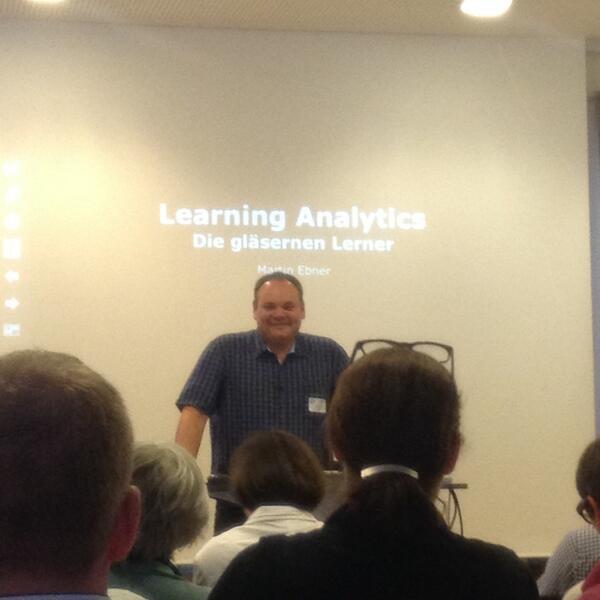
[recording] Learning Analytics – Der gläserne Lerner
Im Rahmen der DINI-Zukunfstwerkstatt durfte ich zum Thema Learning Analytics reden – die Folien sind bereits hier zugänglich. Jetzt gibt es auch noch die Aufzeichnung 🙂