Aufgrund der derzeitigen Situation und darauf aufbauend die Vorrausschau auf den Herbst 2020 haben wir uns entschlossen, die Welcome Days der TU Graz teilvirtuell zu gestalten. Also dort wo Präsenz möglich ist, wird es diese auch geben, den Rest streamen wir aus unserem Studio live 🙂
#COVID19 was and is a big challenge for many people, for teachers as universities as well. And of course we love to share experiences we made or have seen at the TU Graz as well to enrich the contributions on teaching and learning with technologies in HEI.
This time we contributed to a book which collects 133 (!) experiences from colleagues worldwide, all available under CC BY NC ND. Please have look and check:
https://www.learntechlib.org/p/216903/
Our contribution describes:
To train future Austrian teachers in using digital media, a novel didactic design was implemented at several universities in Austria in summer semester 2019: The course includes the participation in a MOOC (massive open online course) on the topic, an accompanying group work at the universities and multiple-choice tests conducted at the universities. In the summer semester of 2020, due to the COVID-19 crisis, the group work and exams had to be switched to virtual space as well. Because the course materials are available under an open license, i.e. as open educational resources, further use is possible and offered.
Ebner, Martin & Schön, Sandra (2020). Remote Future Teacher Training with MOOCs. In: R.E. Ferdig, E. Baumgartner, E., R. Hartshorne, E. Kaplan-Rakowski, & C. Mouza, C. (Ed). Teaching, Technology, and Teacher Education during the COVID-19 Pandemic: Stories from the Field. Association for the Advancement of Computing in Education (AACE). Pp. 493-497. Book is available under CC BY NC ND: https://www.learntechlib.org/p/216903/;. Preprint at ResearchGate: https://www.researchgate.net/publication/342261714_Remote_Future_Teacher_Training_with_MOOCs
Am 6.7.2020 um 11.00 Uhr findet der nächste fnma-Talk zum Thema „Digital Tests, Examinations and Assessments – Chances and Challenges“ statt. Die Teilnahme ist wieder immer kostenlos und wird online gestreamt. Alexander Schulz wird dabei den Input geben:
Alexander Schulz koordiniert am Center für Digitale Systeme (CeDiS) der Freien Universität Berlin seit 2017 den Bereich E-Learning und E-Examinations. Zu dem Bereich gehören das E-Examination Center (EEC) und seit 2019 das E-Examination Center 2 (EEC2), die mit insgesamt mehr als 330 Prüfungsplätzen zu den größten digitalen Prüfungszentren im deutschsprachigen Raum gehören. Er beschäftigt sich seit 2005 mit digitalen Prüfungen und ist langjähriger Referent und Fachautor in diesem Bereich.
Alexander Brunner hat seine Mastearbeit zum Thema „Einsatz von Mixed Reality im Klassenzimmer“ verfasst. Hier nun die Folien seiner erfolgreichen Verteidigung.
Klicken Sie auf den unteren Button, um den Inhalt von www.slideshare.net zu laden.
Die Zeitschrift für Hochschulentwicklung, kurz ZFHE, hat einen neuen Call veröffentlicht zum Thema „The Digital Turn in Internationalization. Konzepte, Strategien und Praktiken„
Soeben wurde ein neuer Call for Papers der Zeitschrift für Hochschulentwicklung veröffentlicht: Das Themenheft 16/2 (Juni 2021) trägt den Titel „The Digital Turn in Internationalization. Konzepte, Strategien und Praktiken“. Herausgeberinnen sind Svenja Bedenlier (Erlangen-Nürnberg) & Elisa Bruhn (Bonn), die Deadline zur Einreichung von vollständigen Beiträgen ist der 15. Jänner 2021.
My PhD-Students wrote a chapter about the usage of Microsoft Hololens „Simulation data visualization using mixed reality with Microsoft HoloLensTM„. Now it got published within the book „New Perspectives on Virtual and Augmented Reality„.
Abstract: Simulations and test beds are very difficult topics, especially for non-experienced students or new employees in the mechanical engineering domain. In this chapter, a HoloLens app and a CAD/Simulation workflow are introduced to visualize CAD models and sensor and simulation data of a test run on an air conditioning system test bed. The main challenge is to visualize temperature and pressure changes within opaque parts, such as tubes, compressors, condensers or electrical expansion valves. The HoloLens app supports various simulations and CAD visualizations. We exemplary implemented colouring the temperature or pressure changes of the test bed parts as Mixed-Reality (MR) overlays. The main purpose of the HoloLens app is to reduce the learning effort and time to understand such simulations and test bed settings. Additionally, the app could be used as a communication tool between different departments to transfer experiences and domain specific knowledge.
Reference: Spitzer, M., Rosenberger, M., Ebner, M. (2020) Simulation data visualization using mixed reality with Microsof HoloLensTM, In: New Perspectives on Virtual and Augmented Reality, Daniela, L. (ed.), pp. 147-162, London: Routledge, https://doi.org/10.4324/9781003001874
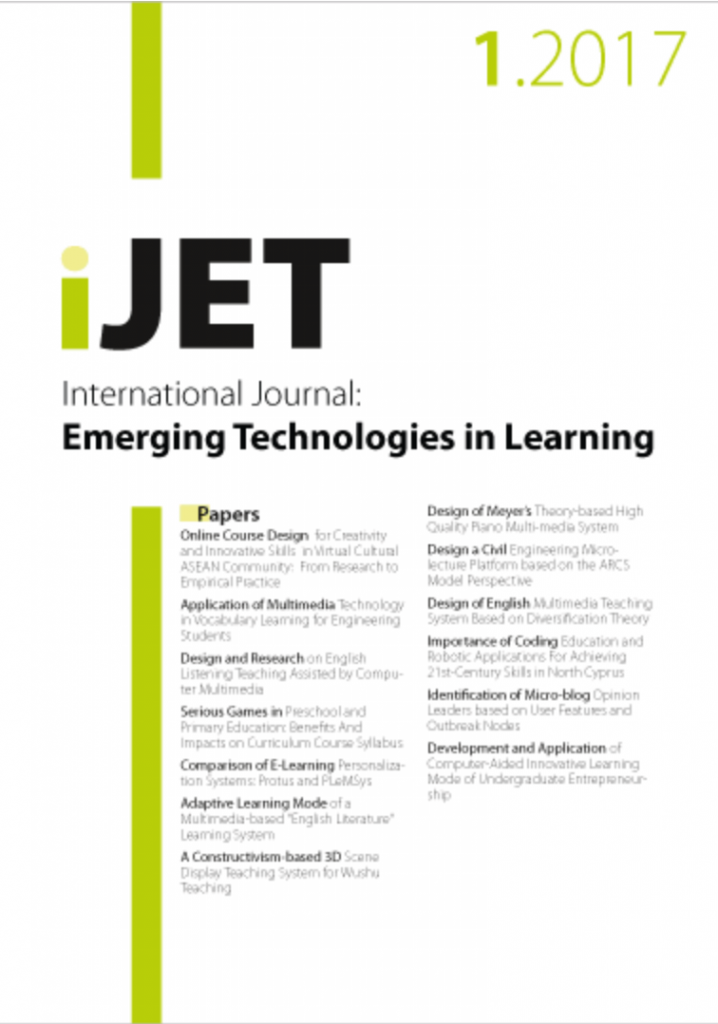
Issue 15(11) of our journal on emerging technologies for learning got published. Enjoy the readings as usual for free :-).
Table of Contents:
Application of Big Data Technology in Blended Teaching of College Students: A Case Study on Rain Classroom
Design and Application of Micro Course in Fundamentals of Computers
Designing Mangrove Ecology Self-Learning Application Based on a Micro-Learning Approach
Blended Web Mobile Learning (BWML) Model to Improve Students’ Higher Order Thinking Skills
Design and Application of Experimental Teaching System Driven by Big Data Technology in Economics and Management Majors
Framework for e-Learning Materials Optimization
The Effectiveness of Google Classroom Among EFL Students in Jordan: An Innovative Teaching and Learning Online Platform
Impact of Information System and Blockchain on Organizational Learning Effectiveness
Effectiveness of the Implementation of Cognitive Conflict Strategy Assisted by e-Service Learning to Reduce Students‘ Mathematical Misconceptions
Empirical Research on the Application of Online Teaching in Chinese Colleges and Universities Under the Situation of Novel Coronavirus Pneumonia Prevention and Control
Perception of Teachers on Collaborative Tools Knowledge Level Mediated by ICT and Their Experience with Students
The Use of Reflective Journal as a Tool for Monitoring of Metacognition Growth in Writing
An Evaluation System and Its Model for Educational Competitiveness of Universities
A New Evaluation Technique Through Serious Games for Children with ASD
Project-Based Learning Technology: An Example in Programming Microcontrollers
The Machine Translation of Literature: Implications for Translation Pedagogy
Students’ Perceptions and Continuous Intention to Use E-Learning Systems: The Case of Google Classroom.
The Effect of Project-Based Learning Assisted PANGTUS on Creative Thinking Ability in Higher Education
Supporting College Students with Disorder of Written Expression: A Web-Based Model for Teachers in Under- Resourced Contexts
Es freut uns, dass wir am 1.Juli das zweite Barcamp an der TU Graz anbieten können. Es wird teilvirtuell sein, also wir werden sowohl vor Ort diskutieren als auch virtuell, leider ist es nur für TU Graz Angehörige geöffnet.
Im Projekt „TEL Marketplace“ dreht sich alles rund um Technology Enhanced Learning (TEL), also technologiegestütztes Lehren und Lernen. An der TU Graz werden ausgewählte Pilotgruppen im Wintersemester 2019/20 und im Sommersemester 2020 dabei unterstützt, innovative TEL-Konzepte in der alltäglichen Lehrpraxis anzuwenden, zu evaluieren und gemeinsam mit Studierenden weiterzuentwickeln – von Lehrvideos über spielerische Quiz-Elemente bis hin zu virtuellen Labors. Beim Barcamp können Sie sich sowohl mit den Lehrenden und Forschenden der Pilotgruppen als auch mit Studierenden rund um technologiegestützte Lehre austauschen.
Zur Vorbereitung auf die Makerdays 2020 an der TU Graz – die Anmeldung ist bereits hier freigeschalten – gibt es nun weitere Social-Media-Auftritte wo regelmäßig aktuelle Nachrichten gepostet werden. Also einfach subscriben 🙂
Our chapter about „Mixed Reality Books: Applying Augmented and Virtual Reality in Mining Engineering Education“ got published in the book „Augmented Reality in Education“.
Abstract: This chapter deals with the integration of Augmented and Virtual Reality (AR/VR) elements into academic mining education. The focus lies on the didactical approach within the EU-funded MiReBooks (Mixed Reality Books) project. The project aims to develop a series of AR- and VR-based interactive mining manuals as a new digital standard for higher education across European engineering education. By combining AR and VR technologies, it is possible to address current challenges in mining education in an innovative way. These virtual applications should make otherwise impossible and dangerous situations accessible to students. Classical paper-based teaching materials are enriched with AR content and translated into pedagogically and didactically coherent manuals for integrative use in the classroom. The authors explore how AR and VR instruments can be effectively integrated into teaching. The results of a broad evaluation of AR/VR-based lectures are presented and discussed in this chapter. The experiences and findings are summarized in a decision matrix for the use of AR/VR-based technologies in teaching.
Reference: Daling, L., Kommetter, C., Abdelrazeq, A., Ebner, M. & Ebner, M. (2020) Mixed Reality Books: Applying Augmented and Virtual Reality in Mining Engineering Education. In: Augmented Reality in Education. Geroimenko, V. (Ed.). pp. 185-195. Springer, DOI: 10.1007/978-3-030-42156-4