
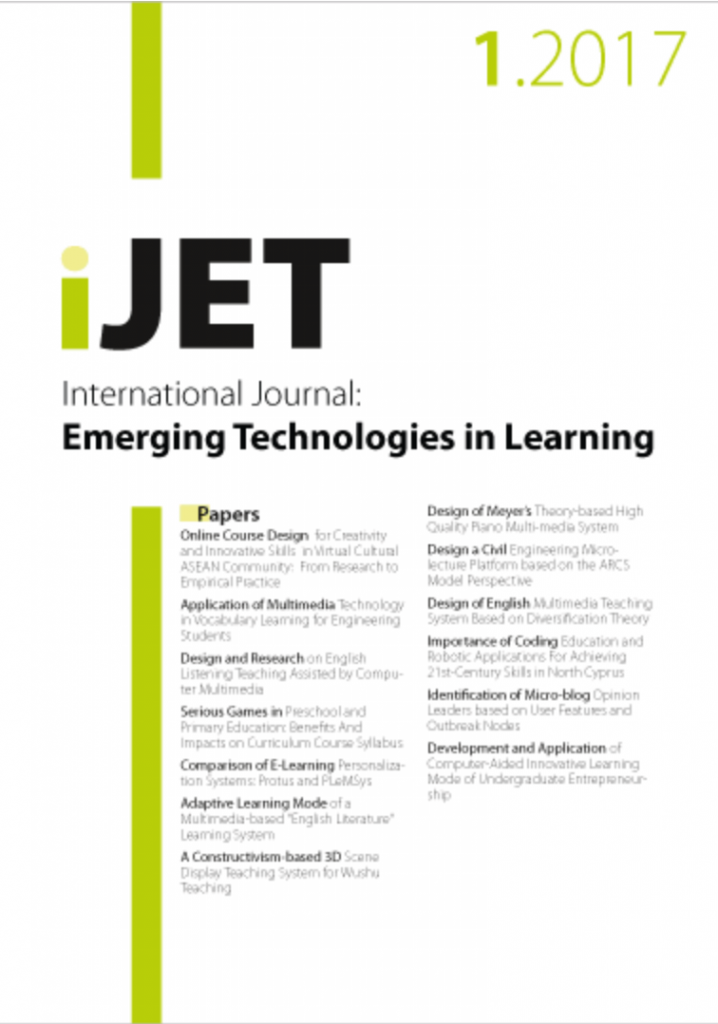
[ijet, journal] Journal of Emerging Technologies in Learning Vol. 15 / No. 8 #ijet #research

Issue 15(8) of our journal on emerging technologies for learning got published. Enjoy the readings as usual for free :-).

Table of Contents:

  • Cloud Computing Based E-Learning in Malaysian Universities
  • Applying Blended Problem-Based Learning to Accounting Studies in Higher Education; Optimizing the Utilization of Social Media for Learning
  • Research on Personalized Recommendations for Students’ Learning Paths Based on Big Data
  • Mobile Application Development for Technology Enhanced Learning: An Applied Study on the Students of the College of Mass Communication at Ajman University
  • The Effect of Learning Motivation, Self-Efficacy, and Blended Learning on Students’ Achievement in The Industrial Revolution 4.0
  • Can a Technology Teach Meditation? Experiencing the EEG Headband InteraXon Muse as a Meditation Guide
  • Design, Construction and Evaluation of a Web Application for the Teaching-Learning Process on Financial Mathematics
  • Point Estimation with Markers for Effective Mobile Auditory Graphs
  • Project-Based Learning Approach for Teaching Mobile Application Development Using Visualization Technology
  • Improving Accuracy in Imitating and Reading Aloud via Speech Visualization Technology
  • Exploring MOOC User Behaviors Beyond Platforms
  • A Sports Teaching Mode Based on Social Networking Service Teaching Resources
  • Exploring Student Academic Performance Using Data Mining Tools
  • A Personalized English Teaching Design Based on Multimedia Computer Technology
  • Correlation between Self-Efficacy and English Performance
  • Toward an Adaptive Educational Hypermedia System (AEHS-JS) based on the Overlay Modeling and Felder and Silverman’s Learning Styles Model for Job Seekers
  • Online Self-Regulated Learning Strategies in MOOCs: A Measurement Model

[Link to Issue 15/08]

Nevertheless, if you are interested to become a reviewer for the journal, please just contact me :-).


[mathe, MINT] Lektion 8: Mathe-MINT-MOOC in letzter Woche zu Matrizen #imoox #mathe

So der Brückenkurs zur Mathematik ist leider schon in der letzten Woche und da greifen wird das Thema Matrizen auf:

Die Lektion 8 befasst sich mit Matrizen. In dieser Lektion wird zuerst erklärt was Matrizen sind. Danach werden die Multiplikation von Matrizen und Vektoren, die Multiplikation von Matrizen , sowie die inverse Matrix behandelt.

Auch haben wir wieder interaktive MATLab-Übungen hinterlegt, um das Gelernte gleich selbst zu Erproben.

Mehr aber dazu wie immer im Video:

[Anmeldung ist jederzeit hier noch kostenlos möglich]

Vielen Dank an die TU Austria, die das Projekt trägt.

[imoox, gadi] Woche 9: Artifical Intelligence, Innovation durch IT und Urheberrecht #gadi20 #imoox

Frank KappeDer MOOC „Gesellschaftliche Aspekte der Informationstechnologie“ auf iMooX befindet sich bereits in der vorletzten und neuten Woche. Dennoch ist es immer noch wahnsinnig spannend, sind doch die Themen immer wieder inspirierend. Diesesmal sind die Experten Wolfgang Slany, Frank Kappe und Michael Lanzinger dran. Zuerst beschwert sich Prof. Kappe über die mangelnde Innovationskraft bei unseren Studierenden, da sie seiner Ansicht nach viel zu wenige Unternehmen gründen. Wie ein Konter wirkt dann das Thema von Michael Lanzinger, da das Urheberrecht ja sehr einschränkend ist. Abschließend adressiert Prof. Slany noch ein sehr spannendes Thema und fragt sich wie die Zukunft so ausschauen kann.
Also unbedingt vorbei schauen und mitdiskutieren – der Einstieg in den MOOC ist jederzeit noch möglich.
[Link zum Kurs]

[publication] Open Educational Resources in Austria

As part of the book Current State of Open Educational Resources in the “Belt and Road” Countries we did a chapter about the current state in Austria.

Abstract:
In Austria, located in the center of Europe, when compared earlier in relation to other German-speaking countries in Europe, individuals and groups started to develop and work on the idea of freely available and usable learning content on the Internet. A first Austrian milestone was the coordination of an international conference on open educational content in 2007 as the final activity of the first European project that was focused on OER (olcos.org). Within the contribution an overview of current state and developments of OER activities in Austria is given, also describing its infrastructure, policy, existing resources, curriculum and teaching methodologies, outcome, stakeholders and impact for education. The chapter gives a comprehensive overview of all OER activities in Austria and outlines the benefits for the educational system as well. It can be summarized that the Austrian way seems to be successful even though the steps forward are often small.

[Chapter @ Journal’s Homepage]
[Chapter @ ResearchGate]

Reference: Schön S., Ebner M. (2020) Open Educational Resources in Austria. In: Huang R., Liu D., Tlili A., Gao Y., Koper R. (eds) Current State of Open Educational Resources in the “Belt and Road” Countries. Lecture Notes in Educational Technology. pp 17-33. Springer, Singapore

[press] #CoronaAlltag: Wenn ein Lehrbetrieb sich neu erfinden muss #covid19 #covid #tugraz

Man hat mich gebeten, die ersten Tage an der TU Graz festzuhalten, als wir auf 100% digitale Lehre infolge der Corona-Krise umgestiegen sind. APA Science hat den Kurzbericht veröffentlicht.

Das öffentliche Leben, den Sport, die Wirtschaft und die Bildung: Ein neuartiges Virus in Österreich veränderte innerhalb weniger Tage alles. Doch während die „Coronakrise“ viele Bereiche vollkommen lahmlegte, legten Österreichs Bildungseinrichtungen sprichwörtlich den Schalter um.

Webseite APA-Science

[Kurzbericht #CoronaAlltag: Wenn ein Lehrbetrieb sich neu erfinden muss]

[mooc, mint] Mathe-MOOC in Woche 7: Die Vektorrechnung #imoox #tuaustria

So der Brückenkurs zur Mathematik kommt in Woche 7 zum Thema Vektorrechnung:

Die Lektion 7 befasst sich mit der Vektorrechnung. In dieser Lektion werden die Multiplikation von Vektoren, die Addition von Vektoren im R3 , sowie die lineare (Un)abhängigkeit behandelt.

Auch haben wir wieder interaktive MATLab-Übungen hinterlegt, um das Gelernte gleich selbst zu Erproben.

Mehr aber dazu wie immer im Video:

[Anmeldung ist jederzeit hier noch kostenlos möglich]

Vielen Dank an die TU Austria, die das Projekt trägt.

[gadi, imoox] Woche 8: Technik & Ethik, IT & Gesellschaft #imoox #gadi20

Der MOOC „Gesellschaftliche Aspekte der Informationstechnologie“ auf iMooX befindet sich bereits in der achten Woche. Diesesmal ist der Experte Günter Getzinger, sowie die Queer STS Mitglieder Susanne Kink, Thomas Berger und Anita Thaler dran.

Queer-STS_Susanne_Thomas_Anita_GADI-2016

Hr. Getzinger geht der Frage nach, inwieweit das Recht auf die eigenen Daten bestand hat. Danach erfolgt eine spannende Diskussion zu dritt zu IT & Gesellschaft an sich. Wenn dies die Neugier weckt, freut es mich, wenn neue Diskussionbeiträge im Forum erscheinen.
Also unbedingt vorbei schauen und mitdiskutieren – der Einstieg in den MOOC ist jederzeit noch möglich.
[Link zum Kurs]

[ijet, journal] Journal of Emerging Technologies in Learning Vol. 15 / No. 7 #ijet #research

Issue 15(7) of our journal on emerging technologies for learning got published. Enjoy the readings as usual for free :-).

Table of Contents:

  • Development of Projo Bale Model Based on Android Application in History and Local Wisdom Studies of Malang
  • An Evaluation Model of the Learning Effect of Physical Education Major Courses in Colleges
  • CLIL Audio Materials: A Speaking Model for Library Science Department Students
  • Integrating Islamic Knowledge into Multimedia-Based Supplementary Listening Materials
  • Blended Learning in Research Statistics Course at The English Education Department of Borneo Tarakan University
  • Increasing Geographic Literacy through the Development of Computer Supported Collaborative Learning
  • Development of ‚Video Bank‘ Based on Prehistoric Community Life at The Sangiran Site as an Independent Learning Media
  • Promoting Effects of Computer Scoring on English Learning of College Students
  • The Development of ‚JEGER‘ Application Using Android Platform as History Learning Media and Model
  • Expanding Learning Environment through Mobile Learning
  • “Defense of the Ancients”, Gamification in Learning: Improvement of Student’s Social Skills
  • Teacher Optimization in Utilizing Media Literacy for Social Science Learning in Semarang
  • The Use of Duolingo Apps to Improve English Vocabulary Learning
  • TSocial Media and Digital Citizenship: The Urgency of Digital Literacy in The Middle of A Disrupted Society Era
  • Promoting Social Cohesion: The Development of E-Learning Management System Materials through Life Based Learning for Sociology of Religion Course
  • 3D Map of Dry Land Use Based Aerial Image as Learning Media in Era of Education 4.0
  • Using SPADA Brightspace to Enhance Pedagogical Skills in Teacher Professional Program
  • From Content to Context: Understanding Introduction to Sociology through MOOC

[Link to Issue 15/07]

Nevertheless, if you are interested to become a reviewer for the journal, please just contact me :-).

[ijet, journal] Journal of Emerging Technologies in Learning Vol. 15 / No. 6 #ijet #research

Issue 15(6) of our journal on emerging technologies for learning got published. Enjoy the readings as usual for free :-).

Table of Contents:

  • Mind Mapping in Learning Models: A Tool to Improve Student Metacognitive Skills
  • A Data Mining Method for Students‘ Behavior Understanding
  • Web Application to Support the Learning of Programming Through the Graphic Visualization of Programs
  • Mobile Multimedia Education for Language Disorders
  • Integration of e-Learning for Mathematics on Resource- Based Learning: Increasing Mathematical Creative Thinking and Self-Confidence
  • Curriculum Data Association Organization and Knowledge Management Method for Unstructured Learning Resources
  • Artificial Intelligence in Autism Assessment
  • Transforming English Language Education in Saudi Arabia: Why Does Technology Matter?
  • Technological Pedagogical and Content Knowledge of ESP Teachers in Blended Learning Format
  • Application of Computer-Based Auto Accompaniment in Music Education
  • Five Stars Teaching Mode of Sports Training Based on APP Microcourse
  • Phet Simulation as Means to Trigger the Creative Thinking Skills of Physics Concepts
  • Special Education: Teaching Geometry with ICTs
  • The Effect of Problem-Based Learning with Character Emphasis toward Students’ Higher-Order Thinking Skills and Characters
  • Formation and Open Access of Institutional Electronic Research Corners for Promotion of Communication Facilities and Quality Research

[Link to Issue 15/06]

Nevertheless, if you are interested to become a reviewer for the journal, please just contact me :-).

[mooc, mint] Mathe-MOOC in Woche 6: Nach der Differential- kommt die Integralrechnung #imoox #tuaustria

So der Brückenkurs zur Mathematik ruft die 6. Woche aus und es geht nach der Differential- nun um die Integralrechnung:

Die Lektion 6 befasst sich mit der Integralrechnung. In dieser Lektion werden unter anderem die grafische Darstellung eines Integrals sowie die Berechnung der wichtigsten Stammfunktionen behandelt.

Auch haben wir wieder interaktive MATLab-Übungen hinterlegt, um das Gelernte gleich selbst zu Erproben.

Mehr aber dazu wie immer im Video:

[Anmeldung ist jederzeit hier noch kostenlos möglich]

Vielen Dank an die TU Austria, die das Projekt trägt.