Im Rahmen der Veranstaltung „Online-Fachtagung: OER im Zeitalter von KI“ veranstaltet vom Multimedia Kontor Hamburg durfte ich Einblicke geben in den OER-Chatbot, welchen wir auf iMooX.at eingebettet haben:
Side Channels sind subtile und leistungsstarke Mechanismen, die sensible Informationen auf indirektem Wege preisgeben, beispielsweise über Timing, Stromverbrauch oder Speicherzugriffsmuster. Diese Kanäle haben in einigen der folgenschwersten Sicherheitslücken der letzten Jahre, darunter Meltdown und Spectre, eine entscheidende Rolle gespielt. Diese umfassende Serie, die vom international renommierten Experten Daniel Gruß unterrichtet wird, besteht aus sechs miteinander verbundenen Kursen, die eine praktische und vertiefte Auseinandersetzung mit Side-Channel- und Fault-Attacken bieten. Sie richtet sich an Studierende, Forscher:innen und Fachleute, die verstehen möchten, wie solche Angriffe funktionieren und wie man sich sowohl in der Software als auch in der Hardware dagegen verteidigen kann.
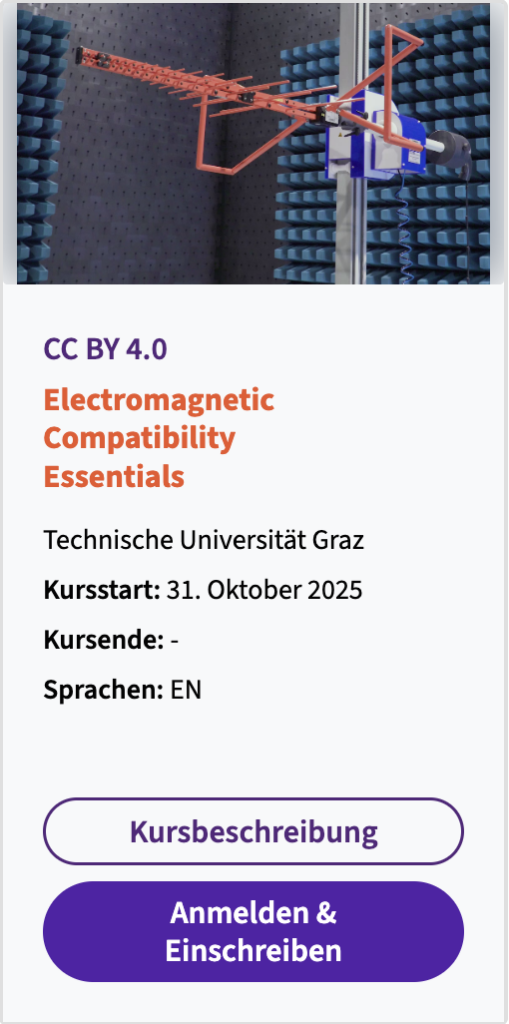
Warum spinnt mein Internet? Warum stoppt meine Bluetooth-Verbindung wenn ich USB4 verwende? Autsch! Ein Funken zwischen mir und meinem PC nachdem ich mich gesetzt hab; hält der PC sowas aus? All diese Szenarien haben eines gemeinsam: Elektromagnetische Verträglichkeit (EMV, engl.: EMC). Top-Forscher David Pommerenke und Bernd Deutschmann analysieren scheinbar hochkomplexe Situationen, um die Ursachen solcher Störungen aufzuzeigen. In diesem Kurs lernst du die heutige Welt der Hochfrequenz besser zu verstehen. Nur als Beispiel: Smartphone-CPUs takten mit Frequenzen von über 3 GHz. Wusstest du aber auch, dass dieses schnelle Schalten auch die Geräte in deiner Nähe stören kann? Im besten Fall sind diese Phänomene nur lästig, im schlimmsten Fall drohen jedoch Gefahren für uns Menschen sowie der wirtschaftliche Ruin. Deshalb existieren internationale Regulierungen, die Emissions- und Immunitätstests vorgeben, bevor ein elektronisches Produkt überhaupt verkauft werden darf. Das Thema EMV muss in allen Aspekten des Schaltungsdesigns berücksichtigt werden, um die Anzahl an Prototypen zu minimieren. Unser Ziel ist es, dir mithilfe von Laborexperimenten ein Gespür für EMV zu vermitteln. Dabei legen wir den Schwerpunkt auf grundlegende physikalische Prinzipien und verzichten auf hochkomplexe mathematische Ableitungen. Wusstest du, dass die TU Graz im Bereich Forschung und Lehre des Fachbereichs EMV international zu den besten Universitäten zählt? Wir publizieren regelmäßig in wissenschaftlichen Fachzeitschriften und sind bei den wichtigsten Konferenzen vertreten. Etwa ein Dutzend Vollzeitforscher sind an unserem Institut im Bereich EMV tätig: sei es experimentell im Labor, oder durch Simulationen am PC, bei denen auch maschinelles Lernen zum Einsatz kommt. Dieses Wissen möchten wir mit der Community teilen, da EMV für alle Elektronikingenieure bis hin zu Projektmanagern von Bedeutung ist. All das kannst du in deinem eigenen Tempo erkunden, es gibt keine Deadlines, und alles ist kostenlos. Tauche mit uns ein in die faszinierende Welt der EMV!
Der Trailer zum MOOC:
Mit dem Laden des Videos akzeptieren Sie die Datenschutzerklärung von YouTube. Mehr erfahren
Und schon sind wir in der sechsten und damit letzten Woche beim MOOC „Lehren und Lernen mit Medien II“. Unglaublich, wie schnell die Zeit immer vergeht 🙂 . Zum Abschluss geht es um offene und partizipative Lehr- und Lernkonzepte am Beispiel des problembasierten Lernens und ich selbst probiere mich an der Frage was denn die Zukunft von digitalen Bildungstechnologien so bringen könnte.
Hier das Video zu „Offene und partizipative Lehr- und Lernkonzepte“:
Mit dem Laden des Videos akzeptieren Sie die Datenschutzerklärung von YouTube. Mehr erfahren
Primär sind Lehramtsstudierende die Zielgruppe des MOOCs, aber natürlich darf jeder mitmachen der daran Interesse hat. Wir freuen uns, wenn möglichst viele von dem Angebot profitieren und mit uns gemeinsam die nächsten Wochen diskutieren. Die Anmeldung ist komplett kostenfrei, wie man es von iMooX.at gewohnt ist 🙂
Wir freuen uns, dass wir einen neuen Partner beim moochub.org begrüßen dürfen. Ab sofort sind auch die offen lizenziert Kurse von ORCA.nrw gelistet und erweitern das Angebot des deutschsprachigen Zusammenschlusses aller MOOC-Plattformen. Damit wir das Bildungsangebot erweitert und breiter sichtbar. Also herzlich willkommen und auf eine gute Zusammenarbeit.
Zuführung, Mischen, Granulierung (nass und trocken) und Tablettierung sind die grundlegenden Prozessschritte für die Herstellung einer Tablette. In diesem Kurs lernen Sie fortschrittliche Hochgeschwindigkeitstechnologien kennen, die die Herstellung von Medikamenten über kontinuierliche Prozesse ermöglichen, die in Echtzeit gesteuert werden.
Technologie ist ein unverzichtbarer Bestandteil der Gesundheitsversorgung. Untersuchungen zeigen jedoch, dass die Fähigkeiten von medizinischem Fachpersonal derzeit möglicherweise nicht auf dem neuesten Stand sind, um den Einsatz von Technologien in der Zusammenarbeit mit Patienten zu ermöglichen, und dass relevante Technologien noch nicht ausreichend implementiert werden. Der Kurs befasst sich mit der konstruktiven und kritischen Anwendung digitaler Technologien – konkret Smartphone Applikationen, Monitoring, Telemedizin und Virtuelle Realität – für Menschen mit akuten oder chronischen Schmerzen. Der Kurs besteht aus zwei Teilen: 1) MOOC-Lernaktivitäten (hier auf imoox.at) und 2) Ressourcen, die über die TECH2MATCH-Homepage verfügbar sind. Die Materialien sind kostenlos verfügbar und umfassen Lesematerial, Lernvideos, Quizze, interaktive Aktivitäten und reale Szenarien.
Mit dem Laden des Videos akzeptieren Sie die Datenschutzerklärung von YouTube. Mehr erfahren
Und schon sind wir in der dritte Woche beim MOOC „Lehren und Lernen mit Medien II„.
Diese Woche geht es zunächst um Computational Thinking und danach um Multimediale Lehr- und Lernunterlagen und erste Gestaltungshinweise, abschließend noch um die Gestaltung von digtialen Lehr- und Lernumgebungen.
Hier mein Video zu Multimediale und interaktive Lehr- und Lernunterlagen gestalten:
Mit dem Laden des Videos akzeptieren Sie die Datenschutzerklärung von YouTube. Mehr erfahren
Primär sind Lehramtsstudierende die Zielgruppe des MOOCs, aber natürlich darf jeder mitmachen der daran Interesse hat. Wir freuen uns, wenn möglichst viele von dem Angebot profitieren und mit uns gemeinsam die nächsten Wochen diskutieren. Die Anmeldung ist komplett kostenfrei, wie man es von iMooX.at gewohnt ist 🙂