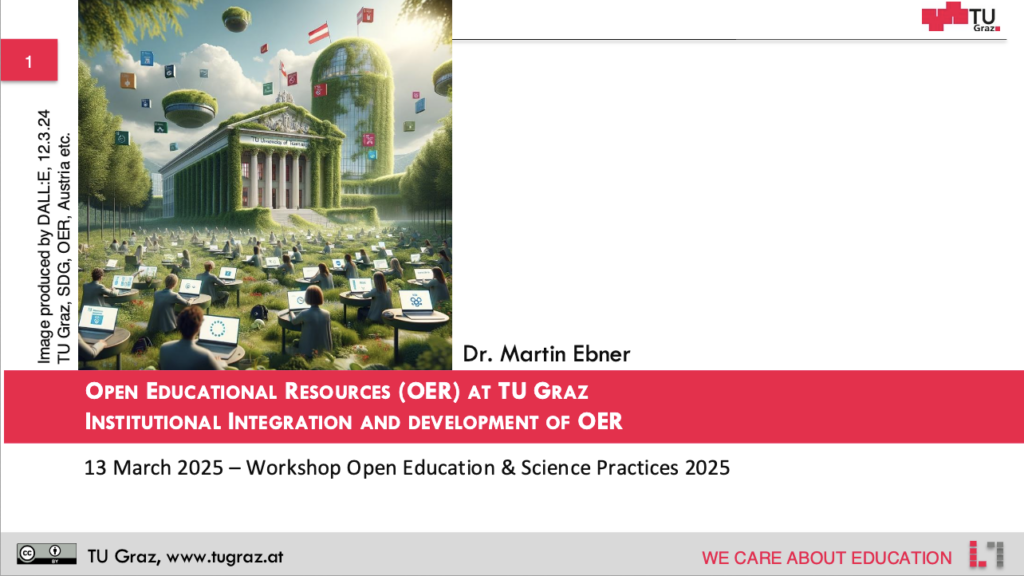
I did a second presentation at this year’s EDEN conference in Graz about „Usage of (Federated) Learning Management Systems in European University Alliances„. Find also my slides here:


Digitale Lehre an und rund um der Technischen Universität Graz
Im Rahmen einer Evening Lecture an der TU Wien wurde ich eingeladen über die Aktivitäten der TU Graz im Bereich microcredentials.at an der TU Graz zu berichten. Dem bin ich natürlich gerne nachgekommen und hier gibt es nun den Foiensatz dazu:

Proudly announcing that the video of our talk within the Aalto series about Open Science is online: We talked about OER in Austria, OER at TU Graz and the Unite! OER courses project (by me, Sandra Schön and Rubén Vincente-Saez) is now online:
Our MOOC on „Open Educational Resources in Higher Education“ for the European alliance UNITE! is reaching the last week – number 4 :-). This time we are discussing the role of OER within Open Science and strategies for implementation in higher education:
And don’t to forget to change the language, all videos are offered in 11 different languages: [free registration link to the open course]
Our MOOC on „Open Educational Resources in Higher Education“ for the European alliance UNITE! is reaching week three. This time we are discussing how to produce and publish OER and you can learn about the OER-Canvas. So I guess it will be interesting content and you can join us for free 🙂
And don’t to forget to change the language, all videos are offered in 11 different languages: [free registration link to the open course]
Our contribution titled „Supporting Sustainable and User-Oriented Educational Technology Innovation with the University Innovation Canvas“ was published in the newest issue of Education Sciences.
Abstract:
Innovating higher education teaching and learning is challenging due to structural, cultural, and resource-related reasons, and research indicates that university innovation benefits from a bottom-up approach as well as strategic alignment with university objectives. In this paper, we investigate such bottom-up innovation processes within higher education as supported by a specific tool: the University Innovation Canvas (UIC). Adapted from the Business Model Canvas and Lean Canvas, the UIC is designed to promote educational technology innovation and foster alignment of the innovation process with strategic objectives of the university: namely, sustainability and user orientation. An evaluation of the UIC based on interview and questionnaire data shows that its usage differs between innovation teams (on paper vs. digital, individual vs. collaborative, co-located vs. remotely, and synchronous vs. asynchronous). UIC usability is linked with these differences and with teams’ experience in realizing innovations. Overall, the UIC is perceived to be useful by (particularly, less-experienced) innovation teams and is successful at supporting sustainable and user-oriented innovations, as 14/15 innovations are still in use after up to four years since completion. To maximize its potential, more effort needs to be devoted to improving understanding of the UIC and supporting different workflows of innovation teams in the future.
[full article @ journal’s homepage]
[full article @ ResearchGate]
Reference: Bangerl, M.; Dennerlein, S.; Maitz, K.; Nitschke, M.; Ebner, M.; Pammer-Schindler, V. Supporting Sustainable and User-Oriented Educational Technology Innovation with the University Innovation Canvas. Educ. Sci. 2024, 14, 528. https://doi.org/10.3390/educsci14050528
Our MOOC on „Open Educational Resources in Higher Education“ for the European alliance UNITE! is reaching the second week. This time we are talking about how to find and use OER. There are some useful hints – so join us for free 🙂

And don’t to forget to change the language, all videos are offered in 11 different languages: [free registration link to the open course]
Jan hat in seiner Masterarbeit ein neues Peer-Review-Verfahren in der MOOC-Erstellung erstellt, getestet und erfolgreich umgesetzt. Nun hat er auch noch die Master-Defense gut bestanden – hier gibt es noch seine Folien:

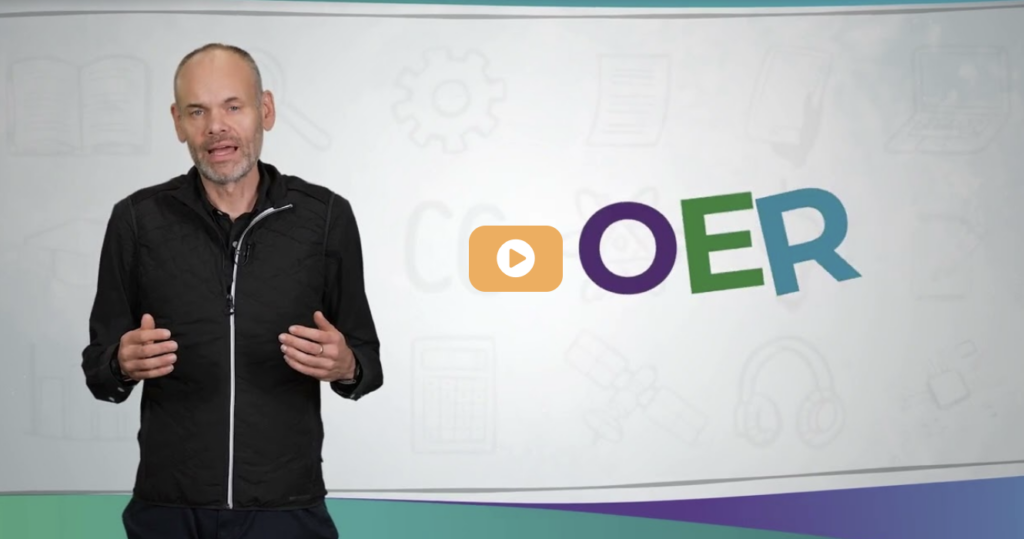
Es freut uns sehr, dass nach langer Vorbereitung es nun endlich soweit ist – der MOOC zu „Open Educational Resources in Higher Education“ startet und es ist ein MOOC mit vielen Besonderheiten, denn das Ziel ist hiermit eine Lehrveranstaltung im Rahmen der europäischen Allianz UNITE! anzubieten. Damit stehen wir unweigerlich vor der schwierigen Herausforderung verschiedenster Landessprachen, wenn wir nicht uns generell auf eine verständigen. Im Zeitalter künstlicher Intelligenz haben wir daher uns zu einem Experiment entschlossen – wir wollten die Videos in allen Landessprachen anbieten, vorgetragen von KI-generierten Avataren und unterstützt von KI-Software was die Übersetzungen betrifft. Wie gut uns das gelungen ist, kann man nun einsehen – also anmelden und mitmachen, wir hoffen ja auch, dass der Inhalt ansprechend ist.
Open Educational Resources (kurz OER) sind Bildungsmaterialien, die frei zugänglich sind und bearbeitet, angepasst und weitergegeben werden können, ohne gegen Urheberrechte zu verstoßen. Das gelingt, weil dazu sog. „offene Lizenzen“ oder gemeinfreie Materialien genutzt werden.
In diesem Kurs wird in das Konzept von Open Educational Resources für Studierende und Lehrende an Hochschulen eingeführt. OER sind nicht nur für internationale Vereinigungen wie UNESCO ein wichtiges bildungspolitisches Thema, OER sind auch ein Bestandteil der Forderung nach „Open Science“.
Im Kurs wird zudem gezeigt, wie und wo OER gesucht und veröffentlicht werden können. Und natürlich werden auch offene Lizenzen wie CC-0, CC BY und CC BY-SA erklärt.
Hintergrund dieses mehrsprachigen MOOC-Angebots ist das gemeinsame Projekt „Unite! OER courses“ aller neun Hochschulen der europäischen Universitätsallianz Unite!.
Das erste Video im MOOC (in der Sprache deutsch):
[Link zur kostenlosen Anmeldung]
WICHTIG: wenn man eine andere Sprache ausprobieren möchte, einfach im Menü die entsprechende wählen, die Videos werden dann automatisch in dieser Sprache zur Verfügung gestellt.
Und nein, weder Sandra noch ich sind einem dieser Videos zu sehen, es sind ausschließlich unsere Avatare 🙂