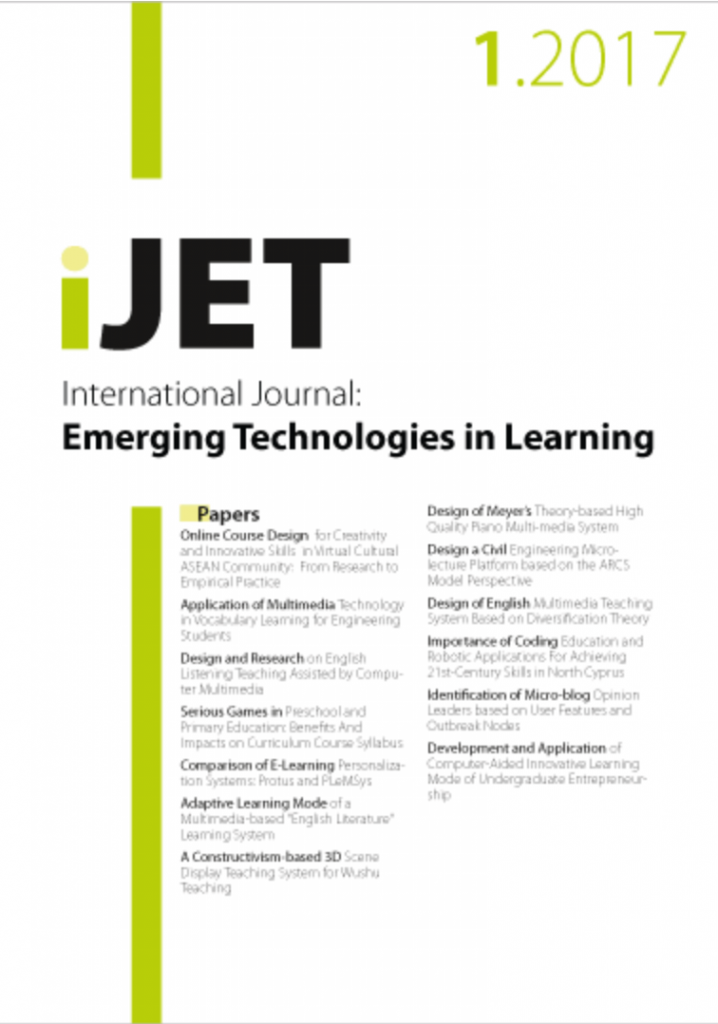
[ijet, journal] Journal of Emerging Technologies in Learning Vol. 14 / No. 12 #ijet #research

Issue 14(12) of our journal on emerging technologies for learning got published. Enjoy the readings as usual for free :-).

Table of Contents:

  • Formative E-Assessment and Behavioral Commitment of Students: Case of the Faculty of Science Ben M’sik
  • Automatic Generation and Evolution of Personalized Curriculum Based on Genetic Algorithm
  • MOOC Learning Behavior Analysis and Teaching Intelligent Decision Support Method Based on Improved Decision Tree C4.5 Algorithm
  • The Knowledge Repository Management System Architecture of Digital Knowledge Engineering using Machine Learning to Promote Software Engineering Competencies
  • Teaching Internship in Math Teacher Education
  • Intelligent Knowledge Service System Based on Depression Monitoring of College Students
  • College English Teaching Status and Individualized Teaching Design in The Context of Mobile Learning
  • Design and Implementation of a Teaching Assistance Platform for College Students Based on ASP.NET
  • Experimental Study on Neural Feedback in Embedded System Teaching Processing Based on ERP Signal Analysis
  • Design and Implementation of a College Teacher Training System Based on Client-Server Structure
  • Students Model in Different Learning Styles of Academic Achievement at the University of Phayao, Thailand
  • Influence of the Cognition of Student Entrepreneurs on Decision Making Based on Factor Analysis
  • Attention and its Role: Theories and Models
  • On Designing Blended Learning Environments for Resource-Challenged Communities

[Link to Issue 14/12]

Nevertheless, if you are interested to become a reviewer for the journal, please just contact me :-).

[presentation] Automatic Authentication of Students at an Interactive Learning-Video Platform #edil19 #edmedia19 #tugraz #video

Our fourth presentation at this year ED-Media 2019 conference in Amsterdam is about our research work about interactive videos. Here you can find the slides:

Klicken Sie auf den unteren Button, um den Inhalt von www.slideshare.net zu laden.

Inhalt laden

[presentation] A Pedagogical Framework for Mixed Reality in Classrooms based on a Literature Review #edil19 #edmedia19 #tugraz #research

Our second presentation at this year ED-Media 2019 conference in Amsterdam is about research work in Virtual Reality for education. This time we present a framework how we can cluster Augmented, Virtual and Mixed Reality scenarios for education. Find the slides here:

Klicken Sie auf den unteren Button, um den Inhalt von www.slideshare.net zu laden.

Inhalt laden

[presentation] Professor YouTube and Their Interactive Colleagues #edil19 #edmedia #tugraz #research

Our first presentation at this year ED-Media 2019 conference in Amsterdam is about our survey taken every year from the beginners. This time we also concentrate on YouTub and learning with videos. Here you can find the slides:

Klicken Sie auf den unteren Button, um den Inhalt von www.slideshare.net zu laden.

Inhalt laden

[ijet, journal] Journal of Emerging Technologies in Learning Vol. 14 / No. 11 #ijet #research

Issue 14(11) of our journal on emerging technologies for learning got published. Enjoy the readings as usual for free :-).

Table of Contents:

  • School Readiness From Kindergarten to Primary School
  • A Study of Applying Automated Assessment in Teaching College English Writing Based on Juku Correction Network
  • Innovation Technologies in Student’s Independent Activity and Creativity Development: The Case of Medical Education
  • Students’ Metacognitive Weaknesses in Academic Writing: A Preliminary Research
  • Exploring the Effectiveness of Glog in Language Learning
  • Evaluation of an Academic Program: The Case of Computing Accreditation Commission Framework in Higher Education
  • Skill-Centered Assessment in an Academic Course: A Formative Approach to Evaluate Student Performance and Make Continuous Quality Improvements in Pedagogy
  • Using Data Expedition as a Formative Assessment Tool in Data Science Education: Reasoning, Justification, and Evaluation
  • Understanding Language MOOC Learners: The Issue of Capability Development
  • A Cognitive Assistant that Uses Small Talk in Tutoring Conversation
  • A Novel Expert Evaluation Methodology Based on Fuzzy Logic
  • A Semantic Web Solution for Enhancing The Interoperability of E-learning Systems by Using Next Generation of SCORM Specifications
  • Organization of Student Project Based Activities through Individual Learning Routes
  • Proposed Model of Multiplayer Matching Game Plugins Using Websocket in Moodle
  • Flipped Classroom Method for the Teacher Training for Secondary Education: A Case Study in the University of Granada, Spain

[Link to Issue 14/11]

Nevertheless, if you are interested to become a reviewer for the journal, please just contact me :-).

Fachtreffen im Rahmen der Makerdays #makerdays #tugraz

Im Rahmen der Makerdays organisieren wir auch aufgrund der vielen Rückfragen ein Fachtreffen und zwar inmitten der Veranstaltungswoche am 7.8.2019 von 10-16.00 Uhr. Dann kann man sich gleich vor Ort überzeugen (lassen) wie die Workshops aussehen und welche kleinen Projekte wir gerade umsetzen mit den Kindern.

Interessierte Studierende, Lehrende und Personen aus dem Bereich Forschung und Wirtschaft sind herzlich eingeladen, die Bedeutung von Making-Aktivitäten und Makerspaces in der Bildung (von der Primarstufe bis zur Hochschule) im Rahmen des Fachtreffens zu diskutieren.

Dabei sollte natürlich auch das „Making“ nicht zu kurz kommen. Beim Fachtreffen können Sie in die Rolle einer Teilnehmerin/eines Teilnehmers der MAKER DAYS schlüpfen und all das ausprobieren, was Sie bei der Führung durch den Makerspace begeistert hat.

Es erwarten Sie kurze Fachvorträge von Martin Ebner, Kristin Narr, Sandra Schön und Maria Grandl.

Die Veranstaltung ist kostenfrei und wir freuen uns über jede Anmeldung: [Link zum Anmeldefomular]

LLT-Frühstück #tugraz #EducationalTechnology

Es freut mich, dass wir heute bereits zum zweiten Mal das LLT-Frühstück anbieten können für unsere Lehrenden an der TU Graz. Wir wollen hier die Idee eines Kurzinputs mit langem und interaktivem Austausch bei Kaffee wieder umsetzen. Morgen ist das zentrale Thema Open Educational Resources, die OER-Zertifizierung und damit verbunden die technische Umsetzung das „OER-Plugin“ im internen Moodlesystem.

fit4internet listet iMooX-Kurse #tugraz #imoox

Es freut uns sehr, dass die neugegründete Plattform fit4internet auch iMooX-Kurse in ihre Empfehlung mitaufgenommen hat. Das Ziel der Website wird dabei folgendemaßen beschrieben:

fit4internet hat sich dem Anheben der digitalen Kompetenzen verschrieben. Auf dieser Plattform können Sie das österreichische Kompetenzmodell verstehen, Ihren eigenen Kenntnisstand ermitteln, spielerisch Neues erfahren, passende Lernangebote finden – und weiterhin gut informiert bleiben. Als Kursanbieter können Sie Ihre Angebote zuordnen und bewerben. Außerdem erfahren Sie hier, wer als Mitglied oder Partner Aktivitäten zur Steigerung der digitalen Kompetenzen in Österreich unterstützt.

[iMooX-Kurse auf der fit4internet-Plattform]

[mooc] Demokratie MOOC / Teil 3 #imoox

Der iMooX Demokratie-MOOC geht nun in den dritten und letzten Teil. Wir freuen uns, wenn sie gemeinsam mit uns diese spannenden Inhalte erarbeiten, denn besonders in diesen Tagen ist das Demokratieverständnis wichtig:

Der Demokratie-MOOC stellt ein Curriculum für die demokratiepolitische Bildung dar, wobei die vollständigen Lehr- und Lernmaterialien zur Verfügung gestellt werden. So dient der MOOC einerseits der Weiterbildung von allen interessierten Personen, MultipliaktorInnen, KurserstellerInnen, LehrerInnen oder (Sozial-)PädagogInnen. Andererseits stellt der MOOC auch Materialien und Methoden zur Verfügung, damit sich die Teilnehmenden auch motiviert und in der Lage fühlen, Kurse, Unterricht oder Projekte zur Politischen Bildung zu entwickeln und anzubieten.

Die Anmeldung ist wie immer vollkommen kostenfrei: [Link zur Anmeldung]

[publication] Effects of a Mathematical Bridging Course #MOOC #imoox #MatheFit

Our contribution about „Effects of a Mathematical Bridging Course“ to this year eMOOCs conference in Naples got published now:

The secondary to tertiary transition is generally considered as problematic. Thereby, especially mathematics is a significant barrier for students of universities. The reasons are diverse and occur not least because of the changes in the school curriculum caused by the centralised school leaving examination. Subsequently, many universities and academies in the European area provide various approaches to work against the widely spread issue. In 2018, a free accessible online bridging courses for mathematics was designed by Graz University of Technology. The course is provided on the iMooX platform 1 and represents a form of technology-enhanced learning. The aim is to optimise the design of the course considering the needs of freshmen and freshwomen. Following the active course period, course participants take part in evaluations. The outcomes are investigated, which represents the empirical part of the paper. The online course receives positive feedback. As a consequence, it is recommended to continue the course offer within the next few years.

[Full article @ ResearchGate]

[Conference Proceeding eMOOCs 2019]

Reference: Reich, S., Ebner, M., Ebner, M. (2019) Effects of a Mathematical Bridging Course. Proceedings of EMOOCs conference, pp. 197-202, Naples (Italy)