[publication] Mobile Learning Applications for Android und iOS for German Language Acquisition based on Learning Analytics Measurements #LearningAnlytics #IdERblog

We did a contribution to the International Journal of Learning Analytics and Artificial Intelligence for Education (iJAI) titled „Mobile Learning Applications for Android und iOS for German Language Acquisition based on Learning Analytics

Abstract:
The use of digital media is increasingly being promoted in school teaching. Since this aspect changes the interaction between teachers and pupils, this research is concerned with the development of a prototype of a mobile application for Android and iOS, in which different learning applications for language acquisition are offered on the basis of learning analytical measurements provided by experts in the field. By logging and collecting interactions of the user, it is possible to create a variety of statistical evaluations and thus respond to the needs and weaknesses of students. For the evaluation of the application, a user experience test was carried out, whereby the child-friendly operation of the application was tested. Due to the very positive feedback, the design was found to be good and can therefore be further developed.

Journal’s homepage

[Link to full article @ ResearchGate]
[Link to full article @ journal’s homepage]

Reference: Friedl, Markus, Ebner, Markus, Ebner, Martin (2020) Mobile Learning Applications for Android und iOS for German Language Acquisition based on Learning Analytics Measurements. International Journal of Learning Analytics and Artificial Intelligence for Education (iJAI). 2(1). pp. 4-13

[publication] The Use of Gamification in Gastronomic Questionnaires

We did a short publication about „The Use of Gamification in Gastronomic Questionnaires“ for the International Journal of Interactive Mobile Technologies (iJIM).

Abstract:
Obtaining customer opinions and customer wishes is increasingly becoming an important part of any entrepreneurial activity for determining customer satisfaction and, subsequently, optimizing products and services as well as strengthen customer loyalty. In catering, there are several ways to capture the guest’s satisfaction or dissatisfaction, as well as customer preferences and customer needs across different channels. One way to obtain a customer’s opinion is to provide a digital online questionnaire. Unfortunately, the participation of guests in such surveys is usually low. In addition, many online questionnaires are aborted prematurely, and questions which require an individual text answer are often left unanswered. Gamification is a process to use game ele-ments, game techniques and game mechanics from games in a different context in order to motivate and force people to do certain activities. This paper discusses whether the use of game elements in an existing gastronomical online questionnaire enhances the engagement of users and whether customer satisfac-tion remains the same. Based on an existing gastronomical online questionnaire from the company ITELL.SOLUTIONS GmbH a gamified questionnaire vari-ant has been developed. Game elements such as points, badges, avatar, story, progress bar and instant feedback have been included. The investigation showed that the use of gamification in questionnaires on open questions did not worsen the involvement of users. The customer satisfac-tion remained unchanged by the embedding of game elements too. Users of the expanded game questionnaire tended to give more precise and longer answers. The completion time also slightly increased for the gamified questionnaire. A direct comparison between the two variants of the questionnaire, showed that users preferred the design of the gamified questionnaire.

Homepage iJIM

[article @ journal’s homepage]
[article @ researchgate]

Reference: Prott, D., & Ebner, M. (2020). The Use of Gamification in Gastronomic Questionnaires. International Journal Of Interactive Mobile Technologies (IJIM), 14(02), pp. 101-118. doi:http://dx.doi.org/10.3991/ijim.v14i02.11695

[app] TU Graz Search #android #app #development

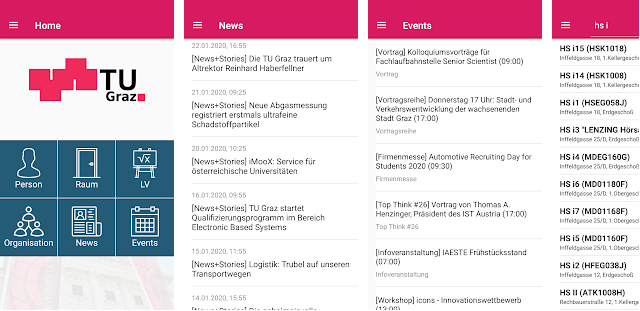
Im Rahmen einer Bachelorarbeit wurde die Android App „TU Graz Search“ überarbeitet bzw. eigentlich neu programmiert. Sie steht ab sofort zum Download bereit:

TU Graz Search App

TU Graz Search enables you to quickly search and find the most important information at Graz University of Technology. This search app includes the following categories:

• people,
• lecture halls and rooms,
• departments and service units,
• lectures,
• exams,
• research publications,
• library catalogue,
• events,
• news (RSS feeds), and
• web-sites.

Moreover, it is possible to add people to your contacts on you Android device or to contact them directly.

This app requires a connection to the Internet.

Google Play Store

[Download TU Graz Search App – Android]

[publication] Microblogging with Padlet: Students’ New Writing Experience on A2–B1 Common European Framework of Reference for Languages (CEFR) #microblogging #research

I did together with my colleagues from Indonesia a small piece of research about „Microblogging with Padlet: Students’ New Writing Experience on A2–B1 Common European Framework of Reference for Languages (CEFR)„.

Abstract:
This research work aims to answer the question, compared to conventional media, whether the use of Padlet as a microblogging platform can improve students‘ German writing skills for A2 – B1 level CEFR standard. Students in the class A wrote with conventional paper sheet. Meanwhile, students in the class B wrote essay writing assignment through the Padlet platform. The study took place in Malang, Indonesia and lasted for one semester. In summary 45 students participated. The pre-test data indicated that there is no difference in the results of the pre-test in the control class and experiment class. The post test scores were obtained from two writing assessments in both classes. The test results indicated the data value sig 0.326 in the ANOVA table, which means that there are no differences in the post-test results in the two classes. Thus, it was concluded that the use of Padlet in microblogging activities in writing did not affect the results of student writing scores. Nevertheless, the use of Padlet has not any disadvantages, whereas students get additonal digital skills and respond additionally positively to the use of Padlet.

Abstract of the publication

[Full article @ journal’s homepage]
[Full article @ researchgate]

Reference: Kharis, S., Ebner, M., Wijayati, P, Hidayat, E., Afifah, L. (2020) Microblogging with Padlet: Students’ New Writing Experience on A2–B1 Common European Framework of Reference for Languages (CEFR). International Journal of Emerging Technologies in Learning (i-JET), 15(1), pp. 176-187

[presentation] Mobile Learning Applications for German Language Acquisition #master #iderblog

Markus Friedl hat im Rahmen seiner Masterarbeit mobile Applikationen entwickelt, die es Kindern ermöglicht spezielle Übungen zur Erlernung der deutschen Sprache zu machen. Hier die Folien seiner Präsentation:

Klicken Sie auf den unteren Button, um den Inhalt von www.slideshare.net zu laden.

Inhalt laden

[workshop] Emerging technologies and emerging trends in education #tugraz #reserach

Im Rahmen des CAS eLearning Zertifikatkurses darf ich heuer eine neues Modul rund um „Emerging Technologies and Trends“ abhalten. Die dafür notwendigen Unterlagen sind hier nochmals übersichtlich dargestellt.


VORMITTAG: EMERGING TECHNOLOGIES – from social to mobile and seamless learning

Klicken Sie auf den unteren Button, um den Inhalt von www.slideshare.net zu laden.

Inhalt laden


NACHMITTAG: EMERGING TRENDS – Learning Analytics, Maker Education & Lernen mit Videos

Klicken Sie auf den unteren Button, um den Inhalt von www.slideshare.net zu laden.

Inhalt laden


Als weiterführende Literatur wird das Lehrbuch für Lernen und Lehren mit Technologien empfohlen mit den entsprechenden Kapiteln, sowie das Kapitel „Mobile Seamless Learning – Die nahtlose Integration mobiler Geräte beim Lernen und im Unterricht„.
Zur Info für Nicht-Teilnehmer/innen: Es handelt sich um einen ganztägigen Workshop.

[app] 1×1 Trainer #tugraz #math #ios #android

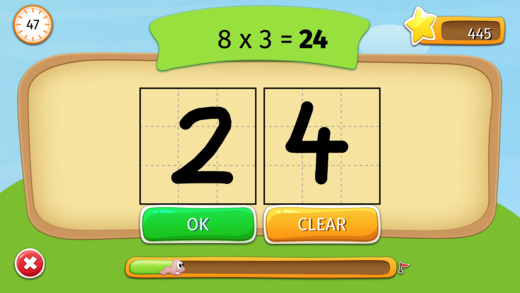
Wir haben den 1×1 Trainer grundlegend überarbeitet und mit Handschrifterkennung ausgestattet. Die iOS-Version für iPhone und iPad gibt es schon länger [iOS-Version], nun ist es aber auch die Android-Version verfügbar. Ab sofort können die Kinder also auch dort die Zahlen per Finger eingeben und wir hoffen so, dass es noch einfacher wird mit der App umzugehen. Die Registierung kann direkt in der App oder auch über unsere LearningLab gemacht werden.

The 1×1 Trainer App with handwriting recognition is supposed to help children with learning multiplication tables. The numbers can be written with the finger.

[Link zur iOS-App]
[Link zur Android-App]


[app] Plus-Minus Trainer #tugraz #learninglab

Es gibt wieder eine neue App im LearningLab der TU Graz – einen Plus-Minus-Trainer für Android-Endgeräte.

Plus-Minus Trainer is a learning software enabling children practicing additions and subtractions on a device running Android.
Multiple training modes are provided for this cause:

  • Online mode: Exercise written addition and subtraction. Tasks and Solutions are retrieved and respectively saved from a web server, located at https://schule.learninglab.tugraz.at/plusminus/.
  • Following modes do not need internet access. The difficulty of the randomly generated tasks can be changed in the application’s settings:
    • Plus-Minus mode: Solving of randomly generated written additions or subtractions.
    • Speed mode: Solving of randomly generated calculations within a timebox of 60 seconds including a high score list.
    • Tree mode: Solving of three randomly generated Calculations connected by a calculation tree.
    • Analogy mode: Solving of similar tasks (e.g. 5+2 and 2+5)
    • Symbolic addition: Solving of simple inline additions with auxiliary symbols.
    • Symbolic subtraction: Solving of simple inline subtractions with auxiliary symbols.

[Download app for free in Google play store]

[app] Multiplication Trainer #app #android #tugraz #trainer

We are happy to announce another learning app – the multiplication trainer for android. It is part of our math-trainer applications, which you can find here.

An educative game where you train your multiplication skills.
You can challenge your skills offline, and to play online, you need to create an account on „Learning Apps TUGraz“ ( https://schule.learninglab.tugraz.at/ ).
With each correct or incorrect answer, you will be prompted with feedback from the server that generated the assignment.
It will either congratulate you or tell you the right answer if you failed to give one.
The server keeps track of your personal statistics and gives you challenges appropriate to the skill level that you previously demonstrated.
The better you are, the harder is the challenge.

[App @ Google-Play-Store]

[iOS, Android] iMooX Coach ist in den Stores #imoox #app #ios #android

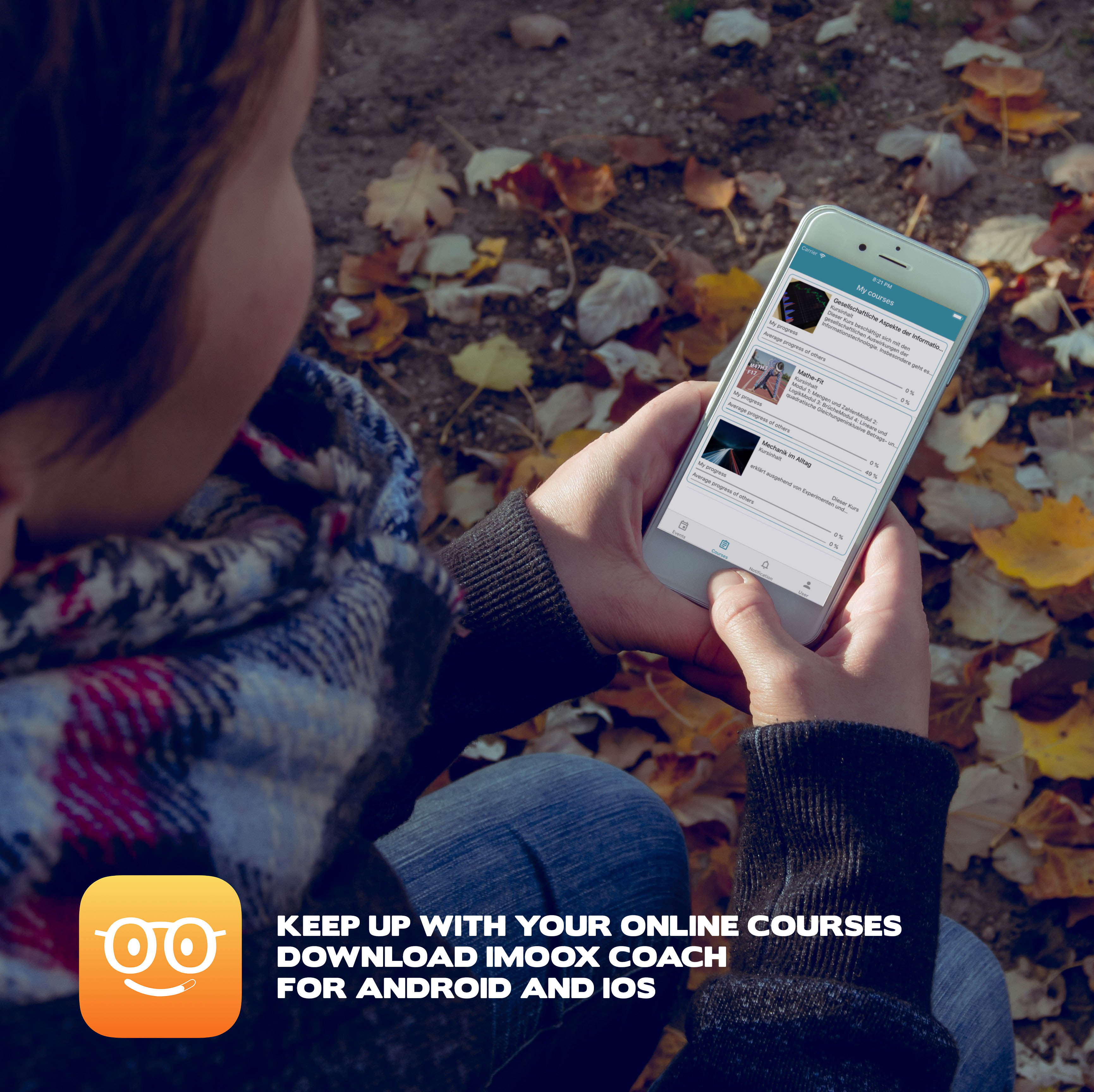
Es freut uns, dass rechzeitig zum Start des Sommersemester 2019 und den damit anstehenden MOOCs auch die Apps für Android- und iOS-Geräte nun verfübar sind. Damit wollen wir die Idee eines Lerntagebuchs für iMooX realisieren:

Die App behält einen Überblick über alle Ihre aktuellen Kurse, Termine und anstehenden Kurse. Außerdem kann die App, sofern Sie dies zulassen, Ihnen Benachrichtigungen und Erinnerungen schicken. Durch das eigene Hinzufügen von Terminen, Lernzielen und Notizen können Sie spielerisch Ihren Lernfortschritt antreiben.
Laden Sie jetzt die iMooX Coach App runter und behalten Sie Ihre Kurse als auch Ihren Lernfortschritt immer im Überblick.

[iMooX Coach im iTunes-Store]

[iMooX Coach im Android-Store]