[GADI14] Big Data & OER

[GADI14] Martin EbnerGADI 2014 - Prof. GerschIch darf heute, Mittwoch 21.05.2014, wieder herzlich aber auch leider zur letzten Vorlesung „Gesellschaftliche Aspekte der Informationstechnologie“ an der TU Graz einladen. Der nun schon wieder achte Termin 2014 besteht aus folgenden Vorträgen:

  • Martin Gersch: „Big Data: wie gut kann und sollte ich meine Nutzer kennen?
  • Martin Ebner: „OER – Warum offene Bildungsmaterialien zwingend für unser Bildungssystem sind

Die Vorträge werden live ab 16.15 Uhr gestreamt (bitte einmalig registrieren) – [Link zum Streamingserver]
Weitere Vorträge/Abstracts findet man hier auf der Vorlesungshomepage.

[publication] Development of a Collaborative Learning Game Using External Plastic Cards as an Input Device on an iPad

Our publication about „Development of a Collaborative Learning Game Using External Plastic Cards as an Input Device on an iPad“ in the International Journal of Interactive Mobile Technologies (iJIM) is now published.
Abstract:

This paper evaluates and describes the usage of plastic cards, coated with conductive paint, as an input device for capacitive touchscreens. By using the developed card prototypes it should be proofed, that usage of this new kind of input device can be handled by primary school pu- pils in a collaborative learning game. For this reason an educative digital learning game has been developed which can be controlled by the card prototypes. The game asks questions of general knowledge and the answer can be given by putting the proper plastic card on the touchscreen.
The evaluation of the game by two groups of four children pointed out, that the cards can be easily used to identify a specific user. Although evaluation shows that the card con- trol has weaknesses to reliably detect the correct answer during the game phase. All pupils enjoy to play the game and they additionally state, that they like the usage of the cards.
Beside the problems with a reliable card recognition the evaluation shows that the collaborative concept of the game is promising due to the fact that the pupils are always work- ing together on finding a solution for the answer. Further they support each other in handling and understanding the plastic cards which leads to a deeper understanding of the technical backgrounds.

[Link to the full article (logged in mode only)]
Reference: Lexow, S., Ebner, M. (2014) Development of a Collaborative Learning Game Using External Plastic Cards as an Input Device on an iPad, International Journal of Interactive Mobile Technologies (iJIM), Vol. 8, Nr. 2, p. 12-17

[GADI14] Green IT & Das digitale Ich

GADI14 - Wolfgang SchinaglGADI 14 - Rüdiger WetzlIch darf heute, Mittwoch 14.05.2014, wieder herzlich zur Vorlesung „Gesellschaftliche Aspekte der Informationstechnologie“ an der TU Graz einladen. Der nun schon siebte Termin 2014 besteht aus folgendenden Vorträgen:

  • Rüdiger Wetzl: „Problematiken und Chancen in der Beschaffung und Entsorgung von Elektronikgeräten
  • Wolfgang Schinagl: „Das Ich – Personale Identität zwischen Vermassung und Individualität im digitalen Zeitalter

Die Vorträge werden live ab 16.15 Uhr gestreamt (bitte einmalig registrieren) – [Link zum Streamingserver]
Weitere Vorträge/Abstracts findet man hier auf der Vorlesungshomepage.

[publication] Aligning Web Collaboration Toolswith Research Data for Scholars

Our publication at this year first workshop on Big Scholarly Data (BigScholar) at the 23rd International World Wide Web Conference (WWW) about „Aligning Web Collaboration Toolswith Research Data for Scholars“ is now online available as draft.
Abstract:

Resources for research are not always easy to explore, andrarely come with strong support for identifying, linking andselecting those that can be of interest to scholars. In thiswork we introduce a model that uses state-of-the-art seman-tic technologies to interlink structured research data anddata from Web collaboration tools, social media and LinkedOpen Data. We use this model to build a platform thatconnects scholars, using their profiles as a starting point toexplore novel and relevant content for their research. Schol-ars can easily adapt to evolving trends by synchronizing newsocial media accounts or collaboration tools and integratethen with new datasets. We evaluate our approach by ascenario of personalized exploration of research repositorieswhere we analyze real world scholar profiles and comparethem to a reference profile.

Aligning Web Collaboration Tools with Research Data for Scholars by Martin

Klicken Sie auf den unteren Button, um den Inhalt von www.scribd.com zu laden.

Inhalt laden

Reference: De Vocht, L., Softic, S., Mannes, E., Ebner, M., Van de Walle, R. (2014) Aligning Web Collaboration Tools with Research Data for Scholars, In: Proceedings of the first workshop on Big Scholarly Data (BigScholar), 23rd International World Wide Web Conference (WWW), Seoul, p. 1203 – 1210

[recording] Content-Strategie & Digital Natives

Die Aufzeichungen vom 09.04.2014 aus der heurigen Vorlesung „Gesellschaftliche Aspekte der Informationstechnologie“ sind nun verfügbar.

  1. Heinz Wittenbrink: Content-Strategie und Webentwicklung
  2. Klicken Sie auf den unteren Button, um den Inhalt von curry.tugraz.at zu laden.

    Inhalt laden

  3. Martin Ebner: Digital Natives – seid ihr alle anders?
  4. YouTube

    Mit dem Laden des Videos akzeptieren Sie die Datenschutzerklärung von YouTube.
    Mehr erfahren

    Video laden

[book, o3r] Das OER-Schulbuch

Das OER-SchulbuchBand 8 der Buchserie „Beiträge zu offenen Bildungsressourcen (O3R)“ ist nun online bzw. als Printversion erhältlich. Gernot Vlaj stellt dafür seine Diplomarbeit zur Verfügung mit dem Titel „Das OER-Schulbuch: Machbarkeitsstudie zum Einsatz / zur Umsetzung von Schulbüchern als freite Bildungsressource„. Er hat sich intensiv damit auseinandergesetzt ob das Schulbuch unter einer offenen Lizenz generell möglich ist und welche Auswirkungen es auf das gesamte System hätte.

Digitalen Lehr- und Lernunterlagen gehört die Zukunft. Der Weg dorthin ist allerdings voller Herausforderungen, die es zu bewältigen gilt. Ein erster Schritt wäre das Schulbuch, ein Medium welches sehr weit verbreitet ist, aus dem analogen Zeitalter in das digitale zu bringen. Die vorliegende Forschungsarbeit wird zeigen, dass dieses Vorhaben in erster Linie aus rechtlicher Sicht aktuell nicht so einfach umsetzbar ist. Sowohl in Österreich als auch in Deutschland sind bei den derzeitigen urheberrechtlichen Bedingungen, die Vorteile eines digitalen Schulbuchs nur eingeschränkt nutzbar. Eine Lösung wird hier mit Open Educational Resources (OER = freie und offene Bildungsressourcen) angedacht.

[Buch bei Amazon]

[Das OER-Schulbuch bei O3R]

[lecture] Seminar Technology Enhanced Learning – Einheit 4

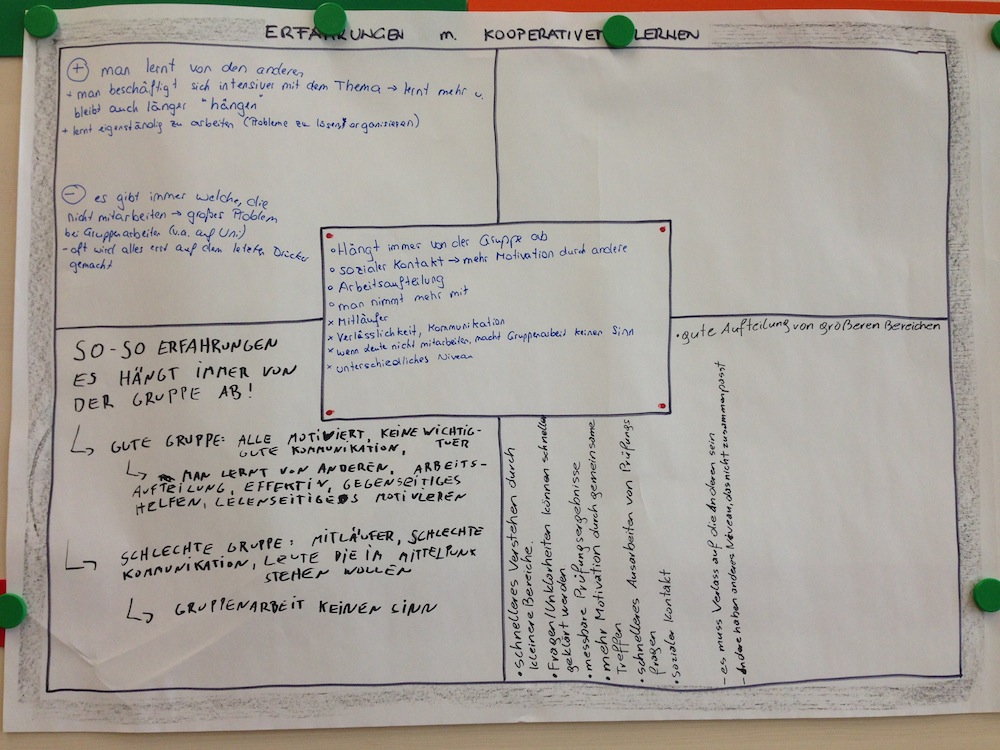
Die vierte Einheit des Seminar über „Technology Enhanced Learning“ beschäftigte sich mit Lehr- und Lernräumen. Ziel war es in etwa 2,5h zu erarbeiten was aus Sicht der Studierenden ein zukünftiger Raum unbedingt enthalten sollte:

Klicken Sie auf den unteren Button, um den Inhalt von www.slideshare.net zu laden.

Inhalt laden
TEL - Einheit 4

[GADI, recording] Enterprise 2.0 und MOOC

Die Aufzeichungen vom 02.04.2014 aus der heurigen Vorlesung „Gesellschaftliche Aspekte der Informationstechnologie“ sind nun verfügbar.

  1. Alexander Stocker: Enterprise 2.0
  2. Klicken Sie auf den unteren Button, um den Inhalt von curry.tugraz.at zu laden.

    Inhalt laden

  3. Michael Kopp: MOOCs: Flirt, One Night Stand oder Lebens(abschnitts)beziehung?
  4. Klicken Sie auf den unteren Button, um den Inhalt von curry.tugraz.at zu laden.

    Inhalt laden

[publication] Offering cMOOCs Collaboratively: The COER13 Experience from the Convenors’ Perspective

Our publication on „Offering cMOOCs Collaboratively: The COER13 Experience from the Convenors’ Perspective“ was not only published in the proceeding of the eMOOCs conference, but also as part of the Special Issue of the eLearning Papers Issue 37, titled „Experiences and best practices in and around MOOCs„.

[Link to the Article]

Reference: Arnold, P., Kumar, S., Thillosen, A. & Ebner, M. (2014) Offering cMOOCs collaboratively: The COER13 experience from the convenor’s perspective, In: eLeanrning Papers, 37, pp. 63-68