Rückschau GMW 2008

Klar, nachdem ich ja an der GWM 2008 teilgenommen habe, muss ich zumindest eine kurze Zusammenfassung schreiben.
Sehr positiv und großes Lob an die Veranstalter – ich habe noch keine Konferenz erlebt mit einem derartig schnellen WLAN Netz UND offenen LAN-Dosen. Gratulation, dass war vorbildlich und das sollte wirklich bald Standard sein.
Inhaltlich ist mir besonders die Keynote von Tom Reeves in Erinnerung welcher vorallem den Begriff „conative domain“ aufgreift und eine starke Bewegung der Bildungsinstitutionen in diese Richtung fordert. Man sollte das auf alle Fälle im Auge behalten.
Weiters waren wir auch sehr aktiv eingebunden bei dieser Konferenz und dank meines Kollegen Walther gibt es einige visuelle „Erinnerungen“ daran.

[publication] The TUGLL-Plug-ins: Special Needs for a University Wide Blogosphere

The paper we presented at the Triple-I Conference is now online available. Poster is already online.
Abstract:

This paper presents extensions that have been programmed by the Department Social Learning (DSL) at Graz University of Technology (TU Graz) for a blogosphere used at TU Graz called TU Graz LearnLand (TUGLL) on base of the open source software ELGG. These extensions are useful upgrades to the system following the demands of the pedagogical straof the TU Graz. A description of the extensions and didactical considerations are discussed.

Reference: Ebner, M., Taraghi, B., Nagler, W. (2008) The TUGLL-Plug-ins: Special Needs for a University Wide Blogosphere Proceedings of I-Know08 and I-Media08, 6th International Conference on Knowledge Management and New Media Technology, edited by Maurer, H. and Tochtermann, K.,Graz, p.453-456, ISSN 0948-695x

[publication] What’s the Power behind 2D Barcodes? Are they the Foundation of the Revival of Print Media?

The publication about the QR-Codes at the Triple-I Conference is now online available. The slides are already online.
Abstract:

2D barcodes are capable of storing different kind of data. A significant number of new mobile phones come with a built-in camera. These technologies together with the fact that mobile phones are next to the owner most of the time are the foundation of a variety of interesting applications. In Japan more than 75% of all mobile phones do have already a pre- installed barcode reader, that allows the user to decode the incorporated information of a barcode. This procedure can be used to improve the user experience while simplifying the input of data into the mobile device. These 2D barcodes can be used to exchange information between mobile phones and to connect to the mobile web. These days the Western World is gaining interest in this technology. In this paper the most importantThe relevance to print media and the advertising industry is shown.

Reference: Schmidmayr, P., Ebner, M., Kappe, F. (2008) What’s the Power behind 2D Barcodes? Are they the Foundation of the Revival of Print Media?, Proceedings of I-Know08 and I-Media08, 6th International Conference on Knowledge Management and New Media Technology, edited by Maurer, H. and Tochtermann, K.,Graz, p.234-242, ISSN 0948-695x

[poster] TUGLL Plug-ins: Special Needs for a University Wide Blogosphere

Today we present during the poster session of the triple-i conference in graz our short paper about „TUGLL Plug-ins: Special Needs for a University Wide Blogosphere„.
We introduce to our ELGG-based TU Graz LearnLand which is used university-wide and point out our own developments:

TUGLL is the campus wide blogosphere used by students and staff at Graz University of Technology since october 2006. It bases on ELGG which is an open source networking engine designed to
handle common web applications and social functionality. Users can establish digital identities and connect with other users, collaborate with them and discover new resources through their
connections. Following plug-ins and extension were implemented to enhance the blogosphere with “special needs”by department of social learning after a year of experience.

Here you can get the poster (.pdf, 6.1MB). The short paper will follow soon.

Beni’s talk can be seen here – I streamed it live via QIK:

Zertifikat eLearning Kurs: Web 2.0 und E-Learning 2.0

Zertifikat e-LearningDie TU Graz wird ab heuer am Zertifikat eLearning als Partner teilnehmen. Das Zertifikat eLearning kann folgendermaßen beschrieben werden:

Das Zertifikat eLearning ist eine gemeinsame Initiative von Universitäten, Fachhochschulen und regionalen Bildungsverbänden mit dem Ziel, ihren Bediensteten bzw. Mitgliedern eine fundierte Weiterbildung im Bereich eLearning und Neue Medien zu bieten. Die teilnehmenden Organisationen tauschen dabei Kursplätze und Online-Materialien, d.h. öffnen geeignete Kurse für TeilnehmerInnen aus Partnerinstitutionen und anerkennen die Teilnahmebestätigungen bzw. Zeugnisse solcher Kurse. Das Zertifikat eLearning ist auch ein gegenseitig anerkanntes Zeugnis, das nach Absolvierung der vorgesehenen Kurse ausgestellt werden kann.

Ich werde ein Seminar zum Thema „Web 2.0 und E-Learning 2.0“ anbieten und hoffe natürlich, dass es auf Interesses stößt. Wer also teilnehmen möchte findet hier mehr Details.

[publication] Will e-Learning die?

Will eLearning die?I wrote toegether with Mandy Schiefner an article about the future of e-Learning one year ago – now the article is published as chapter of the book „E-Learning: 21st Century Issues and Challenges„. Here you will find the draft-version.
Abstract:

The World Wide Web is currently changing dramatically. The buzzword Web 2.0 describes how we deal with the Internet. “The user is the content” is one of the famous descriptions. Users create their own (learning) content by blogging, podcasting or producing mashups. Of course the innovations summed up with the word Web 2.0 influence the traditional e-learning world.
In this paper we focus on how learning will change in the future. The combination of traditional research work combined with emerging technologies lead to an assumption of the learning behaviour of tomorrow. Will today’s teaching soon be a matter of the past? How will a lecture looks like by integrating emerging technologies? We conclude that information anytime and anywhere influences the world of digital natives arbitrarily and causes the death of e-Learning in present sense. Using computer and mobile technologies for learning purposes will be as normal as writing a letter with pencil

Reference for citation: Ebner, M. and Schiefner, M. (2008) Will E-Learning die?;in: E-Learning: 21st Century Issues and Challenges, Audrey R. Lipshitz and Steven P. Parsons (Ed.), Nova Publishers, pp. 69-82, 2008, ISBN: 978-1-60456-156-2

[video] Totally Wired: What Teens and Tweens Are Really Doing Online

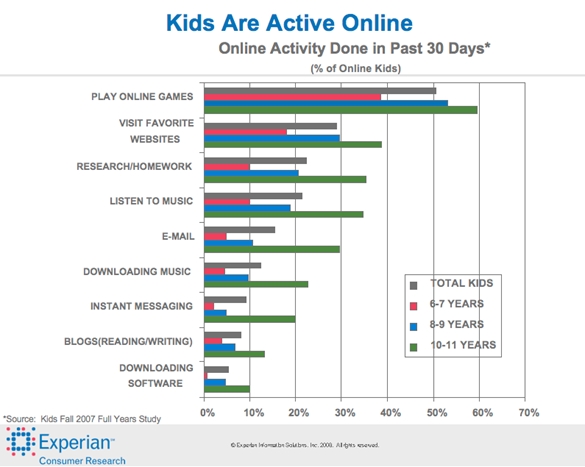
Anastasia Goodstein hat ein Buch mit dem Titel „Totally Wired: What Teens and Tweens Are Really Doing Online“ verfasst, indem sie die veränderte digitale Welt der Jugendlichen darstellt und diskutiert.
Sie stellt in einer Lesung ihr Werk vor und folgende Punkte schienen mir beachtenswert:

  • Digitales Leben ist für Jugendliche normal, selbstverständlich und nicht mehr wegzudenken (oh my god, how should i do my homework“)
  • Es ist zu beobachten, dass das Leben der Jugendlichen immer mehr öffentlich wird, zum Teil ist es bewusst und gewollt, zum anderen mangelt es an Erziehung
  • Die Bewertung von Online Information wird immer wesentlicher
  • Anastasia betont, dass Eltern darauf achten sollen, dass Kinder/Jugendliche nicht zu lang online sind. Es sollten also Grenzen gesetzt werden.
  • Auch die Rolle des Lehrers wird angesprochen und dass es hier ungenügende Schulungen im Umgang mit Technologie gibt

Alles in allem ist ihr Recht zu geben und man kann nur immer wieder betonen das Thema Technologie und Medien sehr Ernst zu nehmen in Bezug auf die Erziehung unserer Kinder.
Nun aber das Video:


(via Moving at the Speed of Creativity)