Im Rahmen der Abschlusstagung des Projekts „INTER-DI-KO – Unterrichtskonstellationen vor dem Anspruch von Digitalisierung und Medienbildung“ an der PH Salzburg durfte ich eine Keynote halten mit dem Titel „Wenn KI (Schul-) Alltag ist, dann …„. Hier gibt es gerne meine Folien dazu:
Abstract: This review explores the role of chatbots in education through a detailed literature review of 60 records. As chatbots become increasingly embedded in students‘ daily lives, their presence in primary, secondary, and tertiary education is expanding rapidly. By analyzing the selected papers, this review highlights both the opportunities and challenges faced by educators and students when using chatbots. The findings indicate that the integration of AI in education offers significant potential but requires careful consideration. In particular, the study emphasizes the need for improved teacher and student training, updated policies, and effective assessments to maintain academic integrity and enhance learning outcomes.
Reference: Gregorac, A., Brünner, B. & Ebner, M. (2025). Chatbots in Education: A Systematic Rapid Literature Review. In Proceedings of SITE 2025 (pp. 588-593). Waynesville, NC USA: Association for the Advancement of Computing in Education (AACE). Retrieved March 24, 2025 from https://www.learntechlib.org/primary/p/225579/.
Zusammenfassung: Unsere Hochschule ist ein Ort der Vielfalt und Heterogenität. Bezüglich der Diversität beim Vorwissen unserer Studienanfänger:innen spielen Individualisierung und gezielte Förderung eine wichtige Rolle. In diesem Beitrag geben wir Einblick in die Implementierung eines generativen KI (genKI) Chatbots für Studienanfänger:innen im Fachbereich Informatik an der TU Graz.
Der dritte OER-Bericht der TU Graz gibt einen Überblick über die Entwicklungen im Bereich Offene Bildungsressourcen (OER) im Zeitraum 10/2023 bis 09/2024. Die TU Graz baut ihre Aktivitäten in diesem Bereich weiter aus und nimmt sowohl national als auch international eine Vorreiterrolle ein. Ein besonderer Fokus liegt auf quantitativen Entwicklungen im OER-Bereich, z.B. zur Entwicklung von Weiterbildungsangeboten, des OER-Repositorium oder auch der Entwicklung der nationalen MOOC-Plattform iMooX.at die von der TU Graz betrieben wird. Zudem wird von Befragungen von OER-Lehrenden an der TU Graz berichtet und Auswertungen einer Befragung von Studienanfänger:innen zu OER und Open Source präsentiert. Im internationalen Kontext engagiert sich die TU Graz in der europäischen Universitätsallianz Unite!, in deren Rahmen unter anderem der multilinguale MOOC „Unite! OER Courses“ entwickelt wurde. Zusätzlich wurde eine internationale Lehrveranstaltung zu OER konzipiert.
Der Bericht kann direkt hier im Repository abgerufen werden oder man findet ihn auch auf unserer Webseite zusammen mit den beiden voran gegangenen.
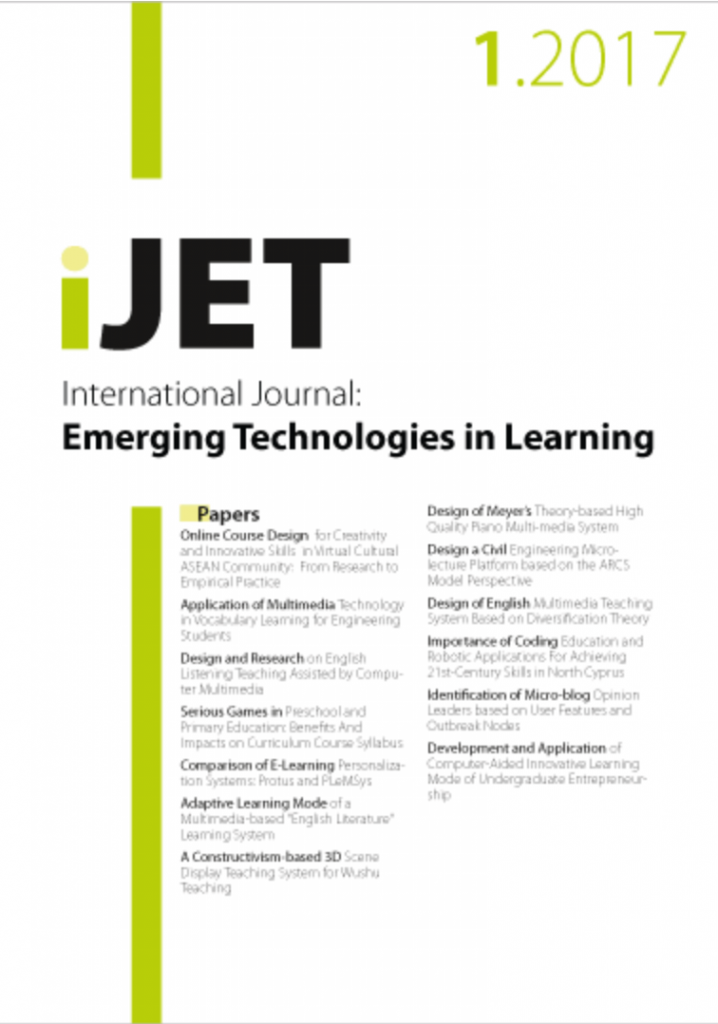
Issue 20(01) of our journal on emerging technologies for learning got published. Enjoy the readings as usual for free :-).
Table of Contents:
Enhancing University Education Quality through MOOCs: Effective Learning Strategy Combinations and Pedagogical Innovations
Evaluating Cognitive Aspects of ADHD Students Using Brain-Computer Interface and a Digital Game: A Study in Brazil
Needs Analysis from Teachers’ Experiences in Online Academic English Writing Model for Chinese EFL College Students
Research in Online Teacher Professional Development: A Systematic Mapping Review
Comparing Students’ Perspectives on Online Learning during the COVID-19 Pandemic: A Cross-Cultural Study of Undergraduate Students in the U.S. and Saudi Arabia
Es freut uns sehr, dass wir die erste österreichische Präsenzbühne beim University Future Festival sein dürfen und das auch noch mit dem Thema KI-Anwendungen für Hochschulen. Das 3-tägige Programm ist digital komplett zugänglich und auch unsere Bühne am 13.5.2025 wird live in den D-A-CH Raum gestreamt, dennoch freuen wir uns wenn viele auch vor Ort mit uns diskutieren wollen. Zwei spannende Keynotes, Vorträge, Workshops und auch künstlerische Darbietungen erwarten euch.
We wrote a short work-in-progress publication about „Work-in-Progress: Key Prerequisites for IT Infrastructures for Learning and Teaching of the European University Alliance “Unite!”
Abstract: In the dynamic landscape of higher education, digital technologies are crucial for fostering collaboration and knowledge dissemination. European universities are embracing this shift through “European Universities”, transnational alliances aimed at enhancing academic exchange and innovation. The Unite! alliance, as part of its Erasmus+ project, established the “Community Digital Campus” (Cm.2) to develop a modern digital campus framework. Based on an analysis to identify and document the technological, organizational, and legal needs for such a campus, using desk research, surveys, and stakeholder discussions, key requirements are formulated. Key requirements identified include ensuring interoperability among digital infrastructures, robust decision-making processes for IT, strategic support for existing systems, and addressing budgetary considerations for federated systems.
Reference: Ebner, M. et al. (2025). Work-in-Progress: Key Prerequisites for IT Infrastructures for Learning and Teaching of the European University Alliance “Unite!”. In: Auer, M.E., Rüütmann, T. (eds) Futureproofing Engineering Education for Global Responsibility. ICL 2024. Lecture Notes in Networks and Systems, vol 1260. Springer, Cham. https://doi.org/10.1007/978-3-031-85652-5_34
Im Rahmen der OPENess Initiative der TU Graz durfte ich die Services rund um Open Educational Resources vorstellen. Hier gibt es noch die zugehörigen Folien:
We wrote an article titled „The Synergy of Educational Technologies and Self-regulated Learning: A Systematic Scoping Literature Review“ that strongly focused on self-regulation in learning. Read more here at the ed-tech.at-Blog.
Abstract: The rapid advancement of artificial intelligence (AI) technology necessitates addressing the topic of self-regulated learning (SRL) given its potential for personalized learning experiences. Educational Technologies (EdTech) have the capacity to facilitate SRL within educational contexts, particularly in remote learning scenarios. This study explores the interplay between EdTech and SRL, highlighting their synergistic relationship. Through a systematic scoping literature review following the methodology of Peters et al., evidence from 328 records in the Scopus database was synthesized, with an analysis of 112 reports meeting the inclusion criteria published between January 2015 and February 2024. Zimmerman’s cyclical phases model emerged as the predominant SRL framework in connection with EdTech. Additionally, the identified EdTechs were categorized into eleven clusters based on shared characteristics and mapped onto Zimmerman’s SRL model to create an EdTech-SRL-Synergy-Map. Recommendations are made for future research, particularly in the secondary education sector, and the significance of SRL practices in an educational landscape permeated by AI is emphasized.
Reference: Brünner, B., Burgsteiner, H., Schön, S., Ebner, M. (2025). The Synergy of Educational Technologies and Self-regulated Learning: A Systematic Scoping Literature Review. In: Auer, M.E., Rüütmann, T. (eds) Futureproofing Engineering Education for Global Responsibility. ICL 2024. Lecture Notes in Networks and Systems, vol 1261. Springer, Cham. https://doi.org/10.1007/978-3-031-85649-5_30
Open Educational Resources (OER) are widely recognized for improving access to education and enabling the sharing of knowledge. However, in the context of European university alliances, such as Unite!, OER offer additional, often underappreciated benefits that are crucial for cross-border collaboration and sustainable development in higher education. This position paper explores three key aspects of OER that are particularly relevant for European alliances. First, OER enable the legally secure use of educational resources across national borders, addressing uncertainties about copyright laws, particularly for translations and adaptations. This ensures compliance with different legal frameworks while fostering collaboration. Second, OER support sustainability by ensuring that investments in educational materials are not limited by restrictive usage rights. This is particularly critical in alliances where shared resources play a central role in fostering long-term cooperation and aligning with sustainability goals, a priority for Unite!. Finally, OER contribute to digital sovereignty by empowering institutions and educators to create, adapt, and share resources without reliance on proprietary platforms or licenses. This aligns with the broader strategic objectives of European alliances to promote autonomy and resilience in their digital ecosystems. By highlighting these often-overlooked benefits of OER, this research aims to broaden the perspective on their strategic importance in fostering collaboration, sustainability, and sovereignty within European university alliances.
Ebner, M., & Schön, S. (2025, März 13). Beyond Open Access: Open Educational Resources (OER) for Legal Clarity, Sustainability, and Digital Sovereignty in European University Alliances. Presentation at the Unite! Ed Future Conference, March 13, 2025. Graz University of Technology. https://doi.org/10.3217/cz2rm-g9g13