[publication] Tutoring writing spelling skills within a web-based platform for children #iderblog #LearningAnalytics

Our publication about „Tutoring writing spelling skills within a web-based platform for children“ got published. We are describing our research project IDERblog and the results using learning analytics.

Abstract:

According to the NMC Horizon Report (Johnson et al. in Horizon Report Europe: 2014 Schools Edition, Publications Office of the European Union, The New Media Consortium, Luxembourg, Austin, 2014 [1]), data-driven learning in combination with emerging academic areas such as learning analytics has the potential to tailor students’ education to their needs (Johnson et al. 2014 [1]). Focusing on this aim, this article presents a web-based (training) platform for German-speaking users aged 8–12.Our objective is to support primary-school pupils—especially those who struggle with the acquisition of the German orthography—with an innovative tool to improve their writing and spelling competencies. On this platform, which is free of charge, they can write and publish texts supported by a special feature, called the intelligent dictionary. It gives automatic feedback for correcting mistakes that occurred in the course of fulfilling a meaningful writing task. Consequently, pupils can focus on writing texts and are able to correct texts on their own before publishing them. Additionally, they gain deeper insights in German orthography. Exercises will be recommended for further training based on the spelling mistakes that occurred. This article covers the background to German orthography and its teaching and learning as well as details concerning the requirements for the platform and the user interface design. Further, combined with learning analytics we expect to gain deeper insight into the process of spelling acquisition which will support optimizing our exercises and providing better materials in the long run.

[Full Publication @ Springer Nature (Open Access)]

[Publication @ ResearchGate]

Reference: Ebner, M., Edtstadler, K., Ebner, M. (2017) Tutoring writing spelling skills within a web-based platform for children. Universal Access in the Information Society (2017). doi:10.1007/s10209-017-0564-6

[report] Erweiterung der Hörsaal-Infrastruktur #tugraz #tube #aufzeichnung

Im Rahmen eines Hochschulraumstrukturmittel-Projekts (kurz HRSM) versuchen wir zusammen mit der Universität Graz und der Medizinuniversität Graz unsere Hörsaalinfrastruktur in Hinblick auf automatiserte Aufzeichnungen zu erweitern. Das schließt unter anderem auch Weiterbildungsangebote und auch die Videoplattform TUbe mitein. Dazu hab ich einen kurzen Artikel in unserer TU-Graz-weiten Zeitschrift TU Graz people gemacht.

Abstract:

Lehrende können ab sofort in fünf weiteren Hörsälen auf den Campus- Bereichen Alte Technik und Inffeldgasse ihre Lehrveranstaltungen automatisch aufzeichnen und ihren Studierenden zur Verfügung stellen.

[Link zur Zeitschrift]

Zitation: Ebner, M. (2017) Erweiterung der Hörsaal-Infrastruktur. TU Graz people. 61 (2017-1). S. 7

[master] Feldstudie zum Einsatz von Lehrveranstaltungsaufzeichnungen #tugraz #recording

Michael Karner hat sich im Rahmen seiner Masterarbeit mit den Möglichkeiten von Lehrveranstaltungsaufzeichnungen auseinandergesetzt. Mit Hilfe von qualitativen Interviews hat er untersucht wie Lehrende und Studierende an der TU Graz den Einsatz hiervon einschätzen. Hier die Folien seiner erfolgreichen Verteidigung:

Klicken Sie auf den unteren Button, um den Inhalt von www.slideshare.net zu laden.

Inhalt laden

[book, itug] Feldstudie zum Einsatz von Lehrveranstaltungsaufzeichnungen #l3t

Michael Karner hat sich in seiner Diplomarbeit mit Lehrveranstaltungsaufzeichnungen beschäftigt und ist dabei vor allem der Frage nach dem „Warum?“ nachgegangen. In zahlreichen qualitativen Interviews mit Lehrenden als auch Studierenden kann er auf interessante Ergebnisse verweisen. Die Arbeit ist nun als 7. Band der iTuG-Reihe erschienen.

Zusammenfassung:

Die Verwendung von Vorlesungsaufzeichnungen in der Lehre wird von zwölf Universitäten in Österreich seit über 10 Jahren vorangetrieben. Die Technische Universität Graz bietet den Lehrenden seit 2006 das Service an, Lehrveranstaltungen aufzuzeichnen, damit sie anschließend den Studierenden zur Verfügung gestellt werden können. Fur diese Arbeit wurden Studierende und Lehrende zum Thema „Videoaufzeichnungen in der Lehre an der TU Graz“ befragt. Die Interviews wurden als Einzelinterviews geführt, wobei den Studierenden elf und den Lehrenden dreizehn offene Fragen gestellt wurden. Bei den Lehrenden sollten die Interviews einerseits uber die Hauptbeweggründe fur den Einsatz der Videoaufzeichnungen und andererseits über die Voraussetzungen fur eine größere Akzeptanz unter den Lehrenden Aufschluss geben. Abschließend kann aus den Befragungen der Studierenden geschlossen werden, dass sie die Vorlesungsaufzeichnungen der TU Graz sehr schätzen und auf einen Ausbau des Services insisteren. Um dies zu bewerkstelligen, müssen die momentan herrschenden Vorbehalte und Befürchtungen der Lehrenden abgebaut werden.

[Buch bei Amazon]

[Buch als .pdf bei itug.eu]

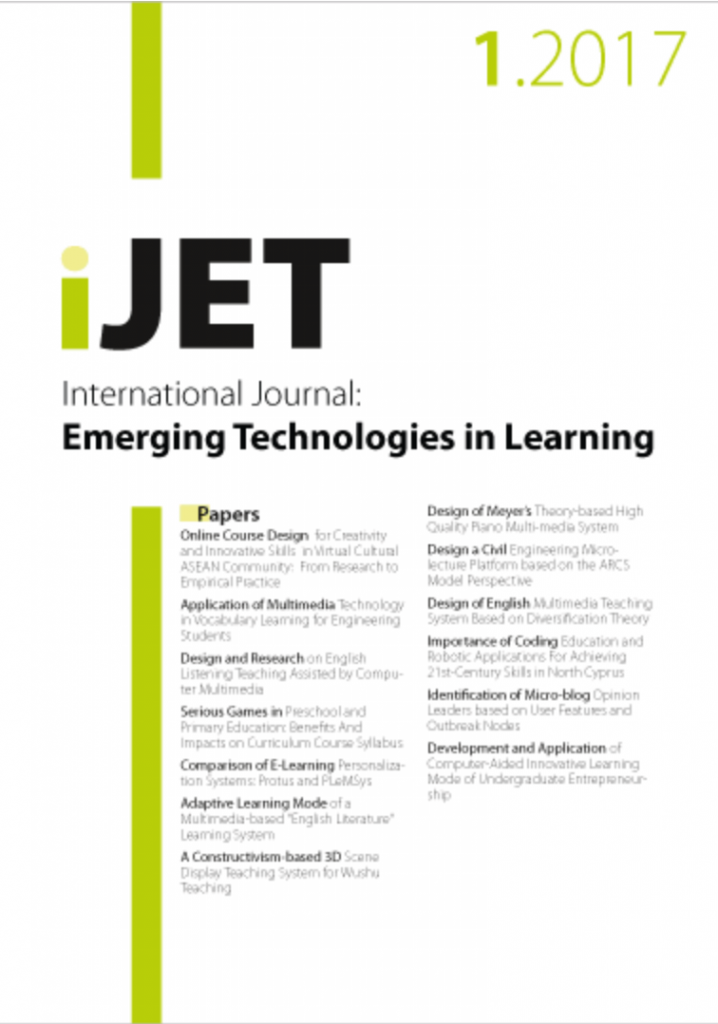
[ijet, journal] Journal of Emerging Technologies in Learning Vol. 12 / No. 07 #ijet #research

Issue 12(07) of our journal on emerging technologies for learning got published. Enjoy the readings as usual for free :-).

Table of Contents:

  • Multimedia Teaching Platform Design for Urban Planning Course Based on Information Entropy
  • Exploration of An Open Online Learning Platform Based on Google Cloud Computing
  • An Online Interaction Mode for International Trade Practice Course under Network Environment
  • Design and Analysis of Online Micro-course of Garden Architecture Design Based on CPC Model
  • Mobile Teaching of Digital Mapping Based on the WeChat Official Account Admin Platform
  • Construction of Multimedia Teaching Platform for Community Nursing Based on Teaching Resource Library Technology
  • Mobile Multimedia Classroom Construction for Rhythmic Gymnastics Based on APT Teaching Model
  • Design of 3D Animation Special Effects in Animation 3D Modeling Teaching Based on QFD Theory
  • Construction of xAPI-based Multimedia Interaction Technology in Architectural Design Teaching
  • Teaching Mode of Mechanical Design Course based on Simulation Analysis Technology
  • Application of Practical Curriculum for College Specialty of Economic Management under TPACK Framework – Taking “Enterprise Operation and Decision Simulation System” Curriculum as an Example
  • Research on Teaching Method of Mold Course Based on CAD/CAE/CAM Technology
  • Investigation and Analysis of College Students‘ Cognition in Science and Technology Competitions
  • Construction of Interactive Teaching System for Exercise Training Based on Education Video Resource Push Technology
  • Exploring the Convergence of the Mobile Learning Mode in Network Environment and the Traditional Classroom Teaching Mode

[Link to Issue 12/07]

Nevertheless, if you are interested to become a reviewer for the journal, please just contact me :-).

[publication] On Using Interactivity to Monitor the Attendance of Students at Learning-Videos #tugraz #research

Another publication at this year ED-Media conference is about „On Using Interactivity to Monitor the Attendance of Students at Learning-Videos„. The presentation has been recorded and can be find here.
Abstract:

Many studies are claiming that compulsory attendance has its benefits for students because it is positively influencing their performance in consequence. This means that fully attending students are receiving a better grade than those who skip parts of the course. Whereas there are existing technologies to monitor the attendance of students in standard classroom situations the possibilities to provide such functionalities at online videos are limited. Because of that this work introduces an approach to assess the performance of students at videos. For that a web-platform which offers a detailed recording of the watched parts of videos is presented. The evaluation shows the performance of the students at a course consisting of videos with compulsory attendance and furthermore it points out that the approach for monitoring the attendance at online videos is basically working.

[Draft version @ ResearchGate]

Reference: Wachtler, J. & Ebner, M. (2017). On Using Interactivity to Monitor the Attendance of Students at Learning-Videos. In Proceedings of EdMedia: World Conference on Educational Media and Technology 2017 (pp. 278-288). Association for the Advancement of Computing in Education (AACE).

[publication] Project Based Learning: from the Idea to a Finished LEGO® Technic Artifact, Assembled by Using Smart Glasses #edmedia17

The first publication at this year ED-Media conference is about „Project Based Learning: from the Idea to a Finished LEGO® Technic Artifact, Assembled by Using Smart Glasses„. The presentation has been recorded and can be find here.
Abstract:

Smart Glasses and 3D printers are now easily available on the market. The challenge is how to integrate them efficiently in a learning environment. This paper suggests a project-based learning (PBL) scenario how to construct, produce and assemble a planetary gear using Open Source tools, LEGO® Technic, 3D printers and Smart Glasses. The whole project-based learning scenario was implemented together with a 16-year-old student. Additionally, the assembly process using Smart Glasses was tested by seven users in a qualitative evaluation. The feedback of the student of the target group together with the feedback of other subjects was considered to improve the PBL scenario and the Smart Glasses (ReconJet) application. The evaluation showed the potential of Smart Glasses to improve hands-free assembly processes and supports the user to understand the structure and functionality of mechanical objects.

[Draft version @ ResearchGate]

Reference: Spitzer, M. & Ebner, M. (2017). Project Based Learning: from the Idea to a Finished LEGO® Technic Artifact, Assembled by Using Smart Glasses. In Proceedings of EdMedia: World Conference on Educational Media and Technology 2017 (pp. 196-209). Association for the Advancement of Computing in Education (AACE).

[publication] Does Gamification in MOOC Discussion Forums Work? #imoox #research #mooc

Our this year’s contribution to the eMOOCs conference is about „Does Gamification in MOOC Discussion Forums Work?„. The chapter is dealing with the idea to enhance a discussion forum with different gamification elements.

Abstract:

Massive Open Online Courses (MOOCs) are a new form of learning environment aimed towards accessibility and openness using contemporary technologies. One of the MOOC’s key features is the social interaction which usually takes place in discussion forums. This article focuses on reworking and analyzing the existing iMooX forum by enriching the new design with gamification elements. The intended objectives aim at refreshing the current style and improving its handling and usability. This article provides our experience of this implementation as well as examining whether or not the gamification ele-ments can help increase the participation rate and the teacher-to-student and student-to-student communication exchange. Results of the new design showed a good user satisfaction and a slight positive impact.

[Publication @ Springer]

[Draft verstion @ ResearchGate]

Reference: Reischer M., Khalil M., Ebner M. (2017) Does Gamification in MOOC Discussion Forums Work?. In: Delgado Kloos C., Jermann P., Pérez-Sanagustín M., Seaton D., White S. (eds) Digital Education: Out to the World and Back to the Campus. EMOOCs 2017. Lecture Notes in Computer Science, vol 10254. Springer, Cham, pp. 95-101. doi: 10.1007/978-3-319-59044-8_11

[ijet, journal] Journal of Emerging Technologies in Learning Vol. 12 / No. 06 #ijet #research

Issue 12(06) of our journal on emerging technologies for learning got published. Enjoy the readings as usual for free :-).

Table of Contents:

  • A Personalized Summative Model based on Learner’s Effort
  • A Teaching Experiment of Chinese College Students’ English Idioms Comprehension
  • Prediction of Learner’s Profile based on Learning Styles in Adaptive E-learning System
  • Towards an Intelligent Hybrid Recommendation System for E-Learning Platforms Using Data Mining
  • A Life-long Learning Recommender System to Promote Employability
  • Barriers Effecting Successful Implementation of E-Learning in Saudi Arabian Universities
  • Competency-based Approach to the Assessment of Professional Training for a Medical Student to Work with Medical Equipment
  • Incorporating Powtoon as a Learning Activity into a Course on Technological Innovations as Didactic Resources for Pedagogy Programs
  • Instructional Design for the Information and Communication Technology (ICT)-Assisted Intercultural Communication Course
  • Analysis of the Reasons of Public High School Students in United States Choosing Chinese as a Foreign Language – The Case of Nevada
  • Analysis on the Co-authoring in the Field of Management in China: Based on Social Network Analysis
  • An Efficient Extreme Learning Machine Based on Fuzzy Information Granulation
  • The Relation between Organizational Network Distance and Knowledge Transfer Based on Social Network Analysis Method
  • A Bibliometric Investigation of Flipped Classroom Research during 2000-2015
  • Study on Effective Using of Multimedia Teaching System and Enhancing Teaching Effect

[Link to Issue 12/06]

Nevertheless, if you are interested to become a reviewer for the journal, please just contact me :-).

[publication] Die Maker-Bewegung macht Schule: Hintergründe, Beispiele sowie erste Erfahrungen #MakerEducation #research

Im Handbuch Kompetenzentwicklung im Netz haben Sandra und ich einen grundlegenden Beitrag zur Maker-Bewegung geschrieben. Natürlich liegt bei uns der Schwerpunkt auf der Bildung von Schulkinder und Jugendlichen.

Einleitung:

Während offene Werkstätten eine lange Tradition in der Kinder- und Erwachsenenpädagogik haben, hat sich mit der Verbreitung von digitalen Technologien wie dem Laser Cutter, dem 3D-Drucker oder auch Schneideplotter eine neue Variante dazugesellt: Selbermacher/innen, die diese Geräte günstig mieten bzw. auch kostenlos in Anspruch nehmen wollen, nutzen die sog. Makerspaces und Fablabs. -Dies sind zwei der Bezeichnungen für Treffpunkte einer Generation von Selbermacher/innen, die auch, aber nicht nur, mit digitalen Technologien, Werkzeugen und Produktionsweisen Produkte entwickeln und produzieren. Auch in den Schulen sowie der Kinder- und Jugendarbeit findet die sog. “Maker-Bewegung” ihren Niederschlag. Mit Kindern werden Spiele und andere Apps programmiert, Modelle für den 3D-Drucker modelliert, Roboter gelötet oder am Schneidplotter beflockte Folien für T-Shirt-Applikationen ausgeschnitten.

[Entwurf @ ResearchGate]

Referenz: Schön, S., Ebner, M. (2017) Maker-Bewegung macht Schule: Hintergründe, Beispiele sowie erste Erfahrungen. Handbuch Kompetenzentwicklung im Netz. Erpenbeck, J., Sauter, W. (Hrsg.). Schäffer-Poeschel Verlag. Stuttgart. S. 257-270