[publication] Open Educational Resources in Ukraine: Current Status and Future Directions #edmedia #OER

Our publication titled „Open Educational Resources in Ukraine: Current Status and Future Directions“ was published at this year’s ED-Media conference in Barcelona, Spain.

Abstract:
This study investigates the current landscape and perceived need for Open Educational Resources (OER) in Ukraine. A comprehensive literature review and analysis of national and international sources was undertaken, and the research identified key benefits of OER, such as affordability, accessibility, and adaptability. The relevance of these benefits in the context of Ukraine’s ongoing digital transformation and crisis conditions was also explored. Survey data and academic initiatives indicate a growing interest in OER among educators and librarians, although awareness and implementation remain uneven, particularly in rural areas. Barriers such as limited digital infrastructure, low digital literacy, and lack of familiarity with licensing were also identified. The study draws upon successful practices from Austria and Germany, emphasising the need for coordinated national strategies, policy development, and educator training. While the research does not confirm a universal demand for OER, it shows clear potential and interest, laying the groundwork for future empirical studies to assess the educational impact of OER implementation in Ukraine.

[draft @ researchgate]
[full version @ conference website]

Reference: Andriichenko, Y., Ebner, M. & Schön, S. (2025). Open Educational Resources in Ukraine: Current Status and Future Directions. In T. Bastiaens (Ed.), Proceedings of EdMedia + Innovate Learning (pp. 1034-1043). Barcelona, Spain: Association for the Advancement of Computing in Education (AACE). Retrieved May 26, 2025 from https://www.learntechlib.org/primary/p/226255/.

[publication] Refactoring and Evaluation of an Interactive Web Portal for German Language Acquisition #edmedia #research

Our research titled „Refactoring and Evaluation of an Interactive Web Portal for German Language Acquisition“ got published at this year’s ED-Media conference in Barcelona.

Abstract:
This paper presents the refactoring and evaluation of IDeRBlog, an educational blog platform designed to support German language acquisition in primary schools. Originally developed as part of an EU Erasmus project, IDeRBlog aims to improve students’ spelling skills through a combination of intelligent feedback and blogging features. The recent redevelopment focused on updating the user interface for mobile compatibility and integrating modern web technologies. To assess the impact of these improvements on user experience, two test classes used the IDeRBlog system during regular German lessons. Students received automated feedback on their writing, while teachers tracked progress using learning analytics to identify common error categories. The evaluation demonstrates significant improvements in usability and user experience due to the refactoring, highlighting its positive impact on both student engagement and learning outcomes.

[draft @ researchgate]
[full Version @ conference website]

Reference: Buchacher, F., Wachtler, J. & Ebner, M. (2025). Refactoring and Evaluation of an Interactive Web Portal for German Language Acquisition. In T. Bastiaens (Ed.), Proceedings of EdMedia + Innovate Learning (pp. 611-621). Barcelona, Spain: Association for the Advancement of Computing in Education (AACE). Retrieved May 26, 2025 from https://www.learntechlib.org/primary/p/226203/.

[publication] Inspired by generative AI, Ignoring Open Knowledge? Findings from a Longitudinal Study on Digital Equipment and Activities of Study Beginners at TU Graz (2011–2024) #edmedia #research

Our paper titled „Inspired by generative AI, Ignoring Open Knowledge? Findings from a Longitudinal Study on Digital Equipment and Activities of Study Beginners at TU Graz (2011–2024)“ at this year’s ED-Media conference in Barcelona got published.

Abstract:
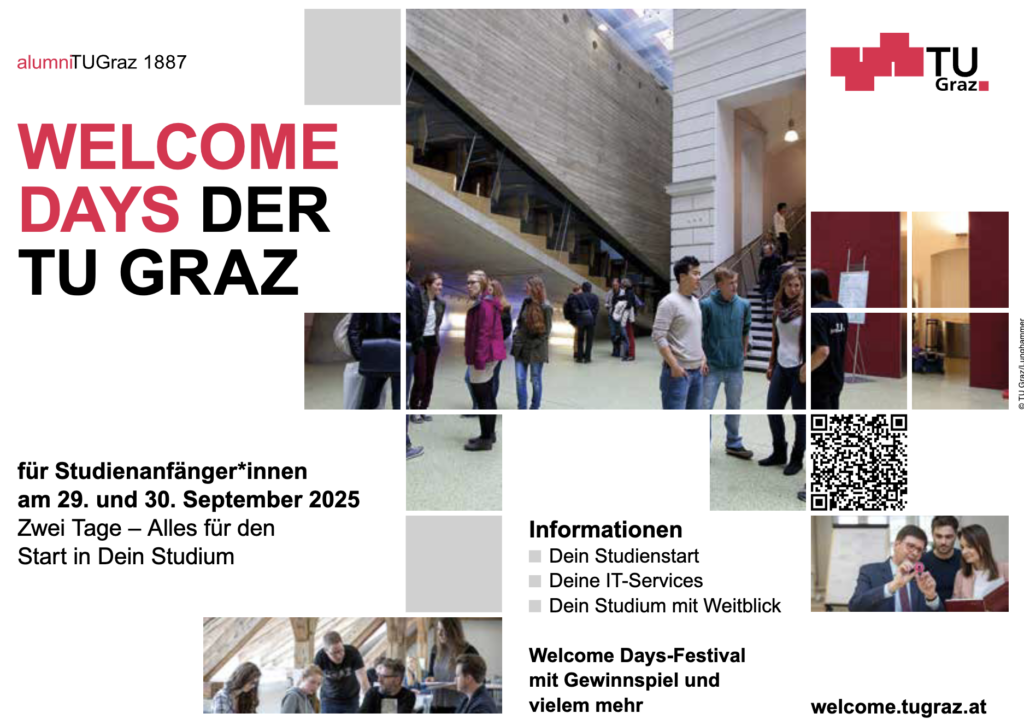
Over the past 13 years, nearly 13,000 students participated in annual surveys during the “Welcome Days” for first-year students at Graz University of Technology (TU Graz) in Austria. This paper presents an analysis of data from 2011 to 2024, offering insights into the evolving digital landscape of incoming students. It explores trends in IT equipment, social media use, communication tools, digital leisure, and engagement with online resources. A key finding is the rising adoption of AI tools, with ChatGPT usage nearly doubling compared to the previous year. At the same time, the use of Wikipedia and open-source software has declined, suggesting shifts in information-seeking and digital work habits. Smartphones and digital communication tools remain essential, though preferences are changing—for example, Discord is gaining popularity while SMS continues to decline. Streaming services are still dominant for digital leisure, yet platforms such as Netflix and Prime are no longer surveyed separately, reflecting broader changes in media use. This longitudinal study provides valuable insights into how students’ digital habits evolve, informing digital learning strategies, educational technologies, and student support services. By understanding these trends, universities can better tailor e-learning environments and digital literacy initiatives to support new student cohorts effectively.

[draft @ researchgate]
[full paper @ conference website]

Reference: Nagler, W., Mair, B., Ebner, M. & Schön, S. (2025). Inspired by generative AI, Ignoring Open Knowledge? Findings from a Longitudinal Study on Digital Equipment and Activities of Study Beginners at TU Graz (2011–2024). In T. Bastiaens (Ed.), Proceedings of EdMedia + Innovate Learning (pp. 1161-1169). Barcelona, Spain: Association for the Advancement of Computing in Education (AACE). Retrieved May 26, 2025 from https://www.learntechlib.org/primary/p/226272/.

[presentation] Exploring Teachers‘ Use of Educational Technology to Support Self-Regulated Learning in Secondary Education #research

Our last talk at this year’s ED-Media conference was „Exploring Teachers‘ Use of Educational Technology to Support Self-Regulated Learning in Secondary Education“. Find the slides here too:

Geier, G., Ebner, M., & Burgsteiner, H. (2025, Mai 22). Exploring Teachers‘ Use of Educational Technology to Support Self-Regulated Learning in Secondary Education. Graz University of Technology. https://doi.org/10.3217/dgs5q-sgc55

[presentation] Refactoring and Evaluation of an Interactive Web Portal for German Language Acquisition #iderblog #research #tugraz

Another talk at this year’s ED-Media conference was about our IDeR-Blog project titled „Refactoring and Evaluation of an Interactive Web Portal for German Language Acquisition“. Find the slides here:

Buchacher, F., Wachtler, J., & Ebner, M. (2025, Mai 22). Refactoring and Evaluation of an Interactive Web Portal for German Language Acquisition. Graz University of Technology. https://doi.org/10.3217/q4epa-dbh95

[presentation] Empowering Students through Visual Analytics: A Dashboard Redesign for Modern Curricula #LearningAnalytics #tugraz #edmedia

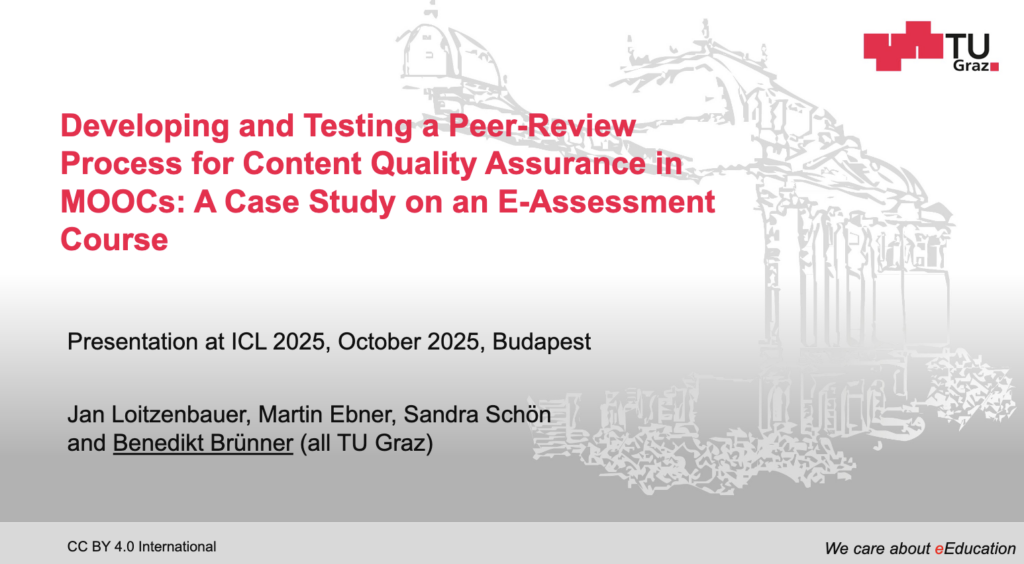
We are proud that one of our research papers won a Best Paper Award at this year’s ED-Media conference. Our presentation titled „Empowering Students through Visual Analytics: A Dashboard Redesign for Modern Curricula“ is also now available online:

Leitner, P., Pranter, P.-P., Brünner, B., & Ebner, M. (2025, Mai 22). Presentation: Empowering Students through Visual Analytics: A Dashboard Redesign for Modern Curricula. Graz University of Technology. https://doi.org/10.3217/35eva-va035

[presentation] Open Educational Resources in Ukraine: Current Status and Future Directions #OER #ukraine #tugraz

Another talk at this year’s ED-Media conference was about „Open Educational Resources in Ukraine: Current Status and Future Directions“. Find the slides right here:

Andriichenko, Y., Ebner, M., & Schön, S. (2025, Mai 22). Open Educational Resources in Ukraine: Current Status and Future Directions. Graz University of Technology. https://doi.org/10.3217/y8prt-8h024

[presentation] Rapid Multilingual Video Production (RMVPro) utilizing Artificial Intelligence #tugraz #ai #video

Our next talk at this year’s ED-Media conference is about „Rapid Multilingual Video Production (RMVPro) utilizing Artificial Intelligence“. Find the slides right here:

Brünner, B. & Ebner, M., (2025). Rapid Multilingual Video Production (RMVPro) utilizing Artificial Intelligence. ED-Media 2025 conference, presentation, Barcelona [slides]

[workshop] Special Interest Group on Emerging Technologies: Exploring Educational Podcasts with AI #tugraz #research

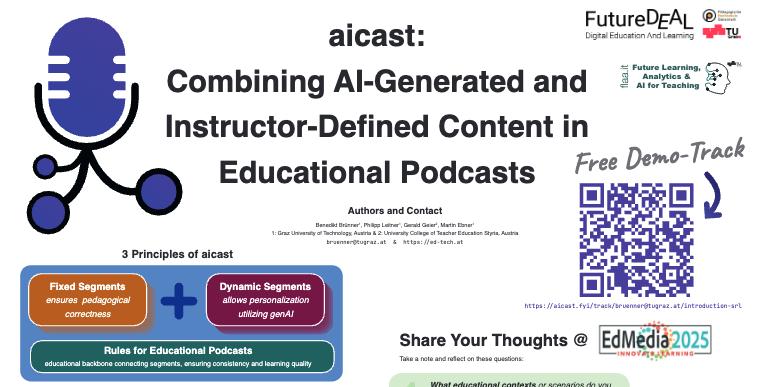
For many years, we have also been organising an annual workshop as part of the ED-Media conference, known as the ‘Special Interest Group on Emerging Technologies’. The aim is always to show and discuss a new innovative technology for education. This year it was our newly developed AI Cast.
Here are the slides:

Ebner, M. & Brünner, B. (2025) Special Interest Group on Emerging Technologies: Exploring Educational Podcasts with AI. ED-Media conference 2025, Barcelona [slides]

[presentation] Inspired by generative AI, Ignoring Open Knowledge? Findings from a Longitudinal Study on Digital Equipment and Activities of Study Beginners at TU Graz (2011–2024) #edmedia25 #tugraz

Our first talk at this year’s ED-Media conference in Barcelona was about „Inspired by generative AI, Ignoring Open Knowledge? Findings from a Longitudinal Study on Digital Equipment and Activities of Study Beginners at TU Graz (2011–2024)„. As has become something of a tradition, I have once again presented the results of our long-term study of our first-year students about IT equipment and the use of IT applications in general and for learning.

Nagler, W., Mair, B., Ebner, M., & Schön, S. (2025, Mai 20). Inspired by generative AI, Ignoring Open Knowledge? Findings from a Longitudinal Study on Digital Equipment and Activities of Study Beginners at TU Graz (2011–2024). Graz University of Technology. https://doi.org/10.3217/7h2qq-tcr64