[publication] Digitaler Überblick statt Datenfragmentierung: Ein Studienfortschritts-Dashboard für die TU Graz

Für das fnma-Magazin 02/25 haben wir einen kurzen Beitrag zu „Digitaler Überblick statt Datenfragmentierung: Ein Studienfortschritts-Dashboard für die TU Graz“ geschrieben. Dieser bzw. das gesamte Magazin ist online erhältlich.

Abstract:
Transparenz, Selbststeuerung und digitale Unterstützung sind zentrale Faktoren für Studierbarkeit im digitalen Zeitalter. In diesem Beitrag zeigen wir, wie an der TU Graz gemeinsam mit Studierenden ein datenbasiertes Studienfortschritts-Dashboard entwickelt wird, das Orientierung schafft, Planung erleichtert und neue Impulse für ein nachhaltiges Digital Wellbeing im Student-Life-Cycle setzt.

[fnma Magazin 02/25]
[Beitrag @ ResearchGate]

Zitation: Brünner, B., Leitner, P., Pranter, P.-P. & Ebner, M. (2025) Digitaler Überblick statt Datenfragmentierung: Ein Studienfortschritts-Dashboard für die TU Graz, fnma-Magazin 02/25, S. 16-19, https://www.fnma.at/content/download/3220/21290?version=2

[publication] Empowering Students through Visual Analytics: A Dashboard Redesign for Modern #learninganalytics #tugraz

Our paper, „Empowering Students through Visual Analytics: A Dashboard Redesign for Modern,“ which was awarded at this year’s EDMedia conference, is now available online.

Abstract:
Graz University of Technology originally launched a study progress dashboard in 2020 to help students monitor their academic progress and better understand their degree structures. In response to systematic changes in the university’s academic data modeling and the phasing out of legacy curricula between 2022 and 2024, the dashboard underwent a complete technical and conceptual overhaul. This paper presents the redesigned tool, which now features a modular, service-oriented architecture, real-time integration of current curricula, and enriched analytics combining student records with historical performance data. Supporting all Bachelor’s and Master’s programs, the updated dashboard continues to prioritize usability, transparency, and student autonomy. Drawing on student feedback and us-age data collected since the dashboard’s introduction, we analyze patterns of adoption and engagement, highlight lessons learned, and offer practical guidance for institutions aiming to implement adaptable, student-centered learning analytics systems.

[draft @ researchgate]
[full paper @ conference website]

Reference: Leitner, P., Pranter, P.P., Brünner, B. & Ebner, M. (2025). Empowering Students through Visual Analytics: A Dashboard Redesign for Modern Curricula. In T. Bastiaens (Ed.), Proceedings of EdMedia + Innovate Learning (pp. 599-608). Barcelona, Spain: Association for the Advancement of Computing in Education (AACE). Retrieved May 28, 2025 from https://www.learntechlib.org/primary/p/226201/.

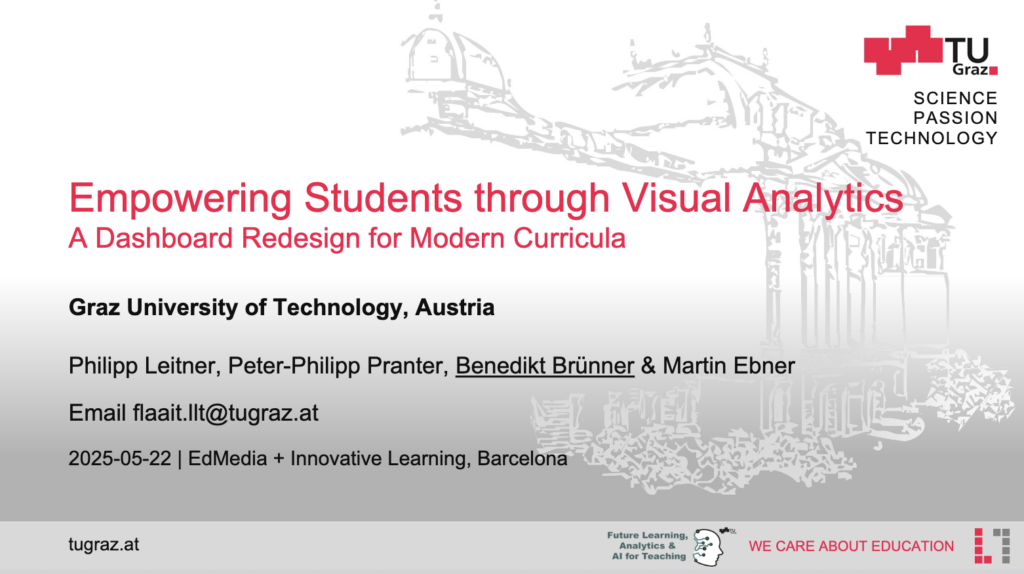
[presentation] Empowering Students through Visual Analytics: A Dashboard Redesign for Modern Curricula #LearningAnalytics #tugraz #edmedia

We are proud that one of our research papers won a Best Paper Award at this year’s ED-Media conference. Our presentation titled „Empowering Students through Visual Analytics: A Dashboard Redesign for Modern Curricula“ is also now available online:

Leitner, P., Pranter, P.-P., Brünner, B., & Ebner, M. (2025, Mai 22). Presentation: Empowering Students through Visual Analytics: A Dashboard Redesign for Modern Curricula. Graz University of Technology. https://doi.org/10.3217/35eva-va035

[publication] Learning Analytics als Instrument für wirkmächtige Mediendidaktik – 10 Jahre Erfahrung im Forschungsfeld #tugraz

In einem kurzen Beitrag zu „Learning Analytics als Instrument für wirkmächtige Mediendidaktik – 10 Jahre Erfahrung im Forschungsfeld“ konnte ich im Buch „Didaktik in einer Kultur der Digitalität“ unsere Erfahrungen darlegen:

Der Beitrag beschäftigt sich mit Learning-Analytics-Applikationen als Werkzeug für Lernenden und Lehrende. Dabei wird in die Begrifflichkeit eingeleitet, um ein gemeinsames Verständnis zu schaffen und danach entlang von umgesetzten und in der Praxis erprobten Beispielen bisher Erkenntnisse herausgearbeitet. Die Erfahrungen stützen sich dabei primär aus zwei Anwendungsbereichen in den Unterrichtsfächern Mathematik und Deutsch. In der abschließenden Diskussion werden die Herausforderungen und Ziele von Learning Analytics besprochen, die in den dafür nötigen Kompetenzen der Lehrenden münden, um im Sinne einer wirkungsmächtigen Mediendidaktik diese gezielt einsetzen zu können.

[Vorabversion @ ReserachGate]

Zitation: Ebner, M. (2023) Learning Analytics als Instrument für wirkmächtige Mediendidaktik – 10 Jahre Erfahrung im Forschungsfeld. In: Didaktik in einer Kultur der Digitalität. Brandhofer, G. & Wiesner, C. (Hrsg.). Verlag Julius Klinkhardt GmbH & Co. KG. S. 163 – 176. ISBN 9783781526037

[presentation] EdTech Talk: Learning Analytics & MOOCs #research #talk #online #tugraz

Am 24.1.24 darf ich einen EdTech Talk zum Thema „Learning Analytics & MOOCs“ halten:

In diesem Talk wird die nationale MOOC-Plattform iMooX vorgestellt und welche Einblicke Learning Analytics im Laufe der Zeit ermöglichten. So konnten einerseits Kursersteller:innen ihre Online-Kurse besser optimieren und ihre Lernenden kennenlernen. Aber auch die Analysen im Video-Bereich zeigen einige interessante Ergebnisse. Learning Analytics haben gut zur Entwicklung der Plattform und der Kurse, aber auch zum Verständnis über das Lehren und Lernen beigetragen.

Jeder kann bitte gerne teilnehmen und mit mir über das Thema diskutieren: [Anmeldung zum EdTech Talk]

[publication] Operationalising Transparency as an Integral Value of Learning Analytics Systems – From Ethical and Data Protection to Technical Design Requirements #gdpr #learninganalytics #tugraz

We did a contribution to the HCII 2023 conference titled „Operationalising Transparency as an Integral Value of Learning Analytics Systems – From Ethical and Data Protection to Technical Design Requirements„. Now you can find the publication online:

Abstract:
With the rising complexity of technology and its introduction into educational settings, the question of trusting and designing trustworthy learning analytics (LA) systems has gained importance. Transparency is one of the values that can contribute to enhancing an LA system’s trustworthiness. It has been included and discussed as a separate core value or principle in many ethical frameworks for LA. Even though these frameworks provide valuable contributions, they are mostly limited to the conceptual level. Defining what transparency entails in the context of LA is an important aspect, nevertheless, the translation and operationalisation of such abstract concepts into technology should be equally considered.In this paper, we focus on the question of how transparency can be translated into concrete design requirements in order to enhance the trustworthiness of LA systems. We present a normative framework in the form of an interdisciplinary Criteria Catalogue for trustworthy LA, which consists of seven core areas, including transparency. Second, we demonstrate how transparency can be translated and operationalised into more specific and low-level elements by using an example of the Learners’ Corner LA dashboard developed within the project “Learning Analytics – Students in Focus”. Third, we share the results of a study conducted to better understand students’ information needs in relation to LA tools and evaluate our design choices for the introduction of three quick information butt
ons within the Learners’ Corner.

[publication @ book’s homepage]
[draft @ ResearchGate]

Rerference: Veljanova, H., Barreiros, C., Gosch, N., Staudegger, E., Ebner, M., Lindstaedt, S. (2023). Operationalising Transparency as an Integral Value of Learning Analytics Systems – From Ethical and Data Protection to Technical Design Requirements. In: Zaphiris, P., Ioannou, A. (eds) Learning and Collaboration Technologies. HCII 2023. Lecture Notes in Computer Science, vol 14040. Springer, Cham. https://doi.org/10.1007/978-3-031-34411-4_37

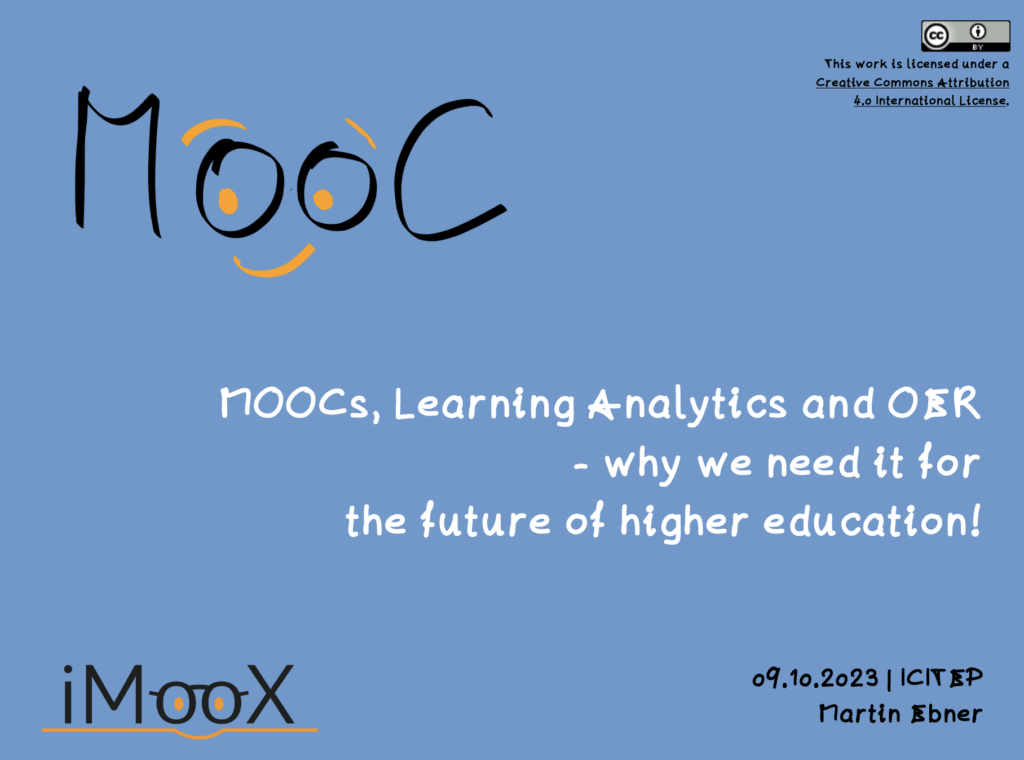
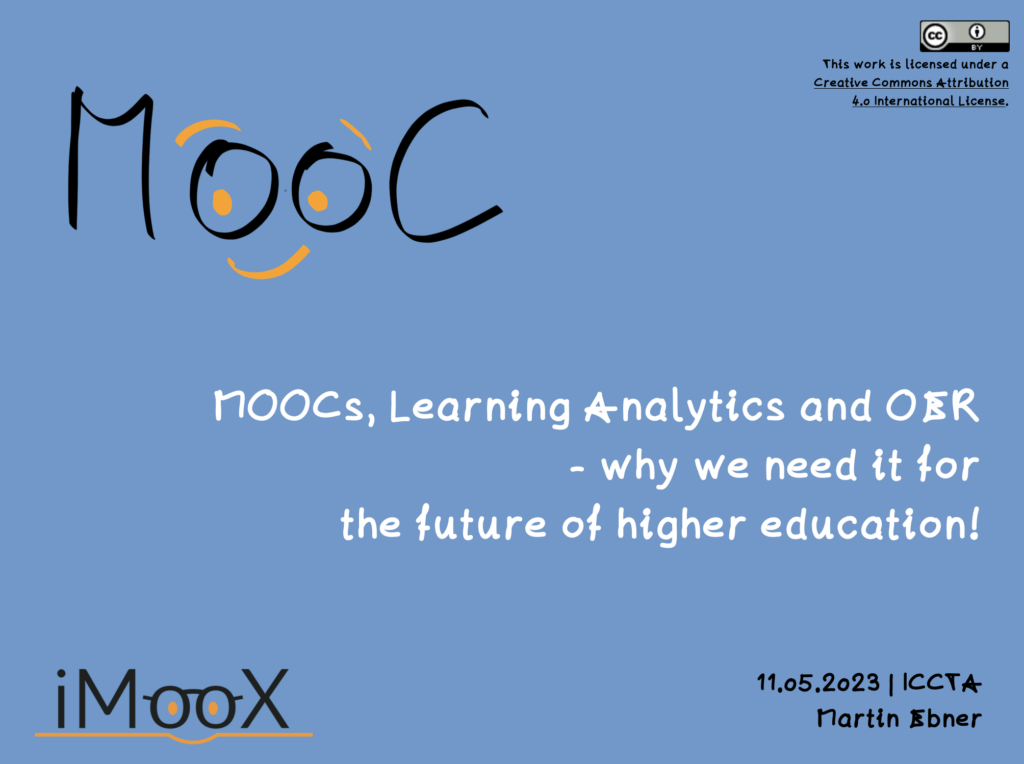
[presentation] MOOCs, Learning Analytics and OER – why we need it for the future of higher education! #keynote #conference

It was a pleasure to give a short keynote talk about „MOOCs, Learning Analytics and OER – why we need it for the future of higher education!“ at 9th International Conference on Computer Technology Applications (ICCTA 2023). Here you can find my slides.

https://www.researchgate.net/publication/370658813_MOOCs_Learning_Analytics_and_OER_-_why_we_need_it_for_the_future_of_higher_education

[publication] Students in Focus – Moving Towards Human-Centred Learning Analytics #LearningAnalytics #LearnersCorner #tugraz #LA

We are very proud that we can announce another research article about our successful Learning Analytics project titled „Students in Focus – Moving Towards Human-Centred Learning Analytics„. It got published with the book Practicable Learning Analytics.

Abstract:
Human-centred design is a well-established approach within research fields such as human-computer interaction, ergonomics, and human factors. Recently Learning Analytics (LA) researchers and practitioners have manifested great interest in exploring methods and techniques associated with this approach to manage the design process in ways that can enhance human interaction with LA technology. The project “Learning Analytics – Students in Focus” aims to use student-related data to support the learning and teaching process in a higher educational context. Our interdisciplinary team investigates LA tools that leverage students’ academic success by acquiring or developing self-regulated learning skills. We adopted a Human-Centred Learning Analytics (HCLA) approach involving students, teachers, and other educational stakeholders in the iterative design of our LA tools. This article contributes to the discussion on how to design LA tools using a human-centred approach. We describe the analysis, design, implementation, and evaluation process of three LA tools comprised in our students’ dashboard, i.e., the planner, the activity graph, and the learning diary. In addition, we present key results gained in several empirical studies which had an implication on the tools’ design. Finally, we provide insights about our experience with the HCLA approach, pointing out benefits and limitations in practice.

[Article @ book’s homepage]
[draft @ ResearchGate]

Reference: Barreiros, C., Leitner, P., Ebner, M., Veas, E., Lindstaedt, S. (2023). Students in Focus – Moving Towards Human-Centred Learning Analytics. In: Viberg, O., Grönlund, Å. (eds) Practicable Learning Analytics. Advances in Analytics for Learning and Teaching. Springer, Cham. https://doi.org/10.1007/978-3-031-27646-0_5