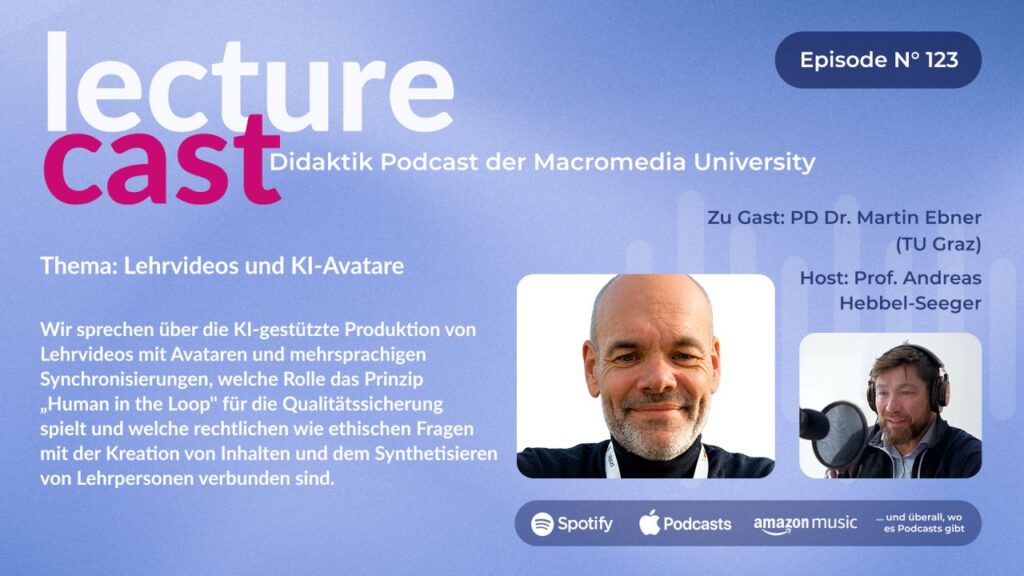
Lehramt Informatik und Digitale Grundbildung #tugraz

Ich darf zunächst alle Studienanfängerinnen und -anfänger an der TU Graz für das Lehramt „Informatik und Digitale Grundbildung“ herzlich willkommen heißen. Als Studiendekan freue ich mich, dass sich wieder so viele für dieses wichtige Unterrichtsfach entschieden haben.

Damit der Einstieg reibungslos klappen kann, haben wir einen Blogpost als Übersicht gestaltet, der nochmals die Anmeldung zu den Lehrveranstaltungen erleichtern sollen.

Bei Fragen, Wünschen oder anderen Begehrlichkeiten bitte einfach melden. Dann wünsche ich uns allen einen guten Semesterstart.

This is an impactful contributions and exceptional novelty in the field of teacher education in austria. The contribution is essential for teacher candidates in the field of computer science and digital technologies, written in german

[publication] Federated Virtual Learning Management in a European University Alliance: First Experiences Using LTI to Connect LMS in Unite! #tugraz

Our publication „Federated Virtual Learning Management in a European University Alliance: First Experiences Using LTI to Connect LMS in Unite!“ is now published in the International Journal on E-Learning.

Abstract:
This paper explores the challenges and first experiences of implementing federated virtual learning management within the European University Alliance “Unite!”. Through the lens of Learning Tools Interoperability (LTI), the study investigates the complexities inherent in connecting Learning Management Systems (LMS) across diverse institutional contexts. This research examines the general hurdles faced by European university alliances in adopting federated LMS. Additionally, it outlines the LMS infrastructure of Unite! in early 2024 and discusses the pilot initiatives undertaken to utilize LTI for connecting LMS platforms at Graz University of Technology (TU Graz). The pilots involve integrating Unite!’s Metacampus with various platforms, including Moodle-based systems from TU Graz. The pilots demonstrate that the integration of LTI is not trivial, as it impacts technology, administration, and teaching due to the novelty of the system (requiring an explanation of how it works). However, the implementation is successful, with difficulties encountered only in specific browsers. Drawing from these pilot experiences, the paper presents insights and lessons learned regarding the efficacy of LTI in facilitating cross-platform connectivity within Unite! and offers implications for future implementations.

[publication @ ResearchGate]
[publication @ Publishers‘ homepage]

Reference: Ebner, M., Edelsbrunner, S., Gasplmayr, K., Hohla-Sejkora, K., Leitner, P., Taraghi, B. & Schön, S. (2025). Federated Virtual Learning Management in a European University Alliance: First Experiences Using LTI to Connect LMS in Unite!. In G. Marks (Ed.), Proceedings of International Journal on E-Learning 2025 (pp. 213-239). Waynesville, NC USA: Association for the Advancement of Computing in Education (AACE). Retrieved September 18, 2025 from https://www.learntechlib.org/primary/p/226307/.

This is an impactful contributions, methodological rigor, and exceptional novelty in the research field of technolgy enhanced learning, with a focus on Learning Management Systems, european Alliances in Higher Education and LTI.

[mooc] EBmooc 2025 – KI-Workflows: Didaktik trifft Recht #imoox #ebmooc

Es freut mich ganz besonders, dass der erfolgreich EBmooc – die größte Erwachsenenbildungsmaßnahme in Österreich – wieder starten kann. Fast schon traditionell ist es wieder gelungen, dass CONEDU einen MOOC zu einem brandaktuellen Thema „KI-Workflows: Didaktik trifft Recht“ erstellt hat und diesen auf iMooX.at anbietet:

Der EBmooc 2025 widmet sich dem Einsatz von KI-gestützten Workflows (d.h. mehrstufigen Arbeitsabläufen) in der Erwachsenenbildung.
Teilnehmer*innen lernen anhand von praxisnahen Beispielen, wie sie KI didaktisch sinnvoll und rechtlich sicher einsetzen können, um ihre Arbeitsabläufe zu optimieren – und zwar in verschiedenen Kontexten, von der Kursgestaltung und -durchführung bis hin zu strategischen Entscheidungen. Sie erweitern ihr Verständnis von generativer KI und kennen die praktischen Auswirkungen des europäischen AI-Act auf die Erwachsenenbildung. Sie reflektieren ihren eigenen KI-Einsatz und ihre eigene Rolle als Erwachsenenbildner*in im Zuge der rasanten technologischen Entwicklungen.
Der Kurs richtet sich an Erwachsenenbildner*innen aus unterschiedlichen Einrichtungen, in unterschiedlichen Beschäftigungsformen und mit unterschiedlichen Aufgaben-Schwerpunkten: Training/Lehre/Unterricht, Bildungsmanagement/Programmplanung, Lernbegleitung und -betreuung.
Dieser MOOC ist eine praxisorientierte Weiterbildung, die Erwachsenenbildner*innen fit für die KI-gestützte Zukunft macht – rechtssicher, didaktisch fundiert und innovativ!

Hier gibt es noch den Trailer:

YouTube

Mit dem Laden des Videos akzeptieren Sie die Datenschutzerklärung von YouTube.
Mehr erfahren

Video laden

Wie alle bisherigen EBmoocs, ist auch diese Version absolut kostenfrei und wir freuen uns über jede Anmeldung: [Anmeldung zum kostenfreien EBmooc]

[presse] KI als Lehrer #tugraz #KI #avatar

Es freut uns, dass der Standard unsere neuesten Ergebnisse im Bereich KI und Avatare aufgegriffen hat und einen kleinen Beitrag mit dem Titel „KI als Lehrer“ abgedruckt hat in der Ausgabe vom 17.09.205

Künstliche Intelligenz und Avatare in der Lehre haben den Standard beschäftigt. Die Zeitung hat darüber mit Sandra Schön von der Organisationseinheit Lehr- und Lerntechnologien gesprochen, wo ein Team untersucht hat, wie sich schulischer, aber auch universitärer Unterricht mithilfe digitaler Methoden sowie mit und durch KI gestalten lässt.

Wer sich gerne ein Bild davon machen möchte, wie die Avatare umgesetzt sind, ist herzlich eingeladen sich jederzeit kostenlos in diesen MOOC einzuschreiben: Open Educational Resources in Higher Education

[mooc] Informatik-FIT #tugraz #brückenkurs

Fast schon traditionell, darf ich den Start des MOOC „Informatik-FIT“ verkünden, welcher vor allem unseren Studienanfänger:innen helfen soll, den Einstieg in die Informatik zu erleichtern:

Die Vielfalt der Probleme, die in der Informatik behandelt werden, macht eine kurze und dennoch vollständige Definition dessen, was Informatik ist, unmöglich.
Unmöglich ist es auch, alle Themen in einem Einführungskurs unterzubringen.
Irgendwo müssen wir aber trotzdem anfangen und so haben wir versucht, die wichtigsten Grundbegriffe und Ideen der Informatik auszuwählen und diese so zu vermitteln, dass sich die Teilnehmer:innen schnell ein breiteres Bild von der Informatik machen können.
Darüber hinaus soll es für die Teilnehmer:innen möglich sein, Zusammenhänge zwischen den einzelnen Themen zu erkennen bzw. herzustellen. 

Der Trailer zum MOOC:

YouTube

Mit dem Laden des Videos akzeptieren Sie die Datenschutzerklärung von YouTube.
Mehr erfahren

Video laden

Die Teilnahme ist natürlich wie immer kostenfrei: [Link zur Anmeldung zum MOOC]

Hinweis: Letztes Jahr hatten wir erstmals einen KI-basierten Chatbot im Einsatz, heuer darf ich verraten ist es eine Videochatbot. Wir sind gespannt wie gut dieser das Lernen unterstützen kann.

[mooc] Woche 5 im MOOC zu „Digitale Kompetenzen für Studienanfänger:innen“ #imoox #digiskill25

Die Woche 5 und damit auch letzte Woche im MOOC zu „Digitale Kompetenzen für Studienanfänger:innen“ liegt vor uns. Diese Woche geht es abschließend bei unserem Digistammtisch um Problemlösen und Weiterlernen. Viel Spaß mit den Inhalten der letzten Woche und wir hoffen euch wieder bei einem andern MOOC begrüßen zu dürfen:

YouTube

Mit dem Laden des Videos akzeptieren Sie die Datenschutzerklärung von YouTube.
Mehr erfahren

Video laden

Und natürlich ist das alles kostenfrei und offen lizenziert – daher einfach anmelden, wir freuen uns auf viele Teilnehmer:innen:

[Kostenlose Anmeldeseite MOOC „Digitale Kompetenzen für Studienanfänger:innen„]

[publication] Empowering Self-Regulated Learning Through Technology and the Teacher’s Role – A Systematic Literature Review #research

This is an impactful contributions, methodological rigor, and exceptional novelty in the research field of AI in education and Self-Regulated Learning.

Our research work titled „Empowering Self-Regulated Learning Through Technology and the Teacher’s Role – A Systematic Literature Review“ is published.

Abstract:
Self-regulated learning (SRL) has been demonstrated in numerous scientific studies as an effective alternative to traditional teaching methods, fostering individual learning processes. The added value of educational technology in supporting SRL has also been widely researched and largely validated. Within this context, the teacher plays a pivotal role. However, much of the existing research has been conducted at universities , while the secondary education level has received comparatively less attention. To gain an overview of the teacher’s influence on students‘ SRL processes, a PRISMA based systematic literature review was conducted. From an initial pool of 553 documents, 27 relevant studies were identified and analyzed. The selected studies were examined to collect data addressing the research questions, focusing on identifying effective teaching methods and essential teacher competencies for fostering SRL in technology-enhanced classrooms. Furthermore, the analysis highlights the evolving role of teachers and underscores the need for additional training to support these changes.

[full article @ publisher’s website]
[draft @ researchgate]

Reference: Geier, G., Ebner, M., Burgsteiner, H. (2025). Empowering Self-Regulated Learning Through Technology and the Teacher’s Role – A Systematic Literature Review. In: Smith, B.K., Borge, M. (eds) Learning and Collaboration Technologies. HCII 2025. Lecture Notes in Computer Science, vol 15807. Springer, Cham. https://doi.org/10.1007/978-3-031-93567-1_5

[publication] Synthetic Educators: Analyzing AI-Driven Avatars in Digital Learning Environments #AIinEducation #tugraz

This is an impactful contributions, methodological rigor, and exceptional novelty in the research field of AI in education.


Our publication „Synthetic Educators: Analyzing AI-Driven Avatars in Digital Learning Environments“ at this year’s HCII conference is published.

Abstract:
Videos can be used in a variety of ways in learning environments today. With advances in generative AI technologies, tools such as HeyGen and ElevenLabs make it easy to create synthetic teachers, promising efficiency and accessibility. This study investigates the impact of AI-generated teaching video avatars on learners‘ emotional responses. A mixed-method approach was adopted, in which 55 participants were shown AI-generated videos and videos with real instructors. Emotional engagement was measured using FaceReader Online, along with quiz questions and follow-up interviews to gauge knowledge retention and perceptions of this educational technology. Results indicate that AI avatars effectively convey content and weakly elicit better recall rates and positive emotional responses comparable to those of real instructors. However, concerns were raised about emotional authenticity and engagement, highlighting the need for improved avatar design. The study concludes with a discussion of the potential and limitations of AI avatars and argues for their thoughtful integration to improve educational equity and learning outcomes.

[full article @ publisher’s homepage]
[draft @ researchgate]

Reference: Struger, P., Brünner, B., Ebner, M. (2025). Synthetic Educators: Analyzing AI-Driven Avatars in Digital Learning Environments. In: Smith, B.K., Borge, M. (eds) Learning and Collaboration Technologies. HCII 2025. Lecture Notes in Computer Science, vol 15807. Springer, Cham. https://doi.org/10.1007/978-3-031-93567-1_13

[publication] InfoFit and Beyond: AI Chatbots as EdTech Tools for Self-Regulated Learning in MOOCs #AIinEducation #research

This is an impactful contributions, methodological rigor, and exceptional novelty in the research field of AI in education.
Our publication titled „InfoFit and Beyond: AI Chatbots as EdTech Tools for Self-Regulated Learning in MOOCs“ at this year’s HCII conference is available.

Abstract:
Massive Open Online Courses (MOOCs) have become essential for the democratization of education by providing accessible learning opportunities to broad audiences. However, their asynchronous and open structure is challenging for learning, especially in terms of maintaining engagement, and self-regulated learning (SRL) is necessary. This study investigates the integration of a retrieval-augmented-generation (RAG) chatbot into a MOOC and uses generative AI (genAI) to enhance learn-ers‘ SRL processes. The chatbot is based on Zimmermann’s SRL framework and is prepared for the MOOC content, basics of computer science. It is designed to support learners in the forethought, performance, and self-reflection phases by providing concise, context-specific responses. A mixed-method evaluation with 79 participants revealed high levels of satisfaction , with over 98% of respondents recommending the chatbot for future courses. The chatbot proved effective in supporting tasks such as summarization and concept clarification; however, its role in maintaining motivation emerged as a key area for further investigation. These findings underscore the transformative potential of AI chatbots in asynchronous learning environments, while also highlighting the importance of incorporating multimodal and motivational features to maximize educational technology (EdTech) impact.

[full article @ publisher’s homepage]
[draft @ ResearchGate]

Reference: Brünner, B., Ebner, M. (2025). InfoFit and Beyond: AI Chatbots as EdTech Tools for Self-Regulated Learning in MOOCs. In: Smith, B.K., Borge, M. (eds) Learning and Collaboration Technologies. HCII 2025. Lecture Notes in Computer Science, vol 15807. Springer, Cham. https://doi.org/10.1007/978-3-031-93567-1_4