Valdrin did his master thesis about „A Mobile Application for School Children controlled by External Bluetooth Devices„. Find here the slides of his defense:
Klicken Sie auf den unteren Button, um den Inhalt von www.slideshare.net zu laden.
Digitale Lehre an und rund um der Technischen Universität Graz
Valdrin did his master thesis about „A Mobile Application for School Children controlled by External Bluetooth Devices„. Find here the slides of his defense:
Klicken Sie auf den unteren Button, um den Inhalt von www.slideshare.net zu laden.
 Wir freuen uns, dass wir heuer auch bei den Open-Access-Tagen in Graz mit unserem Lieblingsthema (OER) vertreten sein werden. Es wurde heuer auch als Schwerpunkt aufgenommen und da haben wir natürlich die Chance genutzt. Sowohl die OER-Stratgie, iMooX oder auch das Open Education Austria Projekt – zu erzählen haben wir ja viel. Noch mehr freuen würde uns, wenn viele vorbei schauen und mitdiskutieren 🙂
Unserer Programmpunkte:
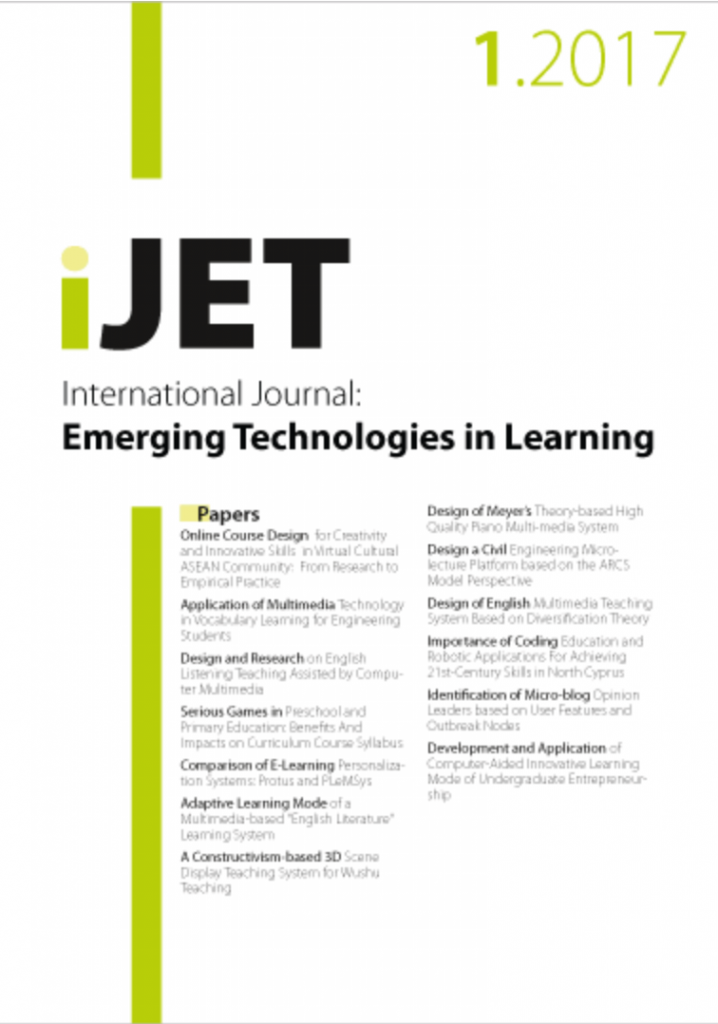 Issue 13(7) of our journal on emerging technologies for learning got published. Enjoy the readings as usual for free :-).
Table of Contents:
Nevertheless, if you are interested to become a reviewer for the journal, please just contact me :-).
At this year ED-Media conference in Amsterdam we present also our LIVE-system. which deals with interactivity in videos. This year we did a first study within a lecture. Here you can find the slides:
Klicken Sie auf den unteren Button, um den Inhalt von www.slideshare.net zu laden.
At this year ED-Media conference in Amsterdam we present our yearly study about our beginners‘ survey. As usual the yearly progress is shown as well as some special research questions. Here you can find the slides:
Klicken Sie auf den unteren Button, um den Inhalt von www.slideshare.net zu laden.
At this year Ed-Media conference in Amsterdam we published our research work about „Increasing Learning Efficiency and Quality of Students´ Homework by Attendance Monitoring and Polls at Interactive Learning Videosn“.
Abstract:
Due to the fact that students are confronted with a growing amount of texts, colours, figures and shapes and due to their ability to process only a limited number of such information simultaneously, it seems to be obvious that efforts should be made to increase the students‘ attention-levels. This is important because research results have indicated that selective attention is considered as the most valuable resource in the process of human learning. The application of interaction and communication to the process of learning is a useful strategy to direct the students‘ attention. It seems to be obvious that this is also true for learning videos. Therefore, this work contains a description of how a video platform with interactive components can be used to support the students and teacher. The video platform is explained and evaluated by analysing its usage in a large teaching course at an institution of higher education. The application of this strategy improved the students‘ performance and optimized the teacher’s workload.
Reference: Wachtler, J., Scherz, M. & Ebner, M. (2018). Increasing Learning Efficiency and Quality of Students´ Homework by Attendance Monitoring and Polls at Interactive Learning Videos. In Proceedings of EdMedia: World Conference on Educational Media and Technology (pp. 1337-1347). Amsterdam, Netherlands: Association for the Advancement of Computing in Education (AACE)
At this year ED-Media conference in Amsterdam we present also our work of the national working group on OER. Last year we published a whitepaper how we can deal with OER in Higher Education. Here you can find the slides:
Klicken Sie auf den unteren Button, um den Inhalt von www.slideshare.net zu laden.
At this year ED-Media conference in Amsterdam we present our publication „German Language Training App for Primary School Children“ and describe our research about an iphone application to assist the IDeRblog-project. Here you can find the slides:
Klicken Sie auf den unteren Button, um den Inhalt von www.slideshare.net zu laden.
At this year ED-Media conference in Amsterdam we start with a workshop on „Making With Kids in Europe – To Foster Digital Literacy, to Make a Better World, and to Build a New Entrepreneurship Education“ where we like to introduce to our activities.
Description:
Some of Europe’s leading experts on making with children will share their experiences and different approaches within this joint workshop The workshop will include presentations about teacher education within makerspaces at the University of Technologies Graz (AT), about inspiring social innovation and educational projects at the Waag Society (NL) and about the European initiative DOIT, which sees making as a good base for an early entrepreneurship education. Participants will work with a set of tools and smaller maker projects. For example, they can program educational games in Scratch, build a dough piano (which will do music!) with a MaKeyMaKey set, or sew some “smart gloves”. Interactive discussions will be the base to develop own future implementations.
Find here the slides and workshop hand-outs at our partner’s website DoIT.
Our publication about „Learning analytics to improve writing skills for young children – an holistic approach“ has been published in the Journal of Research in Innovative Teaching & Learning.
Abstract:
Purpose
Due to the important role of orthography in society, the project called IDeRBlog presented in this paper created a web-based tool to motivate pupils to write text as well as to read and to comment on texts written by fellow students. In addition, IDeRBlog aims to improve student’s German orthography skills and supports teachers and parents with training materials for their students. The paper aims to discuss these issues.Design/methodology/approach
With the aid of learning analytics, the submitted text is analyzed and special feedback is given to the students so that they can try to correct the misspelled words themselves. The teachers as well as the parents are benefiting from the analysis and exercises suggested by the system.Findings
A recent study showed the efficiency of the system in form of an improvement of the students’ orthographic skills. Over a period of four months 70 percent of the students achieved a significant reduction of their spelling mistakes.Originality/value
IDeRBlog is an innovative approach to improving orthography skills combining blogging and new media with writing and practice.
Reference: Nina Steinhauer, Michael Gros, Martin Ebner, Markus Ebner, Anneliese Huppertz, Mike Cormann, Susanne Biermeier, Lena Burk, Konstanze Edtstadler, Sonja Gabriel, Martina Wintschnig, Christian Aspalter, Susanne Martich, (2017) Learning analytics to improve writing skills for young children – an holistic approach, Journal of Research in Innovative Teaching & Learning, Vol. 10 Issue: 2, pp.143-159, https://doi.org/10.1108/JRIT-07-2017-0013