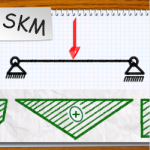
 Es freut uns sehr, dass es nun gelungen ist unser erfolgreiches Spiel „Schnittkraftmeister“ auf den Plattformen iOS, Windows Phone und Android verfügbar zu machen. Wir wünschen allen Spielerinnen und Spielern vor allem viel Spaß beim Lernen von statischen Systemen 🙂 .
Hier gibt es den Download für:
[publication] Do You Mind NSA Affair? Does the Global Surveillance Disclosure Impact Our Students?
Our contribution at this year ED-MEDIA conference in Tampere, Finnland about „Do You Mind NSA Affair? Does the Global Surveillance Disclosure Impact Our Students?“ is now online available. The slides have alreday been published here.
Abstract:
In summer 2013 the discussion about security and Internet peaked when the ex-NSA contractor Edward Snowden uncovered secret details about his former employer NSA. Since then bad news and stories about government surveillance have come along daily worldwide. But did they change anything according to our way of working and living with the Internet? We wanted to know, whether there is a change of Internet behavior to be determined among freshmen coming to Graz University of Technology. On base of an annual questionnaire that is carried out by the Department of Social Learning at TU Graz since 2007 we found out that although a quarter of polled students are influenced by those disclosures there is no decrease in Internet usage to be realized compared to former years results; quite the reverse: applications working on cloud-principle like Dropbox are strongly upcoming. Apart from that, the long term survey generally mirrors new media competences and Internet usage of TU Graz freshmen. This paper discusses this year´s results and progressions of the survey.
Do You Mind NSA Affair? Does the Global Surveillance Disclosure Impact Our Students? by Martin
Klicken Sie auf den unteren Button, um den Inhalt von www.scribd.com zu laden.
Reference: Ebner, M., Nagler, W. & Schön, M. (2014). Do You Mind NSA Affair?Does the Global Surveillance Disclosure Impact Our Students?. In Proceedings of World Conference on Educational Multimedia, Hypermedia and Telecommunications 2014 (pp. 2307-2312). Chesapeake, VA: AACE.
[publication] Technologiegestützte Echtzeit-Interaktion in Massenvorlesungen im Hörsaal. Entwicklung und Erprobung eines digitalen Backchannels während der Vorlesung
Ich habe noch diese Veröffentlichung nachzuholen, die auf der GMW 2014 dann in einem Flipped-Format diskutiert wurde bzw. wo die entsprechende Software auch erprobt wurde.
Zusammenfassung:
Interaktion zwischen Lehrenden und Studierenden in gefüllten, großen Hörsälen ist eine große Herausforderung. Audience-Response-Systeme werden als eine Möglichkeit betrachtet, schnelle Rückmeldungen von den Studierenden zu erhalten und so deren Einbindung und die Interaktion im Hörsaal zu erhöhen. Im vorliegenden Beitrag wird die Entwicklung, das Konzept sowie das Design eines Prototypen einer Anwendung vorgestellt („Backchannel“), die es den Studierenden ermöglicht, den Vortragenden kontinuierlich Rückmeldung zum Vortrag zu geben. Die Lehrenden erhalten ein aggregiertes visuelles Feedback in Echtzeit und können darauf reagieren. Ausführlich werden dabei die Ergebnisse des Testeinsatzes dargestellt sowie zukünftige Adaptionen und Entwicklungsmöglichkeiten diskutiert.
Zitation: Martin Ebner, Christian Haintz, Karin Pichler, Sandra Schön (2014). Technologiegestützte Echtzeit-Interaktion in Massenvorlesungen im Hörsaal. Entwicklung und Erprobung eines digitalen Backchannels während der Vorlesung. In: Klaus Rummler (Hrsg.), Lernräume gestalten – Bildungskontexte vielfältig denken, Münster: Waxmann, S. 567-578. Online-Version URL Gesamt-PDF: https://www.waxmann.com/fileadmin/media/zusatztexte/3142Volltext.pdf; URL Beitrag (Kommentierbar): https://2014.gmw-online.de/567/
Und schwupps: Einheit 4 – Suchen im Web für „Gratis Online Lernen“ #gol14 #imoox
Das Diskussionsforum füllt sich und immer mehr Tests werden abgelegt (obwohl das keine Pflicht ist, aber natürlich eine gute Möglichkeit zu prüfen, ob man das Lernziel erreicht hat). Und auf die neue, die vierte Einheit im iMooX-Kurs Gratis Online Lernern, haben wir uns besonders gefreut. Es dreht sich um das Suchen im Web und wir geben nicht nur Tipps, sondern haben auch ein paar Suchaufträge gestellt, gesammelt werden im Diskussionsforum außerdem all die Dinge die die Teilnehmer/innen spannend finden.
Bei den Rechercheaufträgen geht es übrigens nicht darum, sie überhaupt (richtig) zu lösen – manchmal gibt es auch smartere und weniger smarte Lösungen. Wir sind schon jetzt neugierig, was die Teilnehmer/innen daraus machen.
Wer mitknobeln möchte:
 CC BY Sandra Schön (BIMS e.V.) und Martin Ebner (TU Graz | imoox.at 2014
[presentation] Are MOOCs the chance to open-up Education?
The slides of my talk about „Are MOOCs the chance to open-up Education?“ at the „Workshop on Behind the Scenes: The Making of a MOOC“ in Heidelberg are now online available:
Klicken Sie auf den unteren Button, um den Inhalt von www.slideshare.net zu laden.
[publication] Adaptive Learner Profiling Provides the Optimal Sequence of Posed Basic Mathematical Problems
Our publication about „Adaptive Learner Profiling Provides the Optimal Sequence of Posed Basic Mathematical Problems“ at this year EC-TEL conference is now available.
Abstract:
Applications that try to enhance learners’ knowledge can profit by the creation and analysis of learner profiles. This work deals with the derivation of an optimal sequence of questions by comparing similar learning behaviour of users of a mathematics training application. The adaptation of the learners’ clusters to the answers of the revised optimal question sequence improves learning
Reference: Taraghi, B., Saranti, A., Ebner, M., Großmann, A., Müller, V. (2014) Adaptive Learner Profiling Provides the Optimal Sequence of Posed Basic Mathematical Problems. In: Open Learning and Teaching in Educational Communities. Rensing, C., de Freitas, S., Ley, T., Muñoz-Merino, P. J. (Ed.). Lecture Notes in Computer Science Volume 8719, Springer 2014, pp. 592-59
Englisch für Chemiestudierende #imoox
 Für das TU Graz weite Magazin habe ich einen kurzen Beitrag über den MOOC „Englisch für Chemiestudierende“ geschrieben. Die Ausgabe ist hier öffentlich zugänglich (der Beitrag dann auf S. 10).
Referenz: Ebner, M. (2014) Englisch für Chemiestudierende, TU Graz people, 51/2014-3, S. 10
[publication] Kosten und Wert von MOOCs am Beispiel der Plattform iMooX #imoox
Unsere Publikation über „Kosten und Wert von MOOCs am Beispiel der Plattform iMooX“ ist auf der heurigen GeNeMe-Konferenz präsentiert und auch publiziert worden. Hier gibt es den Beitrag zum Nachlesen:
Kosten und Wert von MOOCs am Beispiel der Plattform iMooX by Martin
Klicken Sie auf den unteren Button, um den Inhalt von www.scribd.com zu laden.
Zitation: Dreisiebner, S./Ebner, M./Kopp, M. (2014): Kosten und Wert von MOOCs am Beispiel der Plattform iMooX, in: Köhler, T./Kahnwald, N. (Hrsg.): Online Communities: Technologies and Analyses for Networks in Industry, Research and Education, 17. Workshop GeNeMe’14, Gemeinschaft in Neuen Medien: Virtual Enterprises, Research Communities & Social Media Networks, TUDpress, Dresden, S. 191-204.
„Gratis Online Lernen“ – die 3. Einheit startet mit fast 850 Teilnehmer/innen #gol14 #imoox
Wir freuen uns, zum Start der dritten Einheit von „Gratis Online Lernen“ berichten zu können, dass sich nun fast 850 Personen beim Kurs angemeldet haben. Und was uns noch mehr freut: Obwohl die Beiträge im Diskussionsforum keine Pflicht sind, nutzen sehr viele diese Möglichkeit – es gibt beinahe 300 Beiträge im Forum. Und die Zahl von 5.000 Zugriffen auf das Diskussionsforum zeigt, dass die Beiträge mit den Kurzvorstellungen und bisherigen Lernerfahrungen der Teilnehmer/innen auch sehr gerne gelesen werden. Schließlich freuen wir uns auch über mehr als 500 abgelegte Tests! – Übrigens gibt es noch in allen Ausgabestellen kostenlose Arbeitshefte zum Kurs!
Und obwohl die imoox.at Kurse ja sogenannte „x-MOOCs“ sind, d.h. es gibt kein intensives „Kümmern“ im Diskussionforum, fühlt sich zumindest eine Teilnehmerin sehr gut betreut und sieht nicht ein, dass die Aussage „Niemand kümmert sich um einen“ typisch für das selbstorganisierte Lernen bzw. nicht typisch für diesen Kurs ist. Schön! 🙂
Und auf geht es in die 3. Woche – Thema: „Lernen im Web“. Alles Gute und viel Spaß.
![[GOL] Woche 3](https://elearningblog.tugraz.at/wp-content/uploads/2014/11/woche3.png)
[publication] The Maker Movement. Implications of new digital gadgets, fabrication tools and spaces for creative learning and teaching
Our article about „The Maker Movement. Implications of new digital gadgets, fabrication tools and spaces for creative learning and teaching“ got republished in the Special Issue „Transforming Education through Innovation and Technology“ of the elearning papers.
Abstract:
The “Maker Movement” deals with innovative forms of production and do-it-yourself work. It is not only a way for new business models and developments, e.g. using 3D print or other new digital tools and gizmos, but also influencing education. This paper introduces several diverse terms (from FabLabs to Hackerspaces) and gives insights into background, practice and existing experiences from Maker Movement in educational settings amongst all age groups. As a conclusion, the authors present reasons why practitioners and researcher should consider its educational potential. Besides its creative and technological impacts, learning by making is an important component of problem- solving and relating educational content to the real world. Besides this, digital tools for making are not expensive, for example apps for mobile devices or rents for 3D printer (compared with desktops in 1:1 settings). The Maker Movement is seen as an inspiring and creative way to deal with our world, it is aware of ecological challenges and of course, and it is able to develop technological interest and competences casually. Finally, the authors give recommendation for reading for all who got interested in making.
Reference: Schön, Sandra; Ebner, Martin & Kurma, Swapna (2014). The Maker Movement. Implications of new digital gadgets, fabrication tools and spaces for creative learning and teaching [Republished in special issue] . In: eLearning Papers, eLearning Papers Special edition 2014 “Transforming Education through Innovation and Technology, September 2014, pp. 86-100. [.pdf]