
Without any further comment – just take a look:
[presentation] Ist der Touchscreen der Füller von morgen?
Diese Präsentation die ich in ähnlicher Form schon gehalten habe, darf ich heute bei einer Tagung für DirektorInnen in Südtirol (Brixen) halten. Die Folien wurden ein wenig erweitert und auch aktualisiert:
Klicken Sie auf den unteren Button, um den Inhalt von www.slideshare.net zu laden.
Unter anderem werde ich auch unseren Backchannel ausprobieren.
[publication] Web analytics of user path tracing and a novel algorithm for generating recommendations in Open Journal Systems
Our publication on „Web analytics of user path tracing and a novel algorithm for generating recommendations in Open Journal Systems“ in the International Journal on Open Information Review got published.
Abstract:
Purpose: The use of articles from scientific journals is an important part of research-based teaching at universities. The selection of relevant work from among the increasing amount of scientific literature can be problematic; the challenge is to find relevant recommendations, especially when the related articles are not obviously linked together. Design/methodology/approach – This paper focuses on the analysis of user activity traces in journals using the open source software “Open Journal Systems” (OJS). The research question is to what extent end users follow a certain link structure given within OJS or immediately select the articles according to their interests. In the latter case, the recorded data sets are used for creating further recommendations. The analysis is based on an article matrix, displaying the usage frequency of articles and their user selected successive articles within the OJS. Furthermore, the navigation paths are analyzed.
Findings: According to the analysis results, it was found that the users tend to follow a set navigation structure. Moreover, a hybrid recommendation system for OJS is described, which uses content based filtering as the basic system extended by the results of a collaborative filtering approach.
Originality/value: We present two original contributions: The analysis of userpath tracing and a novel algorithm that allows a smooth integration of new articles into the existing recommendations, due to the fact that scientific journals are published in a frequent and regular time sequence.
Keywords: Web Analytics, Scientific literature, Open Journal System, Recommender System, Path analysis, Research-Based Teaching, recommendation algorithm
Web analytics of user path tracing and a novel algorithm for generating recommendations in Open Journal Sys… by Martin
Klicken Sie auf den unteren Button, um den Inhalt von www.scribd.com zu laden.
Reference: Behnam Taraghi, Martin Grossegger, Martin Ebner, Andreas Holzinger, (2013) „Web analytics of user path tracing and a novel algorithm for generating recommendations in Open Journal Systems“, Online Information Review, Vol. 37 Iss: 5, pp.672 – 691 [Link]
[video] L3T – die schräge Stunde in Graz
Im Rahmen des L3T 2.0 Projektes machten wir eine schräge Stunde – hier das Produkt aus Graz:

Mit dem Laden des Videos akzeptieren Sie die Datenschutzerklärung von YouTube.
Mehr erfahren
[publication] Indoor Navigation by WLAN Location Fingerprinting – Reducing Training-Efforts with Interpolated Radio Map
Our publication on „Indoor Navigation by WLAN Location Fingerprinting – Reducing Training-Efforts with Interpolated Radio Map“ for this year UBICOMM conference is now online available.
Abstract:
Due to the fact that smartphones are today already used by about one out of seven persons worldwide and their capabilities concerning hardware and sensors are growing, many different indoor navigation solutions for smartphones exist. The solution presented in this paper is based on Wireless Local Area Network Location Fingerprinting. Fingerprinting is a method where signals at a number of specific points are measured once and stored in a database that is needed to determine the position later on. Measuring each and every fingerprint makes the off-line phase a complex and very time- intensive process, especially for big buildings. The bigger the building, the higher is the effort to create the map needed for the on-line phase to determine the position of a device. In order to cope with this complexity, an approach for optimizing the off-line phase is realized. The system substantially lowers the number of positions at which fingerprint measurements have to be taken by identifying ideal positions. All other non- measured fingerprints are determined by using a form of the Log-Distance Path Loss Model.
[Download full article]
Reference: Dutzler, R., Ebner, M., Brandner, R. (2013) Indoor Navigation by WLAN Location Fingerprinting – Reducing Training-Efforts with Interpolated Radio Map. In: UBICOMM 2013, The Seventh International Conference on Mobile Ubiquitous Computing, Systems, Services and Technologies. Narzt, W., Gordon-Ross, A. (editoros). p. 1-6. ISBN 978-1-61208-289-9
[project] Making Of „Monster in der Kurstadt“
Im Medienpädagogik Praxisblog steht ein Beitrag über das Monster-Projekt: Vielleicht werden ja so andere von der Idee angesteckt, mit Kindern im Stadtzentrum einen Trickfilm zu drehen?
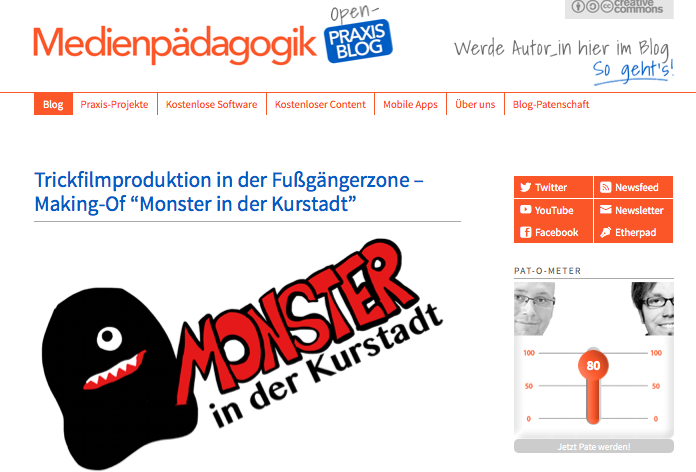
Darin enthalten ist auch das zweiteilige Making-Of des Trickfilms.
Teil 1:
Mit dem Laden des Videos akzeptieren Sie die Datenschutzerklärung von YouTube.
Mehr erfahren
Teil 2:
Mit dem Laden des Videos akzeptieren Sie die Datenschutzerklärung von YouTube.
Mehr erfahren
- Sandra Schön und Martin Ebner (2013). Trickfilmproduktion in der Fußgängerzone – Making-Of „Monster in der Kurstadt“. Beitrag im Weblog Medienpädagogik Praxisblog vom 14.10.2013, URL: https://www.medienpaedagogik-praxis.de/2013/10/14/trickfilmproduktion-in-der-fussgaengerzone-making-of-monster-in-der-kurstadt/
[workshop] Offene Online-Kurse für Massen (MOOC) – was verbirgt sich hinter diesem Trend?
Einladung für Mitarbeiter/innen der Uni Passau (26.10.13): Offene Online-Kurse für Massen (MOOC) – was verbirgt sich hinter diesem Trend?
Zusammen mit Sandra Schön werde ich am Samstag, den 26. Oktober im Rahmen des hochschuldidaktischens Angebots der Universität Passau eine Veranstaltung rund um MOOCs durchführen. Den aller (!) ersten Sketch dazu findet ihr unten – mal schauen, wie das Konzept dann am Ende aussieht.

[L3T] Ein Buch – viele Endformate
 Wie oft mussten wir in den letzten Jahren hören, warum gibt es das Lehrbuch für Lernen und Lehren nicht als ePub gibt oder in einem Format wo man die Texte schön weiterkopieren kann. Nun im digitalen Zeitalter sind diese Fragen berechtigt, aber wer sich damit schon näher auseinandergesetzt hat, weiß dass es die optimale Lösung (noch) nicht gibt.
Wir haben es als Herausforderung des Projekts L3T 2.0 gesehen und uns im Vorfeld auch intensiv mit der Problematik auseinandergesetzt, wie z.B. am Buch „Das Lehrbuch als E-Book“ oder unserem E-Book-Editor sehen kann. Das Ergebnis war, wir brauchen ein gutes Ausgangsformat (XHTML oder HTML) und danach könnten wir rein theoretisch sämtliche andere Formate generieren. Nun das haben wir gemacht – unter der Leitung von Rene haben wir ein Tool entwickelt, welches L3T in seiner zweiten Auflage in sämtliche Endformate konvertieren kann. Ob es gelingt wussten wir damals nicht bzw. welche Hürden alle auf uns zukommen, aber ich denke wir können heute stolz auf ein tolles Endergebnis zurückblicken.
L3T ist nun erhältlich in folgenden Variationen:
[itug, book] Learning Analytics: Mathematik Lernen neu gedacht
 In Zusammenhang mit unserem Angebot https://mathe.tugraz.at ist unter anderem der Additions- und Subtraktionstrainer entstanden. In diesem Buch wird das Thema Learning Analytics im Allgemeinen und das Erlernen der schriftlichen Addition und Subtraktion beschrieben, sowie die Details zum Programm und deren Evaluation. Danke an Benedikt der seine Arbeit der iTuG-Serie zur Verfügung stellt.
Zusammenfassung:
Durch den rasanten Aufstieg des Internets in den letzten Jahren stehen immer mehr digitale Daten von Benutzern zur Verfügung. Dies stellt eine Chance für den Bildungsbereich dar, mit diesen Daten zu arbeiten, diese zu analysieren und daraus wertvolle Schlüsse ziehen zu können. Mit der Thematik der Datensammlung und Analyse beschäftigt sich der Forschungsbereich ”Learning Analytics“.
Dieser stellt Tools und Techniken zur Auswertung von Daten, welche durch Informationssysteme generiert werden, zur Verfügung.
Das Hauptziel dieser Arbeit ist die Konzeption und die Implementierung eines adaptiven Informationssystems für Schülerinnen und Schüler der dritten bis fünften Schulstufe. Dieses System mit dem Namen ”Plusminus-Trainer“ bietet die Möglichkeit, Addition und Subtraktion zu trainieren und eine Echtzeitfehleranalyse zu erhalten.
Das Programm selbst ist unter https://mathe.tugraz.at frei zugänglich.
[publication] Discussing Public Voting in the Web as a Measure to Democratize Award Decisions
Our publication for this year Social Media Conference in HongKong about „Discussing Public Voting in the Web as a Measure to Democratize Award Decisions“ is now online available. The slides were already published here.
Abstract:
As active and innovative e-learning researchers, we had been part of the voting crowd but also were applicants to public voting contents on the Web. L3T, a project delivering an open textbook about learning and teaching with technologies, was applicant at three public voting contests on the Web: at the ‘Neue Deutsche Buchpreis” (2011), at the podcast competition of the MMKH (2011) as well as at the MOOC Production Fellowship (2013). According to our experiences made, we got the impression, that there is a need to re-name ‘public voting” to ‘social voting”, as it is not ‘the public” (i.e. the crowd) that decides who wins. In fact, we found out social aspects, i.e. strong and weak ties in so- cial communities to dictate the voting results. Therefore the publication ad- dresses the research question, whether public voting on the Web is a democratic process at all.
Discussing Public Voting in the Web as a Measure to Democratize Award Decisions by Martin
Klicken Sie auf den unteren Button, um den Inhalt von www.scribd.com zu laden.
Reference: Ebner, M., Schön, S., Stocker, A., Rothe, H., Tsang, P. (2013) Discussing Public Voting in the Web as a Measure to Democratize Award Decisions. In: Tsang,P., Eustace K. Tsoi, R, & Tse, S.(eds) Proceedings of Social Media 2013, pp. 51-59, City University press, ISBN 978 988-19712-1-0