[presentation] It’s a Match! – Chancen und Herausforderung der Digitalisierung im Unterricht #digitalisierung #schule

Im Rahmen einer Vortragsreihe für Lehramtsstudierende bin ich gebeten worden einen kurzem Impuls rund um das Thema Digitalisierung und Unterricht zu geben. Hier der Foliensatz:

Klicken Sie auf den unteren Button, um den Inhalt von www.slideshare.net zu laden.

Inhalt laden

[publication] How to Support Girls’ Participation at Projects in Makerspace Settings. Overview on Current Recommendations #research #tugraz

Our contribution to the Edurobotics conference 2018 got published right now. According to the title „How to Support Girls’ Participation at Projects in Makerspace Settings„. Overview on Current Recommendations“ we did a study with a special view how we can increase the participation of girls in makerspaces.

Abstract:
Several biases and thresholds challenge the reach of girls in technology-related activities. For this contribution we collected and structured existing research and good practices on how to reach girls within projects in the field educational robotics, makerspaces, coding and STEM in general. The contribution presents general guidelines for future activities with a potential higher rate of participating girls in makerspace settings.

Abstract of the publication

[article @ publisher’s homepage]
[draft @ ResearchGate]

Reference: Schön S., Rosenova M., Ebner M., Grandl M. (2020). How to Support Girls’ Participation at Projects in Makerspace Settings. Overview on Current Recommendations​.​ In: Moro M., Alimisis D., Iocchi L. (eds) Educational Robotics in the Context of the Maker Movement. Edurobotics 2018. Advances in Intelligent Systems and Computing, vol 946, pp. 193-196, Springer, Cham

[project] You Can Code YC^2 #tugraz #schule

Das Projekt „You Can Code“ ist nun abgeschlossen und es sind umfassende Unterlagen und Lehrmittel entstanden rund um den Einsatz des Ozobots für den Schulunterricht. Es zahlt sich also auf alle Fälle aus auf dieser Webseite vorbei zu schauen. Alles ist offen lizenziert frei erhältlich. Wir würden uns auch sehr über Rückmeldungen und Einsatzberichte freuen 🙂

You Can Code
Projektlogo

[publication] More Than a MOOC—Seven Learning and Teaching Scenarios to Use MOOCs in Higher Education and Beyond #mooc #imoox

Our contribution to the book Emerging Technologies and Pedagogies in the Curriculum“ got published right now. Following the title „More Than a MOOC—Seven Learning and Teaching Scenarios to Use MOOCs in Higher Education and Beyond“ we described different scenarios how MOOCs can be used in (Higher) Education. Furthermore, we also did a short summary of the outcome, which you can find here.

Abstract:
Since 2010, Massive Open Online Courses (MOOCs) have been one of the most discussed and researched topics in the area of educational technology. Due to their open nature such courses attract thousands of learners worldwide and more and more higher education institutions begin to produce their own MOOCs. Even the (international) press is full of reports and articles of how MOOCs can revolutionize education. In this chapter, we will take a look from a meta-level. After years of experiences with different MOOCs, we recognize that many MOOCs are used in different ways by teachers, lecturers, trainers and learners. So, there are different learning and teaching scenarios in the background often not visible to the broader public. Therefore, we like to address the following research question: “How can MOOCs be used in Higher Education learning and teaching scenarios and beyond?” In the study, the authors will focus on the seven identified scenarios how particular MOOCs were used for teaching and learning and therefore illustrate, that a MOOC can be “more than a MOOC”. MOOCs are one of the key drivers for open education using Open Educational Resources. The use of open licenses for MOOC resources are the mechanism for potential innovations in learning and teachings scenarios.

Abstract of the publication

[article @ publisher’s homepage]
[draft @ ResearchGate]

Reference: Ebner M., Schön S., Braun C. (2020) More Than a MOOC—Seven Learning and Teaching Scenarios to Use MOOCs in Higher Education and Beyond. In: Yu S., Ally M., Tsinakos A. (eds) Emerging Technologies and Pedagogies in the Curriculum. Bridging Human and Machine: Future Education with Intelligence. pp. 75-87 Springer, Singapore

[master] Development of a learning diary for a MOOC platform #app

Markus did his masterthesis about „Development of a learning diary for a MOOC platform“ and developed the iMooX Coach.
Here you can find his slides for the defense:

Klicken Sie auf den unteren Button, um den Inhalt von www.slideshare.net zu laden.

Inhalt laden

50 Mio. Euro für Digitalisierung an unseren Universitäten und iMooX ist dabei #imoox #mooc

iMooX die Bildungsplattform für Österreich

Seit gestern ist nun offiziell, iMooX ist eines der geförderten Projekte in der nun laufenden Ausschreibung des Bundesministeriums. Dabei ist das Ziel des Projektes folgendermaßen definiert:

iMooX wird derzeit von der TU Graz betrieben und soll im Rahmen des Projektes sowohl technisch als auch organisatorisch, logistisch und mediendidaktisch so ausgebaut werden, dass mittelfristig alle österreichischen Hochschulen auf der Plattform MOOCs anbieten können.

Auszug aus dem Projekantrag

Kurzum wir wollen, dass jeder österreichische Hochschule iMooX nun nicht nur passiv, sondern aktiv nutzen kann. Daher haltet uns die Daumen, dass wir das in den nächsten Jahren schaffen und wir freuen uns natürlich auch, dass viele Lernende vom Angebot profitieren können 🙂

[Pressemeldung des BMBWF]
[Bericht auf Futurezone]

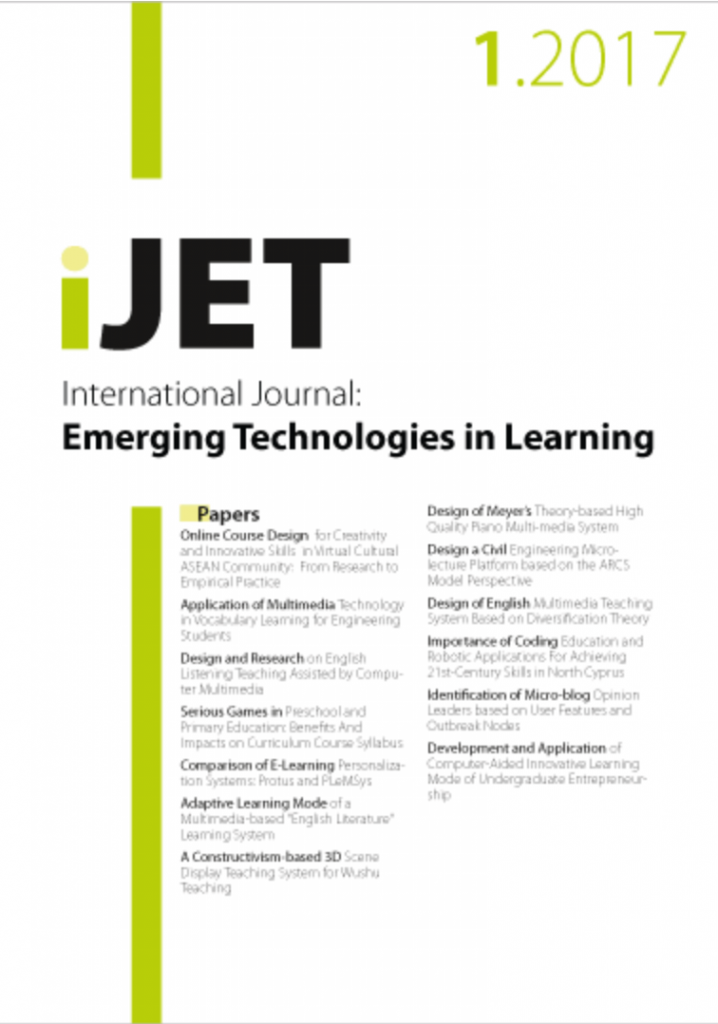
[ijet, journal] Journal of Emerging Technologies in Learning Vol. 15 / No. 1 #ijet #research

Issue 15(1) of our journal on emerging technologies for learning got published. Enjoy the readings as usual for free :-).

Table of Contents:

  • Evaluation of Physical Education Teaching Quality in Colleges Based on the Hybrid Technology of Data Mining and Hidden Markov Model
  • Managerial Potential of Educational Organizations under Conditions of Network Interaction
  • Design and Implementation of a Computer Aided Intelligent Examination System
  • Perceptions of Syrian Student Refugees towards Blended Learning: Implications for Higher Education Institutions
  • The Effectiveness of ECOLA Technique to Improve Reading Comprehension in Relation to Motivation and Self-Efficacy
  • Improving Learning Experience of Probability and Statistics using Multimedia System
  • The Effect of Non-Monetary Rewards on Employee Performance in Massive Open Online Courses
  • Facilitating K-12 Teachers in Creating Apps by Visual Programming and Project-based Learning
  • Effects of Multimedia-Assisted Learning on Learning Behaviors and Student Knowledge in Physical Education Lessons: Using Basketball Game Recording as an Example
  • The Challenges of Adopting M-Learning Assistive Technologies for Visually Impaired Learners in Higher Learning Institution in Tanzania
  • Recognition and Segmentation of English Long and Short Sentences Based on Machine Translation
  • Exploring the Drivers of Intention to Use Interactive Whiteboards among Malaysia University Students: Does Technology Self-Efficacy Matter?
  • Microblogging with Padlet: Students’ New Writing Experience on A2–B1 Common European Framework of Reference for Languages (CEFR)
  • Deep Learning: The Impact on Future eLearning
  • Creative-Thinking Skills in Explanatory Writing Skills Viewed from Learning Behaviour: A Mixed Method Case Study
  • The Digital World for Children and its Relationship with Personality Disorders: Exploring Emerging Technologies
  • Chibumons: A Positive Effect On Game to Undergraduate Students
  • Formation of Professional Orientation of High School Students to Medical Profession by Using ICT Tools

[Link to Issue 15/01]

Nevertheless, if you are interested to become a reviewer for the journal, please just contact me :-).

[publication] Designing a Makerspace for Children – Let’s Do It #makereducation #research

Our contribution to the Edurobotics conference 2018 got published right now. According to the title „Designing a Makerspace for Children – Let’s Do It“ we described our first Makerdays 2015.

Abstract:
When makerspaces are designed for children, special motivation and reasoning needs to be made. Within this article, we describe a case study: A temporary four-day open makerspace for about 40 children per day. Motivation, considerations and the development process as well as the actual realization are described and discussed. We comment on how such a space for children and adolescents should be arranged for future studies. As described, considerations in terms of participation, peer tutoring and gender mainstreaming influence the design of the space, the methods used, as well as the general setting.

Abstract of the publication

[article @ publisher’s homepage]
[draft @ ResearchGate]

Reference: Schön S., Ebner M., Grandl M. (2020) Designing a Makerspace for Children – Let’s Do It. In: Moro M., Alimisis D., Iocchi L. (eds) Educational Robotics in the Context of the Mak-er Movement. Edurobotics 2018. Advances in Intelligent Systems and Computing, vol 946., pp. 3-15 Springer, Cham

[CallForPapers] Special Issue „Computational Thinking“

We are very happy, that we can announce a Call for Papers for a Special Issue on „Computational Thinking“ for the open access journal „future internet„. Of course we would love, if you find some time to make a contribution.

Most important: Deadline for manuscript submissions: 31 July 2020

I made a website for further informations [Link] or you find it also at the journal’s homepage. In any case do not hesitate to contact us for any question.

[publication] Open educational resources in continuing adult education: development in the German-speaking area #OER #research

Our article about „Open educational resources in continuing adult education: development in the German-speaking area“ got published in the Journal „Smart Learnining Environment„. We aimed to give a short overview about the situation in the german-speaking area.

Abstract:
Open Educational Resources (OER) allow many different uses in educational work that are excluded from traditional materials by copyright laws, such as modifying and republishing existing materials. This article examines the current role of OER in the field of adult education in German-speaking area, especially in Germany, Austria and Switzerland. Although nowadays the topic of digitization is given a high strategic importance in continuing education in Switzerland, OER plays just a subordinate role there.

Website Smart Learning Environment

[full article @ publisher’s homepage]
[full article @ ResearchGate]

Reference: Schön, S. & Ebner, M. (2019) Open educational resources in continuing adult education: development in the German-speaking area. Smart Learn. Environ. (2019) 6: 25. https://doi.org/10.1186/s40561-019-0111-4