[imoox] Medienkompetenz in der Lehre #mekomooc #imoox

Es freut uns, dass wir diese Woche den MOOC zu „Medienkompetenz in der Lehre“ nochmals starten können. Es handelt sich dabei um einen Wiederstart des MOOCs aus dem Sommersemester 2018, wobei durch die Rückmeldungen einige Überarbeitungen erfolgten. So wurden z. B. Videos ergänzt bzw. auch Fragen überarbeitet. Das Ziel bleibt aber gleich, es geht darum, dass wir einen ersten Überblick über die wichtigsten Felder des Medieneinsatzes in der Lehre geben, wobei der Schwerpunkt auf den Schulbereich liegt.

Kursinhalt:

Dieser MOOC beschäftigt sich mit den wesentlichen Aspekten des Erwerbs von Medienkompetenzen. Dabei geht es um die Definition des Begriffs ebenso wie Einsatzszenarien neuer Medien in der Lehre und den damit verbundenen Herausforderungen der angewendeten Didaktik, eingebettet in die rechtlichen Rahmenbedingungen und der Wirkung von Medien in Praxissituationen. Die Verknüpfung von Theorie und Praxisbeispielen regt zu einer kritischen Auseinandersetzung mit digitalen Medien und webbasiertem Lehren und Lernen an. Die Inhalte richten sich an Lehrende, Studierende aller Fächer, angehende Lehrerinnen und Lehrer, und grundsätzlich an alle an der Thematik interessierten Personen.

Hier das Einführungsvideo:

YouTube

Mit dem Laden des Videos akzeptieren Sie die Datenschutzerklärung von YouTube.
Mehr erfahren

Video laden

Wer nun mitmachen möchte, ist herzlich eingeladen – wie immer ist die Anmeldung bzw. der gesamte Kurs kostenfrei: [Link zur Startseite des MOOC]

[publication] From refugee to programmer? A framework for a collaborative coding program for higher education institutions

Our article about „From refugee to programmer? A framework for a collaborative coding program for higher education institutions“ got published in the Journal of Research in Innovative Teaching & Learning.

Abstract:

Purpose
The purpose of this paper is to share the lessons learned in teaching programming skills to refugees during a time when circumstances were changing quickly and constantly and the needs of the target group were not well known.

Design/methodology/approach
The integration of refugees poses serious challenges for the hosting society’s education system. A large number of refugees can put a strain on all kinds of public resources, and difficulties with differences in languages, previous curricula, falling behind due to having to spend time outside of education, and psychological traumas have to be expected. In response to the refugee crisis and in order to manage mass migration, the adaptive nature and rapid development of civic approaches can contribute to overcoming some of these challenges. To evaluate the impact of civic approaches, the authors have paid attention to refugees{code} an Austrian coding school for refugees which was developed by the civic community and which shows great potential in terms of providing rapid, innovative and adaptive kinds of educational support for refugees, as well as helping to combat the lack of programmers in the Austrian job market.

Findings
As the great potential that initiatives like refugees{code} have for education, there are also substantial challenges. As we learned from the first course, course completion rates were very low. Therefore, it is important to build an infrastructure and a learning environment around the course. This learning environment includes providing mentoring and support, creating spaces where participants can learn. It was also found that having a pedagogically trained staff who is sufficient in the English language, too, is necessary to cater to a heterogeneous group. Also varying teaching strategies according to the needs and skills of the learner is necessary. One of the issues that confronts projects like refugees{code} is also receiving legal status. The collaboration with universities and colleges can be greatly helpful because they are already familiar with the structure of public authorities as well as with heterogeneous groups. Initiatives like refugees{code} are agile and flexible and know how to take advantage of that. The authors conclude that bringing successful education to heterogeneous and culturally different groups is multi-faceted. It is not something any individual organization or project can do; it can only be the result of a system of different actors working together with traditional educational institutions.

Originality/value
This research study reports on two courses of programming for refugees and seeks to offer practical advice for further research and for the implementation of such courses into the educational system. Therefore a framework is proposed which should be taken into account in case of doing similar work.

[article @ Journal’s Homepage]

[article @ ResarchGate]

Reference: Wolf, D., Ebner, M. (2018) From refugee to programmer? A framework for a collaborative coding program for higher education institutions, Journal of Research in Innovative Teaching & Learning, https://doi.org/10.1108/JRIT-09-2017-0024

[app] Eduludo #appdevelopment #tugraz

Im Rahmen unserer Veranstaltung ist eine kleine, aber feine Lernapp entstanden, mit der man verschiedenste Lektionen durchführen kann. Im Vordergrund stand zwar das generelle Ertesten wie man Apps erstellt, aber vielleicht hat jemand auch an der App selbst Spaß:

Eduludo allow you to learn mathematics, english, french and german for free.

In our app:

  • 100% offline based. You’ll have to resolve challenges in each course, once you think you have the answer, just type it to see the result!
  • Multiple profile! You have the possibility to use 7 different slots for keeping your progress.
  • Perfect for children/home-schooler/ people wanting to improve their skills.
  • More than 50 challenges to solve!

[Link zur App]

[publication] Should You Go for Smartphones at School? How the Use of Modern Media in Class Influences IT-Competences #netgeneration #tugraz #digitalnatives

At this year Ed-Media conference in Amsterdam we published our research work about „Should You Go for Smartphones at School? How the Use of Modern Media in Class Influences IT-Competences“.

Abstract:

Since 2007, Graz University of Technology has been conducting an annual poll amongst its first-year students about their IT preferences and competence. On the basis of more than 8600 data records, this long-term survey reports the changes regarding students´ITstudents´IT device ownership, communicative behavior via IT devices, and use of apps as well as social media services over a time period of eleven years. Furthermore, this publication answers the question, whether the use of emerging technologies in classroom has an influence on these changes or not. It can be stated that an „IT-friendly“ environment (most of all internet access) and teaching at secondary school level significantly promotes IT and coding skills but does not intensify the use of social media applications.

[Draft @ ResearchGate]

Reference: Nagler, W., Grandl, M., Haas, M., Schön, M. & Ebner, M. (2018). Should You Go for Smartphones at School? How the Use of Modern Media in Class Influences IT-Competences. In Proceedings of EdMedia: World Conference on Educational Media and Technology (pp. 735-743). Amsterdam, Netherlands: Association for the Advancement of Computing in Education (AACE)

[presentation] Introducing Augmented Reality at Secondary Colleges of Engineering

Thanks to Andreas – he gave a short presentaion of his exciting work about the use of augmented reality in classroom at an engineering school in Austria at this year International Conference on Engineering & Product Design Education (E&PDE2018).
Here you can find his slides:

Klicken Sie auf den unteren Button, um den Inhalt von www.slideshare.net zu laden.

Inhalt laden

[publication] Practical Usage of OER Material in the EFL Classroom #OER #reseach #OpenEducation

We did a publication about „Practical Usage of OER Material in the EFL Classroom“ and give an overview about daily barriers when you try to use OER in classrooms. The findings are for sure interesting.

Abstract:

In this research work, we want to follow the idea of using open educational resources (OER) in a classroom to gather practical experiences. The topic of our choice is English as a foreign language (EFL), because in our opinion a lot of teaching content should be available. The preparation of the lectures, as well as the final lecturing, is described to understand how OER can be used in the EFL classroom. The feedback of the pupils and the lessons learned point out that there are more obstacles than expected, mainly because of the strict copyright law in German-speaking Europe.

[Full Chapter @ Book Homepage]

[Full Chapter @ ResearchGate]

Reference: Maria Haas, Martin Ebner and Sandra Schön (July 18th 2018). Practical Usage of OER Material in the EFL Classroom, Advanced Learning and Teaching Environments Núria Llevot, IntechOpen, pp. 123-136 DOI: 10.5772/intechopen.72452.

[presentation] Didaktische und technische Integration von interaktiven Matlab-Komponenten in einen Massive Open Online Course #imoox #mooc

Johannes hat sich im Rahmen seiner Masterarbeit um den Einbau von Matlab-Komponente in den Mathe-MINT-MOOC gekümmert und erfolgreich umgesetzt. Hier sind die Folien seiner Diplomarbeitsverteidigung:

Klicken Sie auf den unteren Button, um den Inhalt von www.slideshare.net zu laden.

Inhalt laden

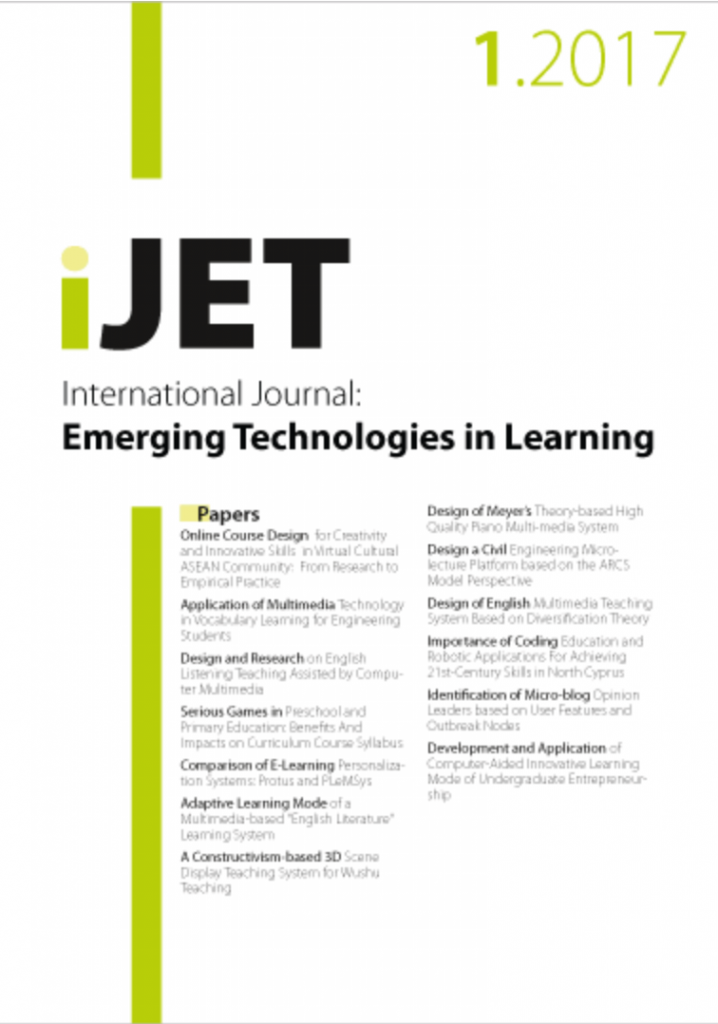
[ijet, journal] Journal of Emerging Technologies in Learning Vol. 13 / No. 8 #ijet #research

Issue 13(7) of our journal on emerging technologies for learning got published. Enjoy the readings as usual for free :-).

Table of Contents:

  • MaGrid: A Language-Neutral Early Mathematical Training and Learning Application
  • A Realistic Visual Speech Synthesis for Indonesian Using A Combination of Morphing Viseme and Syllable Concatenation Approach to Support Pronunciation Learning
  • PE Teaching Activities in Colleges and Universities Based on Decision Tree
  • Effectiveness of Instruction for Summarising Handouts and Academic Writings
  • Mobile English Teaching System Based on Adaptive Algorithm
  • Curriculum Reform and Practice of Mechanical CAD/CAM Technology
  • Guide Teaching System Based on Artificial Intelligence
  • Analysis of a Self-learning System of English Flipped Classroom Based on Adaptive Algorithm
  • Innovation and Entrepreneurship Talents Cultivating: Systematic Implementation Path of “Knowledge Interface and Ability Matching”
  • Teaching Mode of Dance Appreciation Micro-course Based on Primary Teaching Theory
  • An English Translation Teaching Model Based on Interactive Reading Theory
  • A Painting Teaching Mode Based on STEM Theory
  • Animation Production Teaching Model based on Design-Oriented Learning
  • Design of a Digital Art Teaching Platform Based on Automatic Recording Technology
  • An English-language Multimedia Teaching Model Based on Krashen’s Theory
  • A Study of College Basketball LAMS Teaching Model Centered on Learning Activities
  • A Teaching Mode for Art Anatomy Based on Digital Virtual Technology
  • Construction of a Multiple English Teaching Mode Based on Cloud Technology
  • The Effectiveness of Multimedia in Education for Special Education (MESE) to Improve Reading Ability and Memorizing for Children with Intellectual Disability

[Link to Issue 13/8]

Nevertheless, if you are interested to become a reviewer for the journal, please just contact me :-).