
Auf alle interessante Gedanken sind in dem Kurzfilm vorhanden:
[cartoon] Why Politicans like Twitter
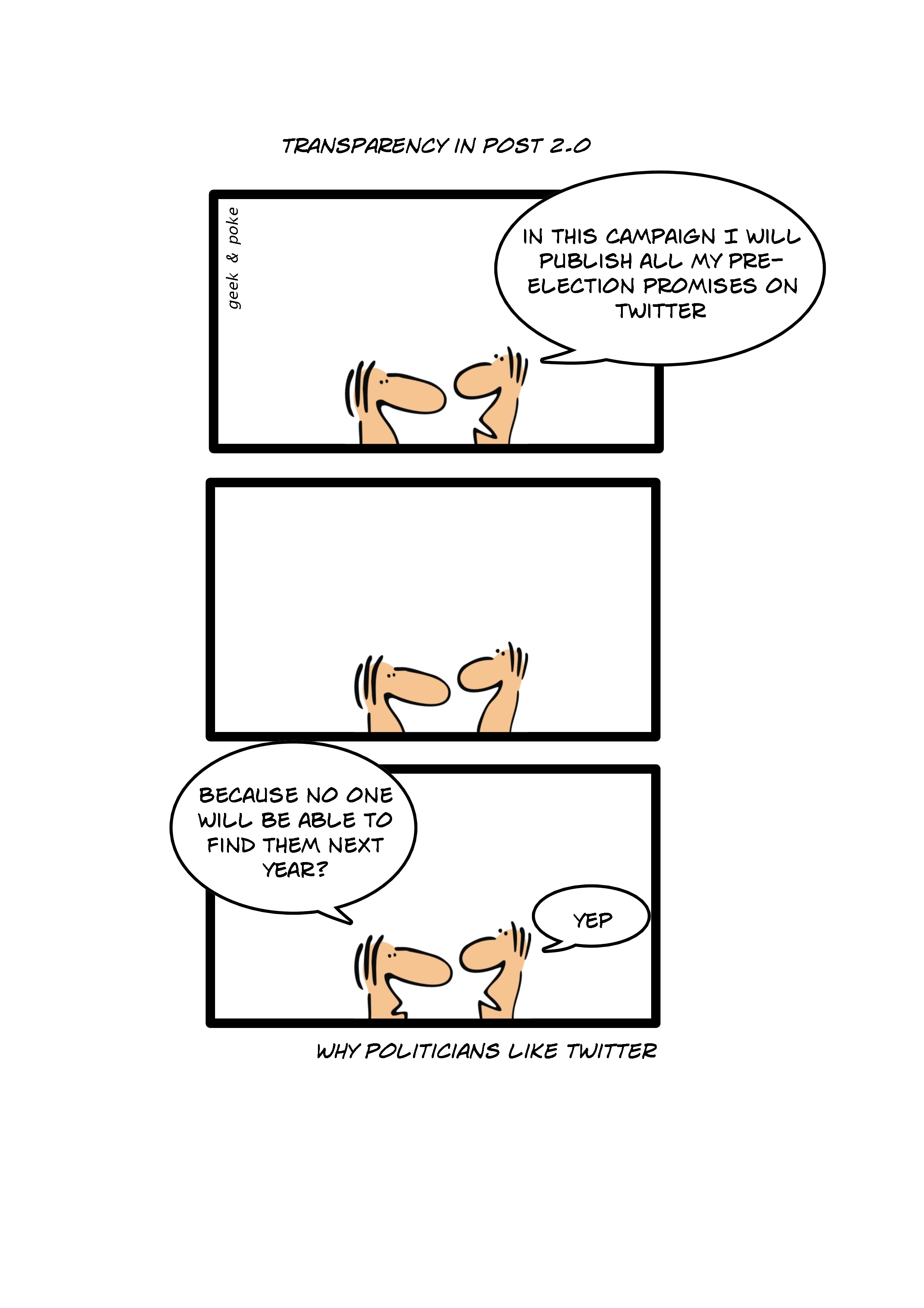
Simply great – thanks to GeekAndPoke
[abstract accepted] Geo-Tagging in Archaeology: Practical Experiences with the TUGeoWiki
Zusammen mit meinem KollegInnen haben wir ein Abstract zum heurigen „International Congress „Cultural Heritage and New Technologies“ (Workshop „Archäologie & Computer“)“ eingereicht. Wir zeigen im Rahmen der Präsentation „Geo-Tagging in Archaeology: Practical Experiences with the TUGeoWiki“ Möglichkeiten und Nutzen von Geotagging im Bereich der Lehre auf und freuen uns auf viele Diskussionsbeiträge.
Abstract:
Introduction and Motivation: The wide spread availability of sophisticated and cheap mobile phones, providing internet access nearly everywhere, have led to advances in the application of new technologies to support field studies and Archaeological documentation. Established tools include Wiki-based mobile geospatial information systems, so called GeoWikis.
Background and Related Work: The primary objective of a GeoWiki is to provide the integration of photographs into an external map via an Application Programming Interface such as the Google maps API. Such MashUps are both a concept and a technology for merging content, services and applications from multiple sites. Experiences gained in civil engineering at Graz University of Technology made it apparent that the creation of a special GeoWiki was necessary: the TUGeoWiki.
Methods and Materials: As a use case we will be evaluating the TUGeoWiki during an archaeological documentation of Roman stones in churches. Relevant issues include both the usability and the usefulness of this application when being utilized in the archaeology domain. During this study the usefulness will be evaluated using heuristic evaluation methods. According to ISO 9241-11 there are three key aspects of usability: efficiency, effectiveness and satisfaction; In order to evaluate the TUGeoWiki against a standardized benchmark, we are applying the System Usability Scale (SUS), a ten-item attitude Likert scale, which isconsidered a valid method of evaluation for mobile devices.
We report on the practical experiences and lessons learned during the use and evaluation of the TUGeoWiki and discuss advantages and disadvantages and possible solutions. Advantages include: taking annotated, geotagged photographs, in a secluded area where the archaeologist has little equipment; the immediate exchange of information and the ability to cooperate with other archaeologists etc.; Disadvantages include the relatively low resolution dependent on the mobile device used; the relative inaccuracy of the GPS location data; and the deviation between the distance of the camera and the object; data protection against tomb raiders etc.
Hier der Link zu unserem Beitrag.
[video] Augmented Reality and the Future of Education
Gut den Kommentaren von Helge, dass es sich hier um reine Science Fiction handelt, ist nichts mehr hinzuzufügen, außer dass meistens irgendwas irgendwie irgendwann dann doch plötzlich real wird. Auf alle Fälle eine nette Gedankenspielerei:
Cloud Computing and E-Book Readers der Hype 2009/2010?
Nun ich denke wir haben/hatten heuer wirklich das Jahr von Twitter und Facebook, sowie es auch im Gartner Hype Cycle angekündigt war (hier hatte ich berichtet).
Nun ein Jahr später befindet sich Microblogging nun im Abwärtstrend und dafür rücken Cloud Computing und E-Book Reader nach bzw. wartet Augmented Reality schon in Lauerstellung. Gespannt darf man auch sein was sich sonst noch alles im Aufwärtstrend befindet.
Hier als der Hype Cycle für 2009:
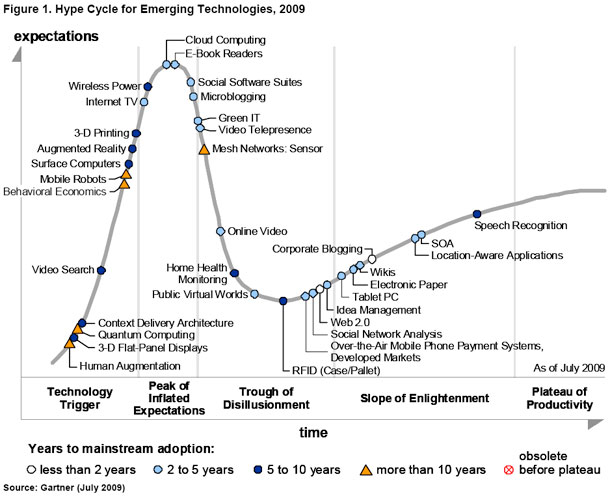
(via Read/Write Web)
Erstes Twittagessen in Graz
Nun also gestern haben wir das erste Twittagessen hier in Graz abgehalten. In einer lockeren Runde haben wir also über das geredet, was wir nicht twittern können 🙂 . Nein es war wirklich nett, ein paar Gleichgesinnte zu treffen und sich auch real kennen zu lernen und ich denke, wir sollten im Herbst das zweite Twittagessen stattfinden lassen.
Hier einmal ein Foto im Gastgarten des Glöcklbräu:
Moblog vom Nokia N95:
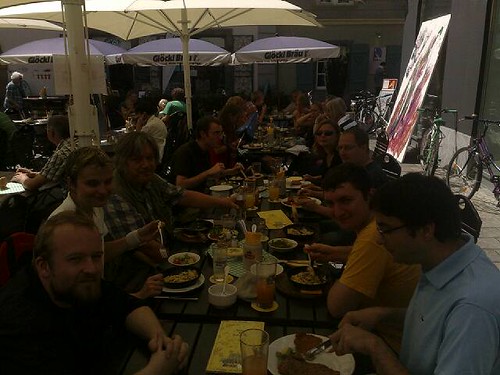
Lifeblog-Inhalt
Lifeblog-Inhalt
Di 11.08.2009 12:35 110820091259
Originally uploaded by Martin Semriach
TeilnehmerInnen: @behi_at, @dobnik, @grr_mono, @heinz, @hzirl, @jakobh, @karlgsoe, @langzahnratte, @walthern und meine Wenigkeit @mebner
Bilder:
- Glöcklbräu
- @walthern und die Kennzeichnung des Tisches
- @mebner bei einem Kurzinterview für FM4
- Jabkobs Bilder auf Flickr
- Beni’s Bild vom Android
Dann bis zum Nächstenmal 🙂 .
[publication] How Web 2.0 Enhance Knowledge Construction in Civil Engineering
Our research article about the use of Web 2.0 technologies in Civil Engineering Education „How Web 2.0 Enhance Knowledge Construction in Civil Engineering“ has been published.
Abstract:
At Graz University of Technology (TU Graz) lots of experience using multimedia or internet based applications in higher education has been gathered. Especially in the field of civil engineering we can refer to a seven year long practical employment. During the very first e-Learning boom at universities in Austria in 2001 some projects in the field of civil engineering have been started in order to investigate the possibilities of web-based education. Nowadays a radical change of the Web, often called Web 2.0, offers possibilities, which can change the e-Education dramatically. The use of Wikis and Weblogs lead to a more collaborative teaching and learning process. Podcasts, in the same way as web based software helps to support the learner of today in a much more efficient way as in the years before.
This paper will discuss how modern technologies can be used in the field of Civil Engineering Education and will show a lot of practical examples of today’s effort in this field at TU Graz. The authors conclude that e-Education will play a very important role in the future of higher education. Bearing in mind that learners of today are the working society of tomorrow this change leads to arbitrarily new situations. Has industry to prepare for a new kind of generation?
Reference: Ebner, M. (2009) How Web 2.0 Enhance Knowledge Construction in Civil Engineering, A. Starcic and M. Kovac (ed.), University & Industry – Knowledge Transfer and Innovation, WSEAS Press, Athen, 2009, p. 77-101
Here you will get the Draftversion.
[CfP] ED-Media 2010 (Toronto/Canada)
Nachdem die heurige ED-Media Konferenz vorüber ist, gibt es ab sofort den Call for Papers (Deadline 18. Dezember 2009) für die nextjährige die in Toronto in Kanada stattfinden wird:
ED-MEDIA – World Conference on Educational Multimedia, Hypermedia & Telecommunications is an international conference, organized by the Association for the Advancement of Computing in Education (AACE).
This annual conference serves as a multi-disciplinary forum for the discussion and exchange of information on the research, development, and applications on all topics related to multimedia, hypermedia and telecommunications/distance education.
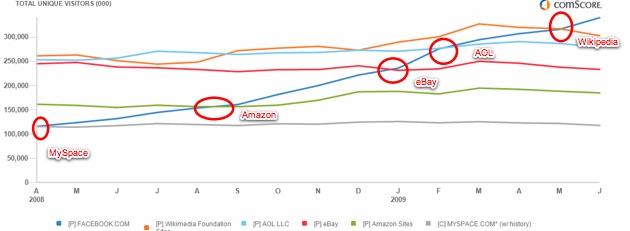
Facebook Is Now the Fourth Largest Site In The World
… dies zeigt ein Bericht auf TechCrunch auf. Vor allem erstaunlich wie schnell derzeit die Applikation wächst und MySpace, Amazon, eBay und die WikiMedia überholt hat.
Nun ich denke man muss weiterschauen, ob es nach dem derzeitigen Boom abklingt aber ernorm ist dieser Wachstum schon.
[video] The Machine is (Changing) Us: YouTube and the Politics of Authenticity
Michael Wesh hat einen Vortrag rund um das Thema wie verändert YouTube unsere Kommunikation gehalten. Ich kann nur sagen großartiger Vortrag und ich denke die 30 Minuten sind es wert es sich anzuhören: