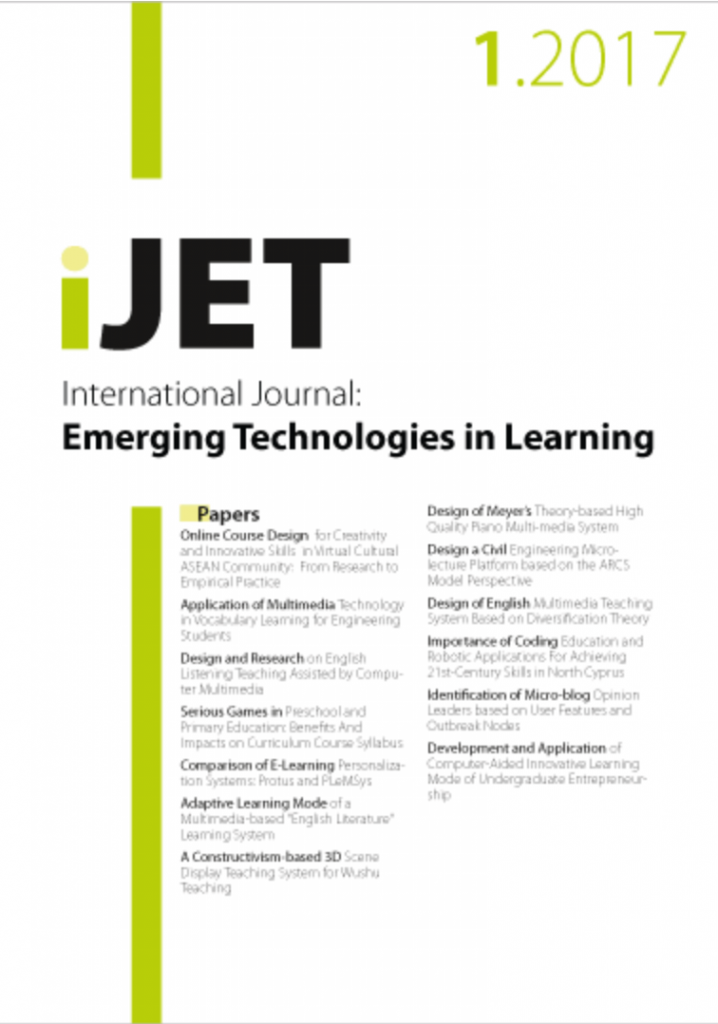
[ijet, journal] Journal of Emerging Technologies in Learning Vol. 21 / No.01 #ijet #research

Issue 21/01 of our journal on emerging technologies for learning got published. Enjoy the readings as usual for free :-).

Table of Contents:

  • Enhancing Power Electronics Labs through Error-Based and Self-Regulated Learning
  • Developing a Gamified Cybersecurity Training Program for Remote Work
  • Enhancing Educational Outcomes through the Integration of Virtual Learning Environment
  • College Students’ Intention to Use AI Tools in Academia
  • From Metaverse Myth to Augmentiverse Reality
  • Assessing the Adoption of Artificial Intelligence in Higher Education

[Link to Issue 21/01]

Nevertheless, if you are interested to become a reviewer for the journal, please just contact me 🙂 .

[guidlines] A digital textbook for everyone: Accessible and interactive, from concept to use #accessibility #tugraz #research

Our final guidlines „A digital textbook for everyone: Accessible and interactive, from concept to use“ are now online available:

The Guidelines offer practical orientation on how to design digital schoolbooks that are didactically sound, inclusive, and accessible. They address everyone involved in creating or using learning materials — from publishers, authors, and teachers to designers, developers, parents, and educational stakeholders.
A key feature of the project is its transdisciplinary approach: experts from subject didactics, inclusive education, UX design, computer science, and accessibility worked together to develop methods, processes, and examples. While the work is based on content from mathematics and geography, the principles are transferable to other subjects.
Digital schoolbooks provide new opportunities for individualized, collaborative, and competence-oriented learning. The Guidelines show how digital materials can follow a “Born Accessible” strategy from the very beginning, aligned with the principles of Universal Design for Learning. They provide concrete recommendations, best practices, and examples that can be directly applied to development projects.
The content covers the entire development process — from defining inclusive learning goals to decisions about design and representation, technical implementation, feedback structures, and ongoing quality assurance.
These guidelines were developed as one of three key outcomes of the Erasmus+ project Digital Education Material (DEM).

[English version @ Zenodo]
[German version @ Zenodo]

Reference:
English version: Brnic, M., Degenhardt, S., Edelsbrunner, S., Erdel, T., Greefrath, G., Kargl, B., Lathan, H., Macchia, V., Mönter, L., Schön, S., Schütt, M.-L., Torri, S., Wetzel, M., & Ebner, M. (2025). A digital textbook for everyone: Accessible and interactive, from concept to use. CDV. https://doi.org/10.5281/zenodo.18313228
German version: Brnic, M., Degenhardt, S., Edelsbrunner, S., Erdel, T., Greefrath, G., Kargl, B., Lathan, H., Macchia, V., Mönter, L., Schön, S., Schütt, M.-L., Torri, S., Wetzel, M., & Ebner, M. (2025). Ein digitales Schulbuch für alle: Barrierefrei und interaktiv von der Idee bis zur Nutzung. CDV. https://doi.org/10.5281/zenodo.18301620

[statement] European Universities alliances must embrace open educational resources #oer

Sandra and I did a short essay about „European Universities alliances must embrace open educational resources“ for the European University Assiciation.

Abstract:
To ensure legally compliant, sustainable and digitally sovereign teaching in European Universities alliances, open educational resources are an essential tool.

[essay @ EUA Homepage]
[essay @ ResearchGate]

Reference: Ebner, M., Schön, S. (2026). European Universities alliances must embrace open educational resources. Expert Voices. European University Association. [draft]

[report] Implementing the European Student Card within the European university alliance Unite! #unite #tugraz

Our report about „Implementing the European Student Card within the European university alliance Unite!. A technical report on status, developments, and plans of Unite! universities“ is online available:

This report describes the implementation of the European Student Card Initiative (ESCI), launched by the European Commission in 2022 and comprising Erasmus Without Paper (EWP), the European Student Card (ESC), and the ERASMUS+ App, within the Unite! alliance. The first part focuses specifically on the ESC, drawing on the actions taken and the information gathered within the framework of the initiative. The Unite! alliance, comprising nine universities (Aalto University, Grenoble INP graduate school of engineering and management, University Grenoble Alpes, KTH Royal Institute of Technology, Politecnico di Torino, Graz University of Technology, Universidade de Lisboa, Universitat Politècnica de Catalunya/BarcelonaTech, Technical University of Darmstadt, and Wroclaw University of Science and Technology), aims to promote the concept of a European campus. The report outlines the nature of this initiative, the strategy adopted since 2023, and the current state of implementation within the Unite! alliance (as of August 2025). It presents two solutions for establishing ESCs within the alliance, including internally developed software solutions, such as a virtual student card application created by Politecnico di Torino, and options involving external service providers, such as Capmonetique in France at UGA (as part of the Unite! partner INP-UGA). The report also highlights potential improvements and broader implications of implementing the ESC, with the objective of supporting and informing other universities about the available solutions.

Recommended Citation:  Bertonasco, R., Diard, J., Landfahrer Berglez, K., Schön, S., Alcober, J., Büttner, W., Cruz, L., Ebner, M., Espadas, C., Ferrian, C., Fink, J., Gasplmayr, K., Hoppe, C., Järvelä, H., Krysiak, J., Oller, M., Petersson, J., Reignier Tayar, N., Schmidt, A., Sessler, C., Szymanska-Kwiecien, A. & Tadaszak, R. (2025). Implementing European Student Card amongst the European university alliance Unite!: A technical report on status, developments, and plans of Unite! universities (Technical Report). Graz University of Technology. DOI: 10.3217/nzz7b-vam63

[Link to the report]

This is an impactful contributions, methodological rigor, and exceptional novelty in the field of european alliances in higher education.

[publication] Digitale Souveränität & OER – Chancen und Verantwortung der Hochschulen #tugraz #OER

Für das letzte fnma-Magazin haben wir noch einen kurzen Beitrag rund um das Thema Digitale Souveräntität und OER geschrieben.

Auf der Tagung Campus Innovation 2021 präsentierten wir, dass die Kombination aus offenen Lehrmaterialien und selbstverwalteten digitalen Infrastrukturen die Unabhängigkeit von externen Anbieter:innen und somit die digitale Souveränität stärkt (Ebner & Schön, 2021). In einem aktuellen Beitrag (Schön & Ebner 2025) haben wir dies erneut aufgegriffen und als einen der Vorteil von OER beschrieben.

[article @ ResearchGate]
[fnma Magazin 04/25]

Referenz: Ebner, M., Schön, S. (2025) Digitale Souveräntität & OER – Chancen und Verantwortung der Hochschulen. fnma Magazin 04/25. S. 31-34. [draft]

[podcast] KI-gestützte Lehre #tugraz

Es freut uns, dass wir nun den 25. Teil unserer Podcast-Serie „Lehren – Lernen – Lauschen“ auf der TELucation-Webseite zur Verfügung stellen können. Diesesmal spricht Benedikt Brünner zu „KI-gestützte Lehre„:

In dieser Folge spricht Benedikt Brünner vom Institute of Human-Centred Computing über seine Forschung zu digitaler Bildung und den verantwortungsvollen Einsatz von KI im Lehr- und Lernprozess. Er gibt Einblicke in seinen Weg vom Lehramt zurück an die TU Graz, erläutert Chancen und Grenzen von KI in der Hochschullehre und zeigt, wie KI-Tutor:innen, gezieltes Prompting und KI-gestützte Lernmaterialien Lehrende und Studierende unterstützen können.

[#27 – Benedikt Brünner zu KI-gestützte Lehre]

Und nicht übersehen – der Podcast ist auch in allen gängigen Portalen verfügbar:


Damit möchte ich mich auch in die Weihnachtspause 2025 verabschieden und mich gleichzeitig bedanken, dass so viele Personen hier mitlesen. Ich darf allen ein schönes Weihnachtsfest 2025 wünschen, sowie ein gutes und gesundes Jahr 2026.
Im Jänner 2026 beginn ich gerne wieder mit alter Frische.