[publication] Offene Bildungsressourcen in der Weiterbildung: Ansätze und Entwicklung im deutschsprachigen Raum #OER #OpenEducation

Im Rahmen des Buches „Digitalisierung und Lernen“ der Serie „Forum Hochschuldidaktik und Erwachsenenbildung“ wurden wir eingeladen über Open Educational Resources zu schreiben und einen Überblick über den deutschsprachigen Raum zu geben:

Offene Bildungsressourcen (englisch Open Educational Resources OER) erlauben zahlreiche Verwendungen in der Bildungsarbeit, die bei herkömmlichen Materialien durch die Urhebergesetze ausgeschlossen sind, wie z. B. die Modifikation und Wiederveröffentlichung vorhandener Materialien. Im Beitrag wird der Frage nachgegangen, welche Rolle OER derzeit im Bereich der deutschsprachigen Weiterbildung, also insbesondere in Deutschland, Österreich und der Schweiz spielen. Obwohl dem Thema Digitalisierung in der Weiterbildung in der Schweiz ein hoher strategischer Stellenwert eingeräumt wird, spielen OER eher eine untergeordnete Rolle.

[Draft @ ResearchGate]

Zitation: Schön, S., Ebner, M., Lüthi-Esposito, G. (2019) Offene Bildungsressourcen in der Weiterbildung: Ansätze und Entwicklungen im deutschsprachigen Raum. In: Digitalisierung und Lernen. Haberzeth, E., Sgier, I. (Hrsg.). Forum Hochschuldidaktik und Erwachsenenbildung. Band 8. hep Verlag. S. 155-168. ISBN 978-3-0355-1334-9

Informationen zum Studienstart an der TU Graz #tugraz #start

Wir freuen uns immer, wenn viele Schülerinnen und Schüler sich entschließen ihr Studium an der TU Graz zu beginnen. Der Einstieg ins Studium ist aber, wie wir wissen, ein sehr schwieriger Zeitraum, denn man muss einmal all die Informationen richtig sortieren können und sich mit dem neuen Umfeld vertraut machen. Daneben geht es dann auch schon inhaltlich los.
Daher versuchen wir schon seit vielen Jahren, ein möglichst umfassende Services anzubieten und so ist auch diese neue Informationsseite mit „Informationen zum Studienstart“ entstanden.

Auf dieser Seite sind u.a. Informationen zu den Vorbereitungskursen und die Online-Versionen des Booklets für die StudienanfängerInnen (deutsche, barrierefreie und englische Version) zugänglich.

[Informationen zum Studienstart (dt., engl.)]

Auch unsere Angebot auf iMooX.at sind gelistet mit den MINT- und FIT-MOOCs inkl. einer Grafik die möglichst anschaulich den zeitlichen Ablauf dieser Online-Kurse darstellen soll:

In diesem Sinn darf ich allen einen guten Studienstart wünschen. Sollte es Fragen geben, stehen wir gerne unter study@tugraz.at zur Verfügung.

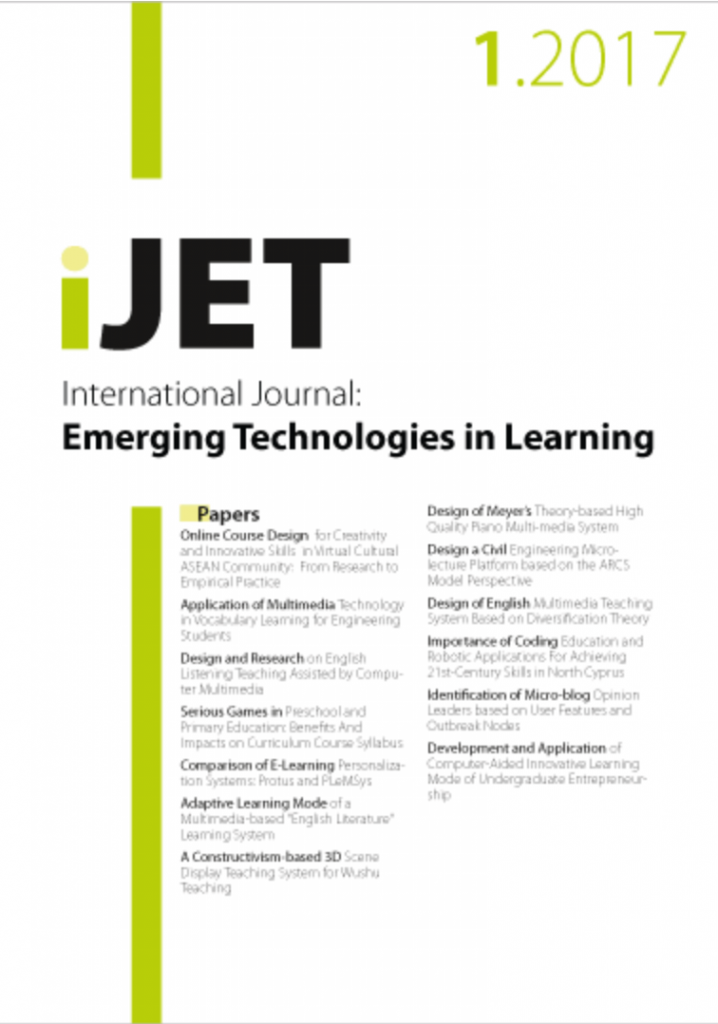
[ijet, journal] Journal of Emerging Technologies in Learning Vol. 14 / No. 13 #ijet #research

Issue 14(13) of our journal on emerging technologies for learning got published. Enjoy the readings as usual for free :-).

Table of Contents:

  • Dyned Programme as Computer Assisted Language Learning (CALL) for University Students: A Perception and Its Impact
  • Effect of Computer Multimedia Assisted Word Annotation on Incidental Vocabulary Acquisition of English Reading
  • The Involvement of Students in Social Network Sites Affects Their Learning
  • College Mathematics Teaching Method Based on Big Data
  • Design and Implementation of a Vue.js-Based College Teaching System
  • The Role of Cloud Computing for the Enhancement of Teaching and Learning in Saudi Arabian Universities in Accordance with the Social Constructivism Theory: A Specialist’s Point of View
  • E-Textbooks and Their Application Levels, from the Perspective of Faculty Members at Ajman University, U.A.E.
  • Physical Education Motion Correction System Based on Virtual Reality Technology
  • Development of an Information-Based Online Foreign Language Teaching Platform with ASP.NET
  • A Trackable Augmented Learning Media System for a Higher Education Level
  • Development and Implementation of Computer Assisted Instruction System in Physical Education Based on ASP.NET Technology
  • Evaluation of Student Performance with Predicted Learning Curve Based on Grey Models for Personalized Tutoring

[Link to Issue 14/13]

Nevertheless, if you are interested to become a reviewer for the journal, please just contact me :-).

[master] Teaching Digital Literacy with the BBC micro:bit in the EFL Classroom #microbit #school

Daniel Wachmann did his master thesis about „Teaching Digital Literacy with the BBC micro:bit in the EFL Classroom„. Here are the slides of his successful defense:

Klicken Sie auf den unteren Button, um den Inhalt von www.slideshare.net zu laden.

Inhalt laden

[publication] A Pedagogical Framework for Mixed Reality in Classrooms based on a Literature Review #VR #AR #tugraz #research

Our publication about „A Pedagogical Framework for Mixed Reality in Classrooms based on a Literature Review“ at this year ED-Media conference in Amsterdam is online available:

Virtual reality devices are not an invention of the previous years. In fact, those are applicable since the 60s and therefore many scholars have elaborated in the potential of virtual reality as a learning platform. There are many diverse ways to integrate these techniques into the classroom. Affordable devices in combination with concepts like making legitimate the usage for learning. Pedagogical motivation factors like collaborations and gamification amply justify the usage of modern VR technologies as a learning platform. A variety of application have been used already in classrooms but in higher education, there is a need to catch up. Those examples have been divided by the way they make use of virtual systems and how they provide supervision. This literature review describes the functional classification of virtual reality, how it typically applies to learning and how it represents the key features for a didactically valuable usage. As a result of the literature research, a framework for the use of mixed reality in education has been developed allowing to spot new capabilities for the implementation of future VR or AR applications. This paper will also clarify the proper direction of development and the potential impact on future educational domains.

[Draft @ ResearchGate]

Reference: Kommetter, C. & Ebner, M. (2019). A Pedagogical Framework for Mixed Reality in Classrooms based on a Literature Review. In J. Theo Bastiaens (Ed.), Proceedings of EdMedia + Innovate Learning (pp. 901-911). Amsterdam, Netherlands: Association for the Advancement of Computing in Education (AACE)

[publication] Business models for Open Educational Resources: how to exploit OER after a funded project? #OER #research

Our publication about „Business models for Open Educational Resources: how to exploit OER after a funded project?“ at this year ED-Media conference in Amsterdam is online available:

Open Educational Resources (OER) projects often face the challenge of how to sustain and develop further the resources after the initial project funding comes to an end. OER are provided for free and open for anybody to re-use, modify and distribute. How than can the producers exploit the resources, are there any feasible business models, especially models which could remove or at least reduce dependence on limited and insecure funding? This article presents results of a survey of literature on OER business models and an overview of models identified in the literature. For projects which developed a learning program with OER the freemium model is being considered as a promising model.

[Draft @ ResearchGate]

Reference: Geser, G., Schön, S. & Ebner, M. (2019). Business models for Open Educational Resources: how to exploit OER after a funded project?. In J. Theo Bastiaens (Ed.), Proceedings of EdMedia + Innovate Learning (pp. 1519-1525). Amsterdam, Netherlands: Association for the Advancement of Computing in Education (AACE).

[publication] Making mit Kindern und Jugendlichen. Einführung und ausgewählte Perspektiven. #MakerEducation #research

Es freut uns sehr, dass unser Beitrag zu „Making mit Kindern und Jugendlichen. Einführung und ausgewählte Perspektiven“ im Buch zu „CHANCE MAKERSPACE – Making trifft auf Schule“ erschienen ist:

Das kreative digitale Gestalten mit Kindern sowie die Maker-Education sind im deutschsprachigen Europa angekommen. Inzwischen gibt es immer häufiger MakerSpaces, die auch Kinder sowie Lehrer*innen und außerschulische Pädagog*innen, die für und mit Kindern Making-Aktivitäten ausführen, zu ihrer Zielgruppe rechnen. In diesem Beitrag werden Kennzeichen und Prinzipien der Maker-Education aufgezeigt, und es wird dargelegt, wie Making-Aktivitäten aus unterschiedlichen ausgewählten Perspektiven Anklang finden. Abschließend wirft der Beitrag einen kurzen Blick auf aktuelle Entwicklungen.

[Beitrag @ ResearchGate]

Auch das gesamte Buch ist auf ResearchGate zugänglich: [Link zum Buch]

Zitation: Schön, S., Narr, K., Grandl, M., Ebner, M. (2019) Making mit Kindern und Jugendlichen. Einführung und ausgewählte Perspektiven. In: CHANCE MAKERSPACE Making trifft auf Schule. Ingold, S., Maurer, B., Trüby, D. (Hrsg). kopaed (muenchen). ISBN 978-3-86736-539-0. S. 45-58

[webinar, recording] Learning and instruction videos: design, production, use #video #education #talk #tugraz

Last week I gave a short webinar about „learning and instruction videos: design, production, use“ for the eduhub network. Now also the recording is available:

Klicken Sie auf den unteren Button, um den Inhalt von tube.switch.ch zu laden.

Inhalt laden

[publication] MAKER DAYS for Kids – ein temporärer Makerspace an der TU Graz #tugraz #MakerEducation #fnma

Das neue FNMA-Magazin hatte den Themenschwerpunkt „Lernräume und Makerspaces„. Hierzu haben wir die MakerDays der TU Graz beschrieben und laden auch gerne nochmals zum Fachtreffen am 7.8.2019 ein (Anmeldung kostenfrei).

Die MAKER DAYS for Kids verfolgen in erster Linie das Ziel, Kindern und Jugendlichen im Alter von 10 bis 14 Jahren einen Zugang zu einem (temporären) Makerspace zu ermöglichen, wo sie Anregungen und Unterstützung zum/beim (digitalen) Selbermachen von erwachsenen Tutoren und Gleichaltrigen, den sogenannten Peer Tutoren, erhalten. Die Aktivtäten im Makerspace sollen dabei neue Lernmöglichkeiten eröffnen, die nicht nur auf den Fachbereich der Informatik beschränkt sind.

[Beitrag @ ResearchGate]

Zitationsangabe: Grandl, M., Ebner, M., (2019) MAKER DAYS for Kids – ein temporärer Makerspace an der TU Graz. fnma-Magazin 02/2019. S. 15-18. ISSN: 2410-5244

[publication] Automatic Authentication of Students at an Interactive Learning-Video Platform #tugraz #edil19 #edmedia19 #research

Our publication about „Automatic Authentication of Students at an Interactive Learning-Video Platform“ at this year ED-Media conference in Amsterdam is online available:

There are many reasons for the implementation of authentication on learning platforms. For instance, it is required for the teachers to identify individual students if the learning platform offers some kind of assessment. In addition, authentication is the base for a successful monitoring of the attendance of the students. Compulsory attendance is often applied because many positive effects have been reported by authors of several studies. To monitor the attendance at online videos interactive components can be applied. Another benefit of such interactive components is that they help retain the attention of the students. This study was carried out to examine how the students used a video learning platform which provides interactive components of the videos as part of a course offered at Graz University of Technology. Up until now, a major drawback of this platform has been that the students have been required to register manually on the platform. Now, students are able to use the platform without manual registration and authentication, because these steps happen automatically via the main learning platform that provides all of the course materials. Furthermore, the course design and the application of the interactive components, presenting multiple-choice questions, are evaluated. It is pointed out that the concept improves the performance of the students and equips the teacher with valuable feedback regarding the students‘ interests.

[draft @ ResearchGate]

Reference: Wachtler, J., Scherz, M. & Ebner, M. (2019). Automatic Authentication of Students at an Interactive Learning-Video Platform. In J. Theo Bastiaens (Ed.), Proceedings of EdMedia + Innovate Learning (pp. 569-582). Amsterdam, Netherlands: Association for the Advancement of Computing in Education (AACE)