[makereducation] MakerDays for Kids nun in Leipzig #tugraz

Nach den MakerDays for Kids ist quasi vor den MakerDays – sie wandern also nach den erfolgreichen Tagen in Graz nach Leipzig im Herbst 🙂

Mehr Infos gibt es dann auf der brandneuen Webseite, die generell über die MakerDays berichtet und das Konzept vorstellt. Und wenn man im Raum Leipzig wohnt und Kinder hat, die zwischen 10-14 sind, kann ich nur wärmstens eine Anmeldung empfehlen 🙂

[Webseite & Anmeldung zu den MakerDays]

[publication] Setup of a Temporary Makerspace for Children at University: MAKER DAYS for Kids 2018 #tugraz #makereducation #makerdays

The conference proceeding of this year „Robotics in Education“ is online now and we contributed with a chapter about the MakerDays for Kids.

Abstract:

The maker movement has become a driving force for the new industrial revolution, whereby all learners should have the opportunity to engage. Makerspaces exist in different forms with different names and a variety of specializations. The MAKER DAYS for kids are a temporary open makerspace setting for children and teenagers with the goal to democratize STEAM education and social innovation and to empower young learners, especially girls, to shape their world. This publication presents the setup and results of a temporary makerspace at Graz University of Technology with more than 100 participants in four days in summer 2018 and discusses the role of new technologies as a trigger of making in education. Moreover, the MAKER DAYS implemented an innovative evaluation concept to document the participants’ activities in open and unstructured learning environments.

[article @ publisher’s Homepage]

[draft @ ResearchGate]

Reference: Grandl M., Ebner M., Strasser A. (2020) Setup of a Temporary Makerspace for Children at University: MAKER DAYS for Kids 2018. In: Merdan M., Lepuschitz W., Koppensteiner G., Balogh R., Obdržálek D. (eds) Robotics in Education. RiE 2019. Advances in Intelligent Systems and Computing, vol 1023. Springer, Cham

[article] Efforts in Europe for Data-Driven Improvement of Education – A Review of Learning Analytics Research in Six Countries #LearningAnalytics #tugraz

I did an article with a hand of colleagues about „Efforts in Europe for Data-Driven Improvement of Education – A Review of Learning Analytics Research in Six Countries“ for the first issue of the „International Journal of Learning Analytics and Artificial Intelligence for Education (iJAI)„.

Abstract:

Information and communication technologies are increasingly mediating learning and teaching practices as well as how educational institutions are handling their administrative work. As such, students and teachers are leaving large amounts of digital footprints and traces in various educational apps and learning management platforms, and educational administrators register various processes and outcomes in digital administrative systems. It is against such a background we in recent years have seen the emergence of the fast-growing and multi-disciplinary field of learning analytics. In this paper, we examine the research efforts that have been conducted in the field of learning analytics in Austria, Denmark, Finland, Norway, Germany, Spain, and Sweden. More specifically, we report on developed national policies, infrastructures and competence centers, as well as major research projects and developed research strands within the selected countries. The main conclusions of this paper are that the work of researchers around Europe has not led to national adoption or European level strategies for learning analytics. Furthermore, most countries have not established national policies for learners’ data or guidelines that govern the ethical usage of data in research or education. We also conclude, that learning analytics research on pre-university level to high extent have been overlooked. In the same vein, learning analytics has not received enough focus form national and European national bodies. Such funding is necessary for taking steps towards data-driven development of education.

[article @ journal’s homepage]

[article @ ResearchGate]

Reference: Nouri, J., Ebner, M., Ifenthaler, D., Saqr, M., Malmberg, J., Khalil, M., Bruun, J., Viberg, O., González, M., Papamitsiou, Z., Berthelsen, U. (2019) Efforts in Europe for Data-Driven Improvement of Education – A Review of Learning Analytics Research in Six Countries. IN: International Journal of Learning Analytics and Artificial Intelligence for Education (iJAI). 2019(1). pp. 8-27

[CfP] Positioning Artificial Intelligence in Education –Evidence and Reflections #ijai #reseach #tugraz

We would like to call for you contribution to a call for „Positioning Artificial Intelligence in Education –Evidence and Reflections„. We would like to do a special issue for the International Journal of Learning Analytics and Artificial Intelligence for Education (iJAI).

Due to recent technological advancements, artificial intelligence (AI) has received increased attention and has been adopted to many sectors and fields, thus, producing a profound impact. Given the rapid advancement of AI, it is expected that AI will continue to develop, integrate deeper and in many different sectors. Although the application of AI in the educational sector has been the subject of research for more than 30 years, a renewed and enforced interest in AI in education can be documented through the themes of scientific conferences, workshops and research papers, as well as how the Edtech industry is increasing efforts to integrate AI in educational applications. Indeed, this development is not unexpected considering that AI is associated with potentials of more personalized, adaptive and inclusive learning, and with empowered teachers and advanced learning environments. This Special Issue aims at highlighting contemporary research that covers AI in education. We are looking forward to receive both theoretical and empirical papers that provide readers with a better understanding of the theoretical discussions that are currently taking place, the empirical studies that are conducted, and the AI applications and systems that are developed

Submission of full paper: December 10, 2019

Find here the „Call for Paper“ with all details.

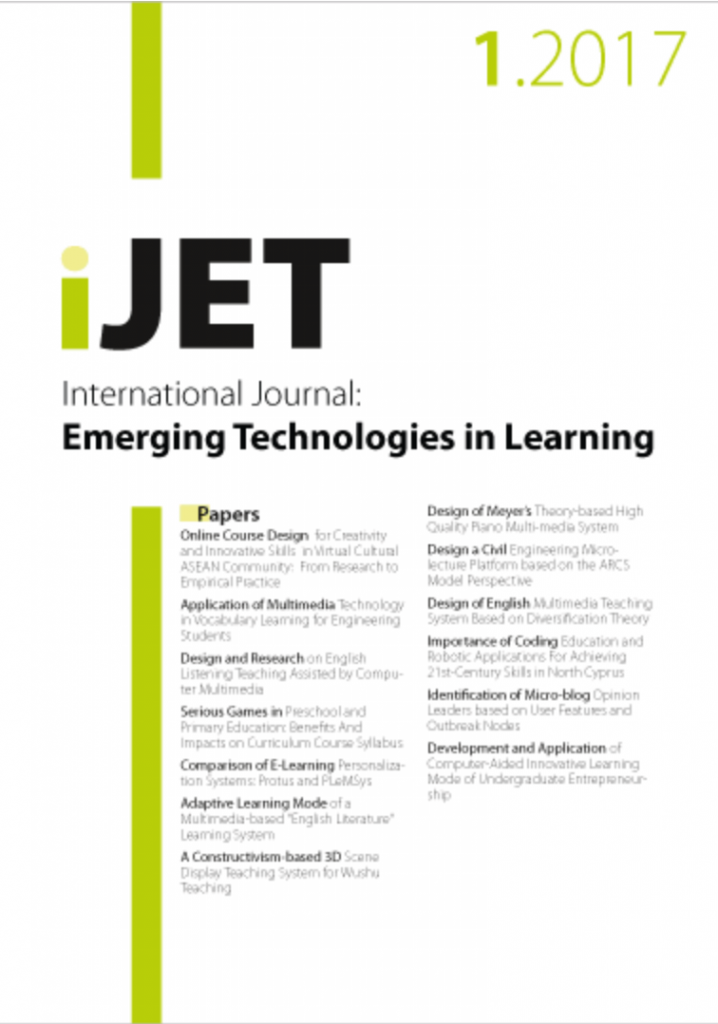
[ijet, journal] Journal of Emerging Technologies in Learning Vol. 14 / No. 16 #ijet #research

Issue 14(16) of our journal on emerging technologies for learning got published. Enjoy the readings as usual for free :-).

Table of Contents:

  • Development of an Instructional Design Model for Mobile Blended Learning in Higher Education
  • Knowledge Management and Reuse in Virtual Learning Communities
  • New Tools for the Immersive Narrative Experience
  • From Learning Game to Adaptive Ubiquitous Game Based Learning
  • Are Educational Games Engaging and Motivating Moroccan Students to Learn Physics?
  • Effectivity of Augmented Reality as Media for History Learning
  • IMS Compliant Ontological Learner Model for Adaptive E-Learning Environments
  • A Flipped Classroom-Based Education System for College English Teaching
  • An Improved Back-Propagation Neural Network for the Prediction of College Students’ English Performance
  • Computer-Aided English Teaching Platform Based on Secure Shell Framework
  • English Teaching Platform Based on Online Education Technology and Licensure and Master’s Program Technology
  • Innovative Methods in Medical Education in Bulgaria: Video Materials and Serious Games
  • Using Broadcasting Learning Design to Enhance Student’s Experiential Skill
  • Adaptive Navigation Support: A Literature Review of Its Application and Implication in Learning Process
  • Massive Open Online Course Platform Blended English Teaching Method Based on Model-View-Controller Framework

[Link to Issue 14/16]

Nevertheless, if you are interested to become a reviewer for the journal, please just contact me :-).

[ijet, journal] Journal of Emerging Technologies in Learning Vol. 14 / No. 14 #ijet #research

Issue 14(14) of our journal on emerging technologies for learning got published. Enjoy the readings as usual for free :-).

Table of Contents:

  • Evaluation of an Educational Media on Cube Nets Based on Learning Effectiveness and Gamification Parameters
  • MAPSS: An Intelligent Architecture for the Pedagogical Support
  • Nursing Students’ Attitudes Toward Simulation Technology in Nursing Education
  • Application of Computer Technology in Aesthetic Education and Feature Analysis
  • An Innovative Preschool Education Method Based on Computer Multimedia Technology
  • An Innovative English Teaching System Based on Computer Aided Technology and Corpus Management
  • A Teaching Quality Evaluation System of Massive Open Online Courses Based on Big Data Analysis
  • Student Academic Performance Prediction using Supervised Learning Techniques
  • Towards a New Generation of Intelligent Tutoring Systems
  • The Effect of Scientific Creativity in Inquiry Learning to Promote Critical Thinking Ability of Prospective Teachers
  • Application of Classroom Response Systems (CRS): Study to Measure Student Learning Outcome

[Link to Issue 14/14]

Nevertheless, if you are interested to become a reviewer for the journal, please just contact me :-).

[imoox, mooc] Medienkompetenz in der Lehre #MeKoMOOC20 #imoox

Es freut uns, dass der MeKoMOOC, also jener zu „Medienkompetenz in der Lehre“ in eine neue Runde geht und mit 1.10.2019 auf iMooX.at startet:

Dieser MOOC beschäftigt sich mit den wesentlichen Aspekten des Erwerbs von Medienkompetenzen. Dabei geht es um die Definition des Begriffs ebenso wie Einsatzszenarien neuer Medien in der Lehre und den damit verbundenen Herausforderungen der angewendeten Didaktik, eingebettet in die rechtlichen Rahmenbedingungen und der Wirkung von Medien in Praxissituationen. Die Verknüpfung von Theorie und Praxisbeispielen regt zu einer kritischen Auseinandersetzung mit digitalen Medien und webbasiertem Lehren und Lernen an. Die Inhalte richten sich an Lehrende, Studierende aller Fächer, angehende Lehrerinnen und Lehrer, und grundsätzlich an alle an der Thematik interessierten Personen.

YouTube

Mit dem Laden des Videos akzeptieren Sie die Datenschutzerklärung von YouTube.
Mehr erfahren

Video laden

Natürlich ist die Teilnahmen kostenfrei und man sich bereits jetzt für diesen Online-Kurs anmelden: [Anmeldung zum Kurs]

[special issue] Trends and Opportunities in Online Education #research #tugraz

I editored a special issue on „Trends and Opportunities in Online Education“ together with Markus. A first article got published right now with the title „Crossing the Borders: Re-Use of Smart Learning Objects in Advanced Content Access Systems„:

Abstract:

Researchers in many disciplines are developing novel interactive smart learning objects like exercises and visualizations. Meanwhile, Learning Management Systems (LMS) and eTextbook systems are also becoming more sophisticated in their ability to use standard protocols to make use of third party smart learning objects. But at this time, educational tool developers do not always make best use of the interoperability standards and need exemplars to guide and motivate their development efforts. In this paper we present a case study where the two large educational ecosystems use the Learning Tools Interoperability (LTI) standard to allow cross-sharing of their educational materials. At the end of our development process, Virginia Tech’s OpenDSA eTextbook system became able to import materials from Aalto University’s ACOS smart learning content server, such as python programming exercises and Parsons problems. Meanwhile, University of Pittsburgh’s Mastery Grids (which already uses the ACOS exercises) was made to support CodeWorkout programming exercises (a system already used within OpenDSA). Thus, four major projects in CS Education became inter-operable.

[Link to website of the Open Access Journal]

[mooc] EBmooc plus 2020: Die digitale Praxis für ErwachsenenbildnerInnen #ebmooc #imoox

Es freut uns, dass iMooX.at wieder den neuen EBmooc hosten wird, diesmal unter dem klingenden namen „EBmooc plus 2020„. Und es ist tatsächlich ein Aufbaukurs auf den bereits durchgeführten EBmooc:

Der EBmooc plus ist die neue Generation des offenen Onlinekurses zur digitalen Praxis für ErwachsenenbildnerInnen. Er beinhaltet alles Wichtige zum digitalen Arbeiten in der Erwachsenenbildung:

  • Erwachsenenbildung im digitalen Zeitalter
  • Formate und Didaktik im digitalen Raum
  • Digitale Werkzeuge für die Erwachsenenbildungs-Praxis
  • Sicherheit und Datenschutz in der Erwachsenenbildung
  • Soziale Lernumgebungen im digitalen Raum
  • Kritische Medienkompetenz und Erwachsenenbildung
  • Offene Bildungsressourcen
  • Webinare und Live-Videoformate für die Erwachsenenbildung
  • Möglichkeiten zum Weiterlernen

Der EBmooc plus eignet sich auch als Aufbaukurs zum EBmooc.

Hier gibt es auch den Teaser zum MOOC:

YouTube

Mit dem Laden des Videos akzeptieren Sie die Datenschutzerklärung von YouTube.
Mehr erfahren

Video laden

Die Anmeldung zum MOOC ist ab sofort freigeschaltet und wie immer kostenlos 🙂 [Anmeldung zum MOOC]