[presentation] On Using Learning Analytics to Track the Activity of Interactive MOOC Videos #LAK16 #research

Today Behnam Taraghi is presenting our activities using learning vidoes in MOOCs to enhance the interactivity: „On Using Learning Analytics to Track the Activity of Interactive MOOC Videos„. The presentation is part of the „Workshop on Smart Environments and Analytics in Video-Based Learning (SE@VBL)“ of 2016 Learning Analytics Conference in Edinburgh.
The slides are already available here:

Klicken Sie auf den unteren Button, um den Inhalt von www.slideshare.net zu laden.

Inhalt laden

[publication] Portraying MOOCs Learners: a Clustering Experience Using Learning Analytics #emoocs2016 #mooc

Our paper on „Portraying MOOCs Learners: a Clustering Experience Using Learning Analytics“ at this year EMOOCs conference is now online available.
Abstract:

Massive Open Online Courses are remote courses that excel in their students‘ heterogeneity and quantity. Due to the peculiarity of being massiveness, the large datasets generated by MOOCs platforms require advance tools to reveal hidden patterns for enhancing learning and educational environments. This paper offers an interesting study on using one of these tools, clustering, to portray learners‘ engagement in MOOCs. The research study analyse a university mandatory MOOC, and also opened to the public, in order to classify students into appropriate profiles based on their engagement. We compared the clustering results across MOOC variables and finally, we evaluated our results with an eighties students‘ motivation scheme to examine the contrast between classical classes and MOOCs classes. Our research pointed out that MOOC participants are strongly following the Cryer’s scheme of Elton (1996).

[Full paper @ ResearchGate]

[Conference Proceeding @ ResearchGate]

Reference: Khalil, M., Kastl, C., Ebner, M. (2016) Portraying MOOCs Learners: a Clustering Experience Using Learning Analytics. In: Proceedings of the European Stakeholder Summit on experiences and best practices in and around MOOCs. Khalil, M., Ebner, M., Kopp, M., Lorenz, A., Kalz. M. (Eds.). BookOnDemand, Norderstedt. pp. 265 – 278

[presentation] What is Learning Analytics about? #LearningAnalytics #IA9 #research

Today, Mohammad Khalil is presenting our publication about „What is Learning Analytics about?“ at Smart Learning Excellence Conference in Dubai. Here are his presentation slides:

Klicken Sie auf den unteren Button, um den Inhalt von www.slideshare.net zu laden.

Inhalt laden

[publication] Design für eine Plattform zum Schreibenlernen im Grundschulalter #LearningAnalytics

IDeR BlogIm Rahmen der heurigen DeLFI-Tagung hab ich kurz unser kürzliches begonnenes EU-Projekt, den IDeR-Blog, vorstellen können. Hier gibt es nun noch auch die zugehörige Publikation.
Zusammenfassung:

Viele Jugendliche haben mit Lese- und Schreib- oder Rechtschreibproblemen zu kämpfen. Werden diese nicht erkannt und gefördert, wirkt sich das im Erwachsenenalter negativ aus [SMH08]. In diesem Beitrag beschreiben wir ein Informationssystem für den deutschsprachigen Raum, das sich derzeit im Aufbau befindet und mit Hilfe von Learning Analytics versucht personalisiertes Lernen zu fördern. Die Zielgruppe des Forschungsprojekts sind Kinder im Alter zwischen 8 und 12 Jahren. Schülerinnen und Schüler können Texte in Form von Blogeinträgen verfassen, welche automatisiert auf orthografische Fehler ausgewertet werden. Die qualitative Analyse wird mit Hilfe eines eigens dafür entwickelten Wörterbuches umgesetzt und den Lehrkräften zur Verfügung gestellt.

[Link zum Beitrag]

Zitation: Ebner, M., Taraghi, B., Ebner, M., Aspalter, C., Biermeier, S., Edtstadler, K., Gabriel, S., Goor, G., Gros, M., Huppertz, A., Martich, S., Steinhauer, N., Ullmann, M., Ziegler, K. (2015) Design für eine Plattform zum Schreibenlernen im Grundschulalter. In: Proceedings of DeLFI Workshops 2015 co-located with 13th e-Learning Conference of the German Computer Society (DeLFI 2015)München, Germany, September 1, 2015, S. 118-122.

[conference proceeding] EMOOCs 2016 #graz #emoocs2016

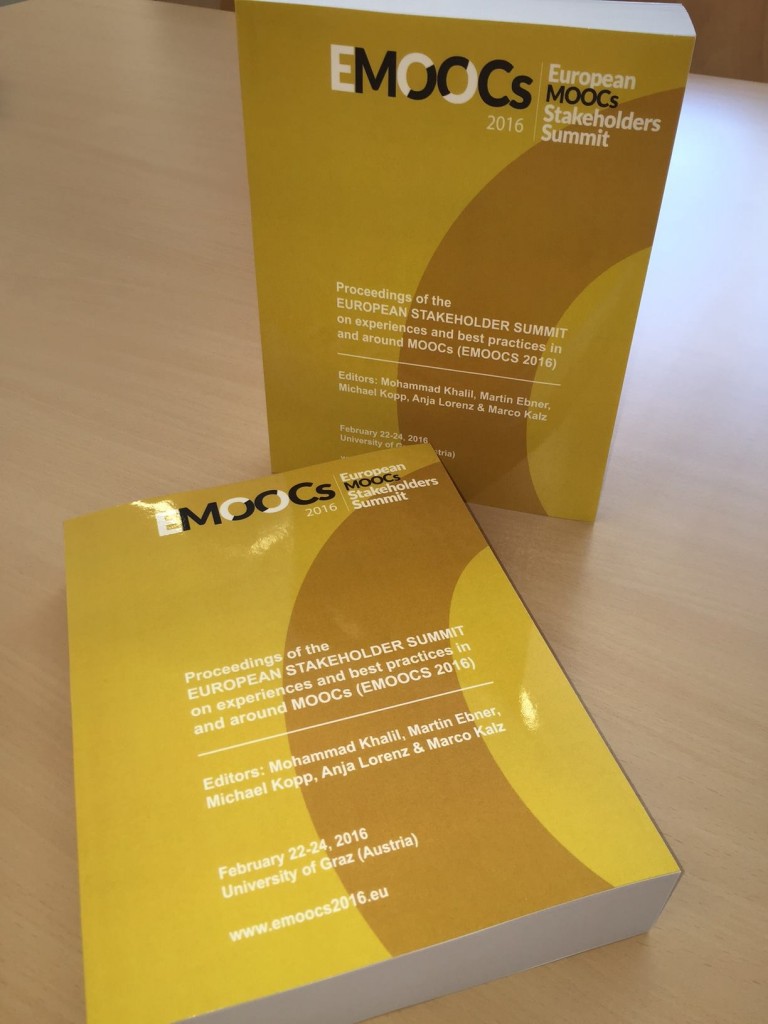
Timley, just one week for conference start the „Proceedings of the European Stakeholder Summit on experiences and best practices in and around MOOCs (EMOOCS 2016)“ are online. Enjoy a huge number of research publications and experience reports as well as some posters in the end. Of course we will love if you visit us in Graz to great discussions on MOOCs.

[Full proceeding @ ResearchGate]

[Buy the proceeding as printed book]

EMOOCs 2016 Conference Proceeding

[presentation] When Learning Analytics Meets MOOCs #tugraz #imoox #emoocs2016

My today’s keynote at the eduhub days 2016 (program) is about Learning Analytics with a special focus to MOOCs. Especially I am talking about our experiences we gathered in the last month and give an overview about our research studies. Enjoy the slides:

Klicken Sie auf den unteren Button, um den Inhalt von www.slideshare.net zu laden.

Inhalt laden

[publication] Wozu Learning-Analytics-Applikationen im Mathematikunterricht #LearningAnalaytic #research

Ich habe für die letzte Ausgabe des L.A.multimedia Magazin einen Kurzbeitrag zu „Wozu Learning-Analytics-Applikationen im Mathematikunterricht?“ verfasst, der nun hier erschienen ist.
Zusammenfassung:

Learning Analytics ist noch ein sehr junges Forschungsgebiet, da es erst seit wenigen Jahren infolge des Internets möglich ist, Daten zentral zu sammeln. Die Interpretation solcher Daten kann Lehrende nun dabei unterstützen den Unterricht individueller zu gestalten und Lernende gezielt zu fördern. Am Beispiel des Einmaleins- Trainer wird gezeigt welche Aussagen getroffen werden können und welche Potentiale Datenanalyse für den Lehr- und Lernbereich haben kann.

[Link zum Beitrag als .pdf]

Zitation: Ebner, M. (2015) Wozu Learning-Analytics-Applikationen im Mathematikunterricht?. L.A. multimedia, 3-2015, S. 40-41

[publication] Schreiben – Rechtschreiben lernen und Lesen mit der Plattform Individuell Differenziert Rechtschreiben mit Blogs – kurz IDeRBlog

Unsere Publikation über das IDER-Blog-Projekt mit dem Titel „Schreiben – Rechtschreiben lernen und Lesen mit der Plattform Individuell Differenziert Rechtschreiben mit Blogs – kurz IDeRBlog“ ist in der neuesten Ausgabe der LA-Multimedia erschienen.
Zusammenfassung:

Schreiben und Lesen ist eine der grundlegenden Fertigkeiten, die in der Schule vermittelt wird. Durch die Existenz von Computern, Tablets und Handys werden den Schülerinnen neue Zugange zum Schreib- und Leselernlernprozess ermöglicht. Diese greift das Erasmus + Projekt IDeRBlog auf, indem es für das Schreiben eine Internetplattform mit vielen Möglichkeiten zur Verbesserung der Rechtschreibung zur Verfügung stellt.

[Full Article at ResearchGate]

Zitation: Gros, M., Steinhauer, N., Ebner, M., Taraghi, B., Ebner, M. Aspalter, C, Martich, S. , Edtstadler, K., Gabriel, S., Huppertz, A.,, Goor, G., Biermeier, S. & Ziegler, K. (2015) Schreiben – Rechtschreiben lernen und Lesen mit der Plattform Individuell Differenziert Rechtschreiben mit Blogs – kurz IDeRBlog. LA Multimedia, 04/2015. S. 22-24

[publication] Improved German Spelling Acquisition through Learning Analytics #iderblog #LearningAnalytics

Our publication about the Learning Analytics implementation within the IDER-blog procject has been published: „Improved German Spelling Acquisition through Learning Analytics“.
Abstract:

Many pupils struggle with the acquisition of the German orthography. In order to meet this struggle a web based platform for German speaking countries is currently developed. This platform aims to motivate pupils aged 8 to 12 to improve their writing and spelling competences. In this platform pupils can write texts in the form of blog entries concerning everyday events or special topics. Since the core of this platform consists of an intelligent dictionary focussing on different categories of misspellings, students can improve their own spelling skills by trying to correct their mistakes according to the feedback of the system. Teachers are informed about specific orthographic problems of a particular student by getting a qualitative analysis of the misspellings from this intelligent dictionary. The article focuses on the development of the intelligent dictionary, details concerning the requirements, the categorization and the used wordlist. Further, necessary information on German orthography, spelling competence in general and the platform itself is given. By implementing methods of learning analytics it is expected to gain deeper insight into the process of spelling acquisition and thus serves as a basis to develop better materials on the long run.

[Full article at ResearchGate]

Reference: Edtstadler, K., Ebner, M., Ebner, M. (2015) Improved German Spelling Acquisition through Learning Analytics. eLearning Papers, 45, pp. 17-28

[webinar] So macht Mathelernen Spaß! #learninglab #tugraz

Im Rahmen eines Webinars habe ich unsere Learning-Analytics-Applikationen vorgestellt. Das Webinar „So macht Mathelernen Spaß!“ steht als Aufzeichnung auch auf YouTube zur Verfügung:

YouTube

Mit dem Laden des Videos akzeptieren Sie die Datenschutzerklärung von YouTube.
Mehr erfahren

Video laden

[Mehr Informationen rund ums Webinar]