[ijet, journal] Journal of Emerging Technologies in Learning Vol. 18 / No.07 #ijet #research

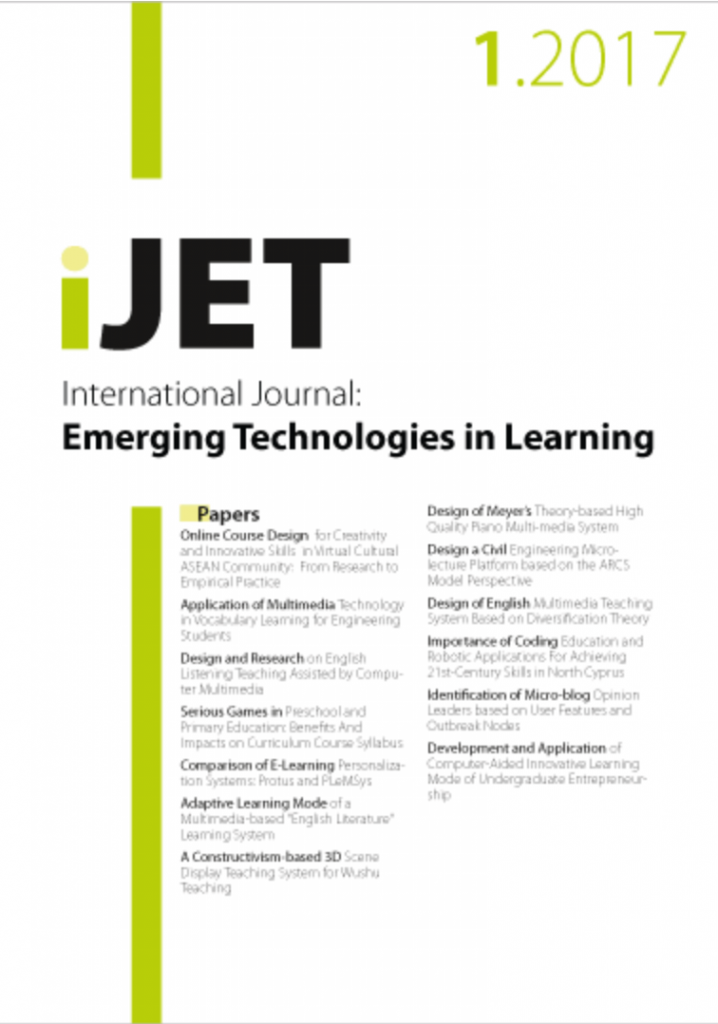
Issue 18(07) of our journal on emerging technologies for learning got published. Enjoy the readings as usual for free :-).

Table of Contents:

  • Simulating Social Emotion Regulation in Virtual Reality
  • A Gamification Approach for Making Online Education as Effective as In-Person Education in Learning Programming Concepts
  • Media Literacy and Young People’s Digital Skills
  • Students’ Attitudes towards Mobile Learning: A Case Study in Higher Education in Vietnam
  • Higher Educational Information Resource Sharing Model Based on Blockchain
  • Learning Outcomes of Civil Engineering Students in PBL Based on Building Information Modeling
  • The Impact of a Scenario-Based Learning Model in Mathematics Achievement and Mental Motivation for High School Students
  • Teaching Decision Optimization for Sustainable Development of Students
  • Personalized Recommendation Service of Educational Media Resources Based on Multi-dimensional Feature Fusion
  • Influence of Sports App Usage on the Exercise Adherence of University Students
  • Faculties Behavioural Intention Toward the Use of the Fourth Industrial Revolution Related-Technologies in Higher Education Institutions
  • Structural Evolution Features of Collaborative Innovation Network of College Students from the Perspective of Knowledge Flow
  • The Impact of Virtual Classrooms and Google Sites on Teaching Computer Skills Courses: Karak University College-Jordan
  • Influence of a New Media Data Interaction System on the Course Teaching Effect
  • A New Pre-Processing Approach Based on Clustering Users Traces According to their Learning Styles in Moodle LMS
  • Technology Enabled Integrated Fusion Teaching for Enhancing Learning Outcomes in Higher Education

[Link to Issue 18/07]

Nevertheless, if you are interested to become a reviewer for the journal, please just contact me 🙂 .

[publication] Learning Analytics in Hochschulen und Künstliche Intelligenz. Eine Übersicht über Einsatzmöglichkeiten, erste Erfahrungen und Entwicklungen von KI-Anwendungen zur Unterstützung des Lernens und Lehrens. #KI #KünstlicheIntelligenz #Artificialintelligence #Learninganalytics #research #tugraz

Es freut uns sehr, dass unser Beitrag zu „Learning Analytics in Hochschulen und Künstliche Intelligenz. Eine Übersicht über Einsatzmöglichkeiten, erste Erfahrungen und Entwicklungen von KI-Anwendungen zur Unterstützung des Lernens und Lehrens.“ nun erschienen ist. Das Ziel war den Unterschied herauszuarbeiten und einen ersten Einblick zu geben in das Themenfeld. Wir hatten seinerzeit auch ein Video, quasi als Teaser für das Kapitel erstellt:

YouTube

Mit dem Laden des Videos akzeptieren Sie die Datenschutzerklärung von YouTube.
Mehr erfahren

Video laden

[full article @ ResearchGate]
[full article @ Verlag Homepage]

Zitation: Schön, Sandra; Leitner, Philipp; Lindner, Jakob & Ebner, Martin (2023). Learning Analytics in Hochschulen und Künstliche Intelligenz. Eine Übersicht über Einsatzmöglichkeiten, erste Erfahrungen und Entwicklungen von KI-Anwendungen zur Unterstützung des Lernens und Lehrens. In: Tobias Schmohl, Alice Watanabe, Kathrin Schelling (Hg.), Künstliche Intelligenz in der Hochschulbildung, Bielefeld: transkript, S. 27-49. Online zugänglich unter: https://www.transcript-verlag.de/media/pdf/c9/16/59/oa9783839457696.pdf

[ijet, journal] Journal of Emerging Technologies in Learning Vol. 18 / No.06 #ijet #research

Issue 18(06) of our journal on emerging technologies for learning got published. Enjoy the readings as usual for free :-).

Table of Contents:

  • Effects of Touch-type Online Educational Games on Learners’ Learning Motivations
  • The Effectiveness of Students’ Use of Computer Modeling in Learning Engineering Mathematics
  • A Deep Learning-oriented Practical Training Course for Computer Application Skills
  • Impact of Deep Learning Strategy in Mathematics Achievement and Practical Intelligence among High School Students
  • A Combined E-Learning Course Recommender System
  • Mathematics Preservice Teachers’ Preparation in Designing Mathematics-Based Programming Activities Rich in Metacognitive Skills
  • Influence of an Immersive Virtual Environment on Learning Effect and Learning Experience
  • Influence Mechanism of Students‘ Learning Enthusiasm Based on Educational Big Data
  • Evaluation of Research Performance at Universities: A Comprehensive Methodological Approach
  • Relationship between Knowledge Flow of Scientific and Technological Innovation and the Collaborative Innovation Ability of Students
  • Personalized Learning Resources Recommendation for Interest-Oriented Teaching
  • Personalized Combination Recommendation of Short Video Online Learning Resources
  • Pre-Evaluation with a Personalized Feedback Conversational Agent Integrated in Moodle
  • Learners‘ Perception Towards the Shift from Offline to Online Pedagogy and Factors Affecting it
  • The Design of An Adaptive E-learning Model Based on Artificial Intelligence for Enhancing Online Teaching
  • The Influence of Blockchain Implementation for Virtual Meetings at Home Learning Indonesia
  • Review of Morel and Spector’s (2022) book “Foundations of Educational Technology: Integrative Approaches and Interdisciplinary Perspectives” Taylor & Francis

[Link to Issue 18/06]

Nevertheless, if you are interested to become a reviewer for the journal, please just contact me 🙂 .

[publication] Development of an Austrian OER Certification for Higher Education Institutions and Their Employees #OER #OpenEducation #research

Our chapter about „Development of an Austrian OER Certification for Higher Education Institutions and Their Employees“ got published right now – enjoy the interesting read 🙂

The “Forum Neue Medien in der Lehre Austria” (fnma) is responsible for the development and introduction of a procedure to attest open educational resources (OER) competences and OER activities in higher education. The aim is to develop and implement a convincing and recognized procedure that succeeds in sustainably promoting and making visible OER activities and OER competences at Austria’s higher education institutions. Within this paper, the development of the Austrian OER certification approach, in other words its framework, will be addressed. A working plan and first results will be presented; among others, the competence framework and its compatibility with existing frameworks.

[full chapter @ ResearchGate]
[full chapter @ Book’s homepage]

Reference: Schön, S., Ebner, M., Berger, E., Brandhofer, G., Edelsbrunner, S., Gröblinger, O., Hackl, C., Jadin, T., Kopp, M., Neuböck, K., Proinger, J., Schmölz, A. & Steinbacher, H.-P. (2023). Development of an Austrian OER Certification for Higher Education Institutions and Their Employees. In: Otto, D., Scharnberg, G., Kerres, M., Zawacki-Richter, O. (eds) Distributed Learning Ecosystems . Springer VS, Wiesbaden. https://doi.org/10.1007/978-3-658-38703-7_9

[publication] Development of an Amazon Alexa App for a University Online Search #alexa #research #tugraz

Our chapter about „Development of an Amazon Alexa App for a University Online Search“ for the HCII 2022 conference got published.

Abstract:
Today, our homes become smarter and smarter. We started to interact with our home with Intelligent Personal Assistants, like Amazon Alexa. In this paper we want to present and give a review on the Alexa skill developed for an online search for resources like rooms, courses, and persons. The goal is to provide the users an easy-to-use way to ask for information like phone numbers, e-mail addresses, room details, … and the Alexa Skill should provide this information also in an easy understandable way. We will describe how we solved to formulate suitable search queries from spoken Alexa commands and how we presented them to the user accordingly. Other obstacles like the presentation of the search results, due to the limited context and prioritization for individual search results, to the user will be discussed.

[full article @ book’s homepage]
[draft @ ResearchGate]

Reference: Rupitz, J., Ebner, M., Ebner, M. (2022). Development of an Amazon Alexa App for a University Online Search. In: Zaphiris, P., Ioannou, A. (eds) Learning and Collaboration Technologies. Designing the Learner and Teacher Experience. HCII 2022. Lecture Notes in Computer Science, vol 13328. Springer, Cham. https://doi.org/10.1007/978-3-031-05657-4_10

[ijet, journal] Journal of Emerging Technologies in Learning Vol. 18 / No.05 #ijet #research

Issue 18(05) of our journal on emerging technologies for learning got published. Enjoy the readings as usual for free :-).

Table of Contents:

  • OLMs Development to Improve Students’ Ability to Produce Learning Media
  • Research Trends and Applications of Gamification in Higher Education: A Bibliometric Analysis Spanning 2013–2022
  • Real-time Twitter Sentiment Analysis for Moroccan Universities using Machine Learning and Big Data Technologies
  • Gamers’ Total Experience and Game Motivation for Further Education Digital Manpower
  • Comprehensive Test and Evaluation Path of College Teachers‘ Professional Development Based on a Cloud Education Big Data Platform
  • Impediments of Using E-Learning Platforms for Teaching English: A Case Study in Jordan
  • Influences of Use of Flipped Classroom Models on the Learning Outcomes of Students Majoring in Road and Bridge Engineering Technology
  • A New Learning Resource Recommendation Method for Improving the Efficiency of Students‘ Online Independent Learning
  • Artificial Intelligence System in Aid of Pedagogical Engineering for Knowledge Assessment on MOOC Platforms: Open EdX and Moodle
  • Prediction of College Students‘ Classroom Learning Effect Considering Positive Learning Emotion
  • Implementation of Data Analytics and Machine Learning in Thailand Education Sector
  • Impact of the Blended Teaching Model on Learning Outcomes
  • Influences of Online Teaching Ability of University Teachers on Learning Engagement of Learners
  • The Use of Knowledge Correlation for Classification and Evaluation of a Distance Education Teaching Resource Database
  • Verifying EFL Autonomous Learning by Digital Gaming: Definitions and Concepts
  • Metaverse Technologies in Education: A Systematic Literature Review Using PRISMA

[Link to Issue 18/05]

Nevertheless, if you are interested to become a reviewer for the journal, please just contact me 🙂 .

[publication] Supporting Learning and Teaching with Good Design: Report and Lessons Learned from Learning Experience Design in Higher Education #LXD #tugraz #research

Our chaper about „Supporting Learning and Teaching with Good Design: Report and Lessons Learned from Learning Experience Design in Higher Education“ got published (online first) and is free available 🙂

Abstract:
Learning experience design (LXD), that is, the conscious design of learning experiences based on the principles and methods of the design discipline, is a term that is increasingly being used in the design of (digital) learning environments. The aim is to make learning a positive, exciting experience for the learner. This article will introduce the understanding of “learning experience design” and describe its application at Graz University of Technology (TU Graz). As creativity is a base for the design discipline, the organizational unit “educational technology” sees LXD as a chance to develop innovative, quality online teaching and learning materials. The article will show the application and results of LXD of several different projects and resources developed for teachers and students by the educational technology team at TU Graz: the student study progress dashboard, the TELucation website relaunch, and the development of a modifiable digital template for lecturer training.

[chapter @ book’s homepage]
[chapter @ ResearchGate]

Reference: Ebner, M., Edelsbrunner, S., & Schön, S. (2022). Supporting Learning and Teaching with Good Design: Report and Lessons Learned from Learning Experience Design in Higher Education. In K. Kang, & M. F. Namisango (Eds.), E-service Digital Innovation [Working Title]. IntechOpen. https://doi.org/10.5772/intechopen.107489

[publication] Erwachsenenbildung und MOOCs #mooc #imoox#research

Unser gemeinsames Kapitel zu „Erwachsenenbildung und MOOCs“ ist nun als Buchkapitel erschienen – vielen Dank vorweg auch für die gute Zusammenarbeit.

Zusammenfassung:
Mit der Abkürzung MOOC für „Massive Open Online Courses“ werden Online-Kurse bezeichnet, die mehr als 150 TeilnehmerInnen erreichen. Diese Lern- und Darbietungsform von Inhalten für sehr viele Personen, auch aus unterschiedlichen Einrichtungen und persönlichen Situationen, ist auch für die Erwachsenen- und Weiterbildung interessant. Auf der österreichischen MOOC-Plattform iMooX.at werden seit 2014 MOOCs mit offen lizenzierten Bildungsmaterialien von Hochschullehrenden angeboten, die ohne weitere Zugangsvoraussetzungen (wie z. B. Hochschulreife) genutzt werden können. Einige der Online-Kurse sind explizit der Erwachsenen- und Weiterbildung zuzuordnen und werden von EB-Einrichtungen (mit-)veranstaltet. Die Verantwortlichen für diese MOOCs mit insgesamt etwa 21.000 registrierten TeilnehmerInnen und mehreren Auszeichnungen tragen in dieser Veröffentlichung ihre Erfahrungen zusammen: Wo liegen Potenziale von MOOCs? Wo gibt es Schwierigkeiten und Herausforderungen? Welche Empfehlungen gibt es für NachahmerInnen? Dieser Beitrag ist somit ein kondensierter Blick auf den aktuellen MOOC-Einsatz in der Erwachsenenbildung und unter der Voraussetzung der Nutzung offen lizenzierter Bildungsmaterialien.

[Kapitel @ Homepage des Buches]
[Vorabversion @ ResearchGate]

Zitation: Schön, S., Edelsbrunner, S., Ebner, M., Aschemann, B., Bisovsky, G., Eglseer, D., Kreiml, T., Lanzinger, M., Reisenhofer, C., Steiner, K. (2022). Erwachsenenbildung und MOOCs. In: Egger, R., Witzel, S. (eds) Hybrid, flexibel und vernetzt?. Doing Higher Education. Springer VS, Wiesbaden. https://doi.org/10.1007/978-3-658-37204-0_12

[ijet, journal] Journal of Emerging Technologies in Learning Vol. 18 / No.04 #ijet #research

Issue 18(04) of our journal on emerging technologies for learning got published. Enjoy the readings as usual for free :-).

Table of Contents:

  • Motivational Impact and Promotion of Research Culture Through the Development of Deep Learning Models
  • Toward an Effective Model for Evaluating Distance Education
  • Designing Learning Activities in Minecraft for Formal Education in Geography
  • A Training Program According to Interactive Teaching Strategies and its Impact on Achievement and Creative Problem Solving for Fourth-Grade Preparatory Students in Chemistry
  • Intelligent Student Relationship Management Platform with Machine Learning for Student Empowerment
  • Teaching Quality Evaluation of Engineering Cost Courses Based on Fuzzy Analytic Hierarchy Process
  • A New Learning Resource Retrieval Method Based on Multi-knowledge Association Mining
  • Forecasting of Post-Graduate Students’ Late Dropout Based on the Optimal Probability Threshold Adjustment Technique for Imbalanced Data
  • Does E-Feedback Impact Minimizing ESL Writing Errors? An Experimental Study
  • Teaching Knowledge Sharing in Virtual Practice Teaching
  • Prolonged Online Learning: An Exploratory Mixed-Methods Study on EFL Learners’ Needs and Need Satisfaction
  • Big Data Analysis and Forecast of Employment Position Requirements for College Students
  • Learning in Online Environment
  • Development of a Web Application for Learning Basic Mandarin Chinese
  • Investigating the Validity and Reliability of a Comprehensive Essay Evaluation Model of Integrating Manual Feedback and Intelligent Assistance
  • Information Technologies that Help Improve Academic Performance, A Review of the Literature

[Link to Issue 18/04]

Nevertheless, if you are interested to become a reviewer for the journal, please just contact me 🙂 .