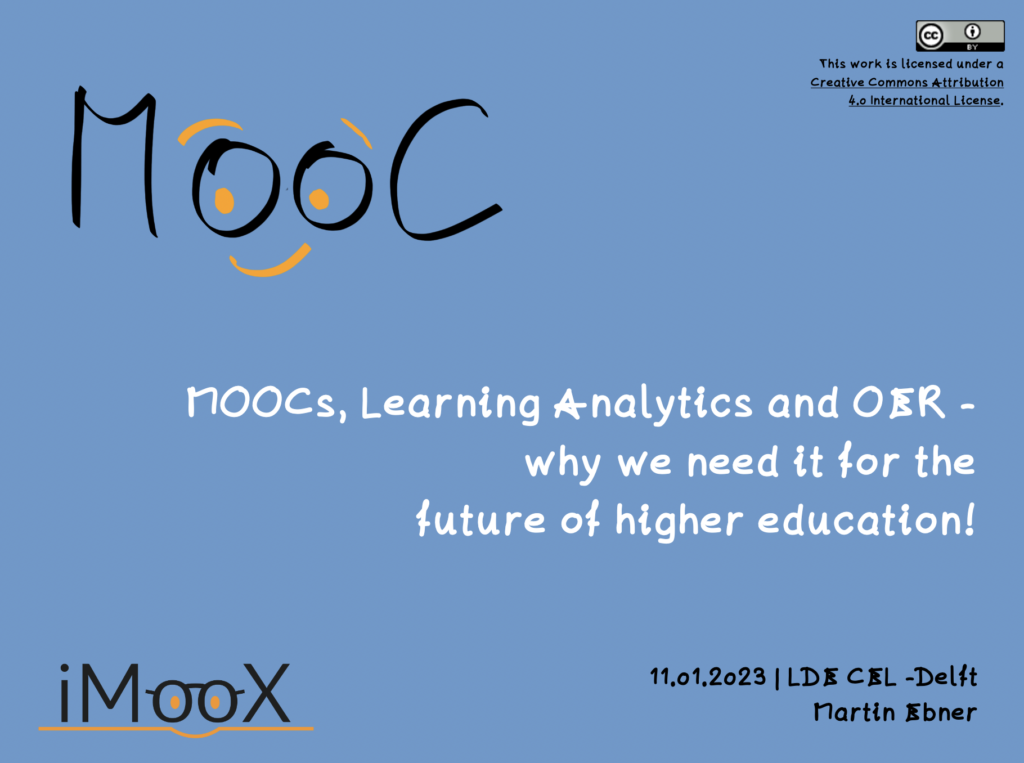
I gave a short guest lecture at TU Delft and taked about our research and experiences with the OER-MOOCs on iMooX.at. Here you will find the slides on ResearchGate:
Digitale Lehre an und rund um der Technischen Universität Graz
Veröffentlichungen zu jeweiligen Thema
Unser Artikel zur Geschichte der Zeitschrift für Hochschulentwicklung (ZFHE) ist erschienen und wir haben versucht darzustellen, wie auch Open-Access selbst erfolgreich sein kann:
Die Zeitschrift für Hochschulentwicklung hat einen langen und interessanten Werdegang. In diesem Artikel wollen wir diesen beschreiben und einer Analyse unterwerfen, um die Entwicklung über die Zeit darzustellen. Es wird gezeigt, wie sich Themen und Schwerpunkte verlagern und mit der Hochschul-Praxis einhergehen. Um die Vergleichbarkeit und den Impact der Zeitschrift vorzustellen, werden Überlegungen angestellt, die untermauern, wie wichtig die Rolle der Zeitschrift für die Hochschulen im deutschsprachigen Raum ist, aber auch darüber hinaus. 40 Jahre, davon beinahe 20 Jahre als Open Access, ist ein beachtlicher Zeitraum für ein solches Medium. Dies ist uns daher Anlass, die Entwicklung der Zeitschrift zu reflektieren.
[Artikel @ ZFHE]
[Artikel @ ResearchGate]
Zitation: Ebner, M., Krempkow, R., Zawacki-Richter, O. (2022) Die Zeitschrift für Hochschulentwicklung – Rückblick und Analyse. Zeitschrift für Hochschulentwicklung (ZHFE) Jg. 17/3 pp 201-223
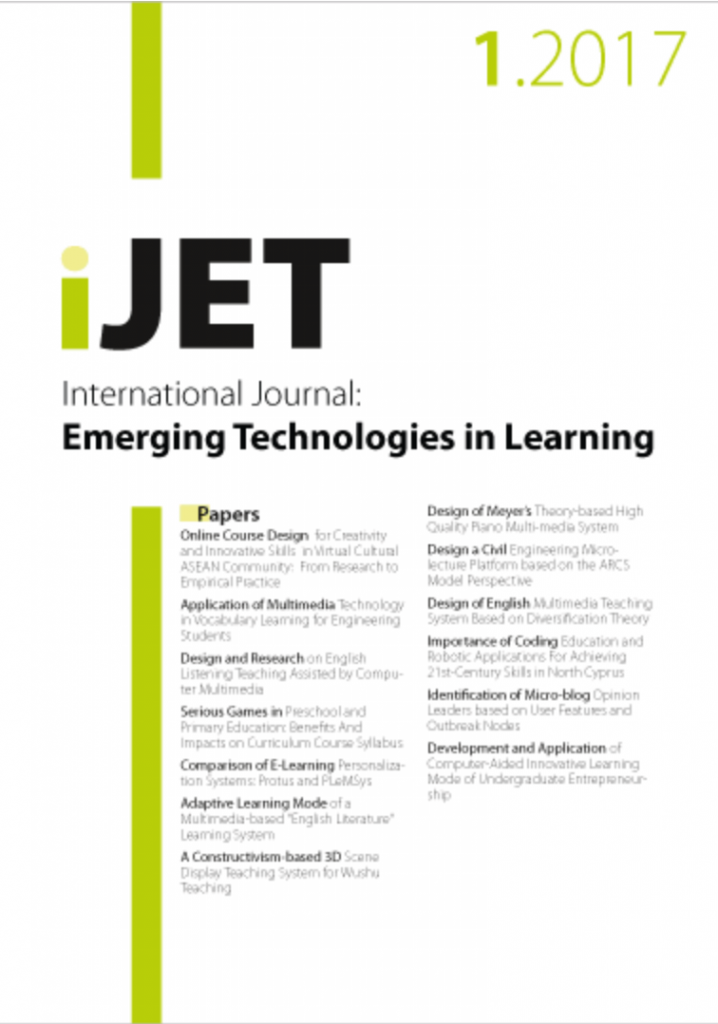 Issue 18(03) of our journal on emerging technologies for learning got published. Enjoy the readings as usual for free :-).
Table of Contents:
Nevertheless, if you are interested to become a reviewer for the journal, please just contact me 🙂 .
Im FNMA-Magazin 1/2022 haben wir die Ergebnisse des Webinars im Dezember 2021 nochmals zusammengefasst unter dem Titel „Weitere österreichische Hochschulen veröffentlichen eine Policy zu offenen Bildungsressourcen – Zum Austausch der AG OER„:
Bei der fnma-Arbeitsgruppe zu offenen Bildungsressourcen dreht sich alles um die bisherige Entwicklung und Förderung von OER. Anfang Dezember 2021 ging es um Erfahrungen mit der Erstellung von strategischen Bekenntnissen und Maßnahmen österreichischer Hochschulen.
[Artikel @ ResearchGate]
[FNMA-Magazin 1/2022]
Zitation: Ebner, Martin und Schön, Sandra (2022). Weitere österreichische Hochschulen veröffentlichen eine Policy zu offenen Bildungsressourcen – Zum Austausch der AG OER. In: fnma Magazin, 1/2022, S. 7-9.
At NLASI in Stockholm we presented what was developed and experienced concerning Learning Analytics at the national MOOC platform iMooX.at
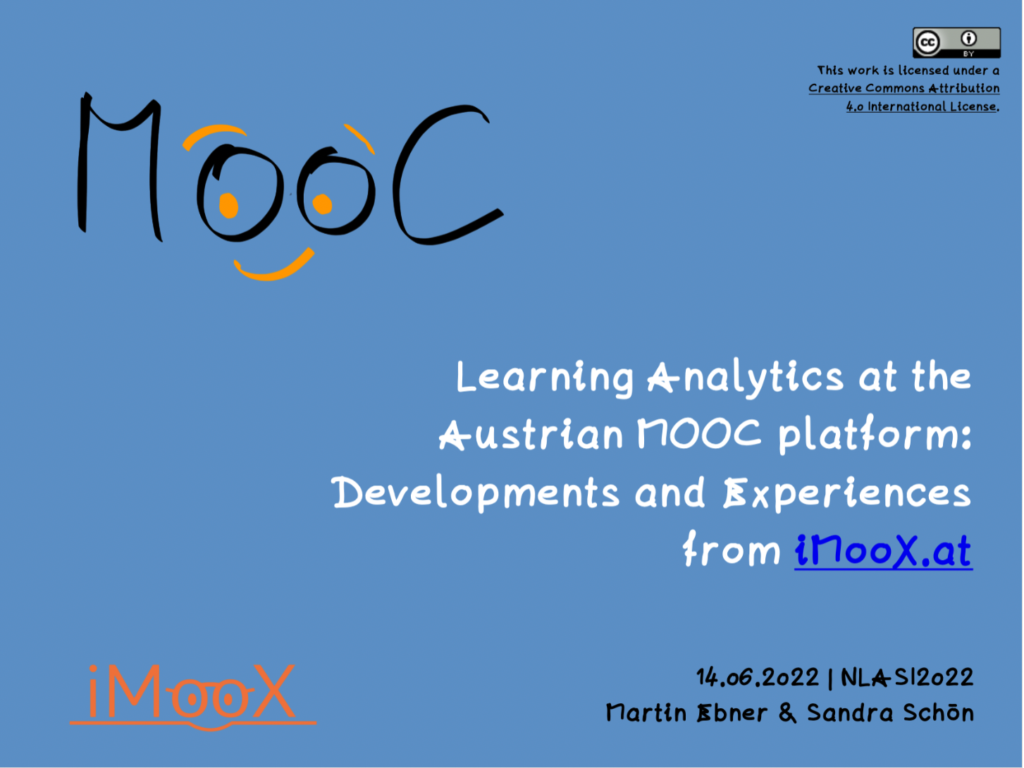
Find here the slides @ ResearchGate.
One of our contributions to the EdMedia + Innovate Learning 2022 is about „A decade of first-semester students surveys concerning IT equipment and communication applications and effect of Covid-19 related experiences for first-year students in 2021„
Abstract:
The technical equipment of first-year students and their preferred communication applications are changing, perhaps also influenced by their experiences in the Covid-19 pandemic concerning digital teaching and learning. This paper presents the 2021 survey of first-year students at Graz University of Technology (N=1,207) and compares the results concerning devices and applications with the results of the surveys conducted since 2011. It is striking that there are no striking changes in the endowment of the that can be interpreted as an effect of Covid-19 pandemic. A question introduced in 2021 about experiences with distance online instruction and experiences with online courses before and after Covid-19 shows clearly that new students‘ prior experiences with online learning here have dramatically changed as a result of school closures in Austria.
[Full paper @ conference homepage]
[draft @ ResearchGate]
Reference: Nagler, W., Schön, S., Mair, B., Ebner, M. & Edelsbrunner, S. (2022). A decade of first-semester students surveys concerning IT equipment and communication applications and effect of Covid-19 related experiences for first-year students in 2021. In T. Bastiaens (Ed.), Proceedings of EdMedia + Innovate Learning (pp. 1060-1067). New York City, NY, United States: Association for the Advancement of Computing in Education (AACE). Retrieved July 12, 2022 from https://www.learntechlib.org/primary/p/221412/
I did a talk about our microcredentials.at iniative at the EADTU-webinar week about microcredentials. Find the slides here online:

Our article about „Teaching German as a Foreign Language with Open Educational Resources (OER)“ got published in the International Journal of Emerging Technologies:
Abstract:
The focus of this research is to find OER to be used in learning German as a foreign language levels A1 to B1 of the The Common European Framework of Reference for Languages (CEFR) standards and to implement in teaching at University of Malang (Indonesia). An overview of the OER will be given, which was categorized language learning level, themes, among others level and themes. From the implementation in university classes with about 19-21 years old, our interviews with five lecturers and their answers in an online questionnaire showed that the OER material in learning did provide many benefits for lecturers and students, including the variety of materials, the forms, and the economic aspect. However, the existing OER still have some downsides, like their suitability to the needs of lecturers and students, in terms of their themes, the technical requirements and levels of difficulty.
[full article @ ResearchGate]
[full article @ Journal’s Homepage]
Reference: Wijayati, P. H., Kharis, M., Hidayat, E., Ardiyani, D. K., Ebner, M., & Schön, S. (2022). Teaching German as a Foreign Language with Open Educational Resources (OER): Implementation in and Experiences from an Indonesian University. International Journal of Emerging Technologies in Learning (iJET), 17(04), pp. 225–238. https://doi.org/10.3991/ijet.v17i04.23225
Our chapter for the HCII conference 2022 about „Evaluation of Mixed Reality Technologies in Remote Teaching“ got published.
Abstract:
The trend towards remote teaching is steadily increasing and intensified by the current situation of the global pandemic. This is a particular challenge for subjects with a high practical relevance, such as mining engineering education, as practical experiences and on-site excursions are an integral part of the curriculum. In face-to-face teaching settings, mixed reality technologies are already considered a promising medium for the implementation of e.g., virtual field trips. Based on this, the current study addresses the question to what extent the integration of mixed reality technologies is suitable for remote teaching and which strengths and challenges are perceived by students and teachers. For this purpose, two 60-min remote lectures in the field of mining engineering were conducted, in which the use of mixed reality was tested on the basis of shared 360° experiences and 3D models and evaluated by students and teachers. Results reveal that the use of mixed reality in remote teaching was perceived as useful, enabled a realistic experience and improved students’ understanding of presented theory compared to traditional teaching methods. In this paper, we discuss possible potentials and risks of using mixed reality in remote teaching and derive directions for further research.
[full article @ book’s homepage]
[draft @ ResearchGate]
Reference: Daling, L.M., Khoadei, S., Kalkofen, D., Thurner, S., Sieger, J., Shepel, T., Abdelrazeq, A., Ebner, Markus, Ebner, Martin & Isenhardt, I (2022). Evaluation of Mixed Reality Technologies in Remote Teaching. In: Zaphiris, P., Ioannou, A. (eds) Learning and Collaboration Technologies. Novel Technological Environments. HCII 2022. Lecture Notes in Computer Science, vol 13329. Springer, Cham. https://doi.org/10.1007/978-3-031-05675-8_3
I manged the section „Future of Learning“ for the book Learning with Technologies and Technologies in Learning:
This section deals with the “future of learning” and asked for contributions dealing with meta-studies ore forecasts. This is not a simple task because we all know from the pandemic that changes are unpredictable sometimes. Anyway, we are very happy that seven groups of researchers out of more than 23 proposals tried to give us insights to their research. Those 7 publications deal with different topics—meta studies, Social Interaction and communication, Open Educational Resources, Augmented and Virtual Reality.
[chapter @ book’s homepage]
[draft @ ResearchGate]
Rerference: Ebner, M. (2022). Introduction to ‘The Future of Learning’. In: Auer, M.E., Pester, A., May, D. (eds) Learning with Technologies and Technologies in Learning. Lecture Notes in Networks and Systems, vol 456. Springer, Cham. https://doi.org/10.1007/978-3-031-04286-7_1