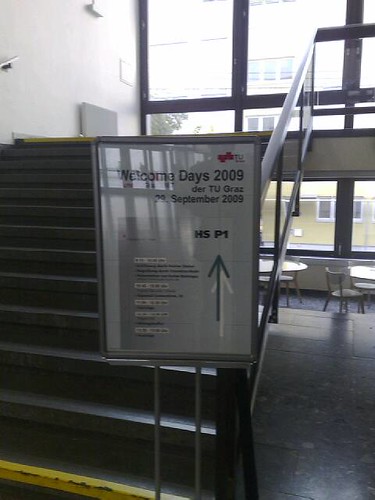

The presentation of our poster at this year i-Know conference recorded by my mobile phone – Beni’s talk about „Will PLEs Become Ubiquitous through the Use of Widgets?“
[publication] Will Personal Learning Environments Become Ubiquitous through the Use of Widgets?
Our publication „Will Personal Learning Environments Become Ubiquitous through the Use of Widgets?“ for this year i-Know Conference is now online available.
Abstract:
Nowadays Personal Learning Environments (PLEs) are described as the use of different social software tools for learning and teaching. The use of common web browsers often is a precondition to fulfil the requirements of social software tools. In this publication a new perspective as well as a couple of prototypes is presented to allow a more independent solution in this context. Using the new JavaFX technology so called widgets are implemented which can be used on different devices as well as different operating systems. Furthermore also the web browser can be replaced by a browser instance. It can be summarized that through the use of widgets the learning environment of the future can be more individualized and personalized.
Reference: Taraghi, B., Mühlburger, H.; Ebner, M.; Nagler, W. (2009) Will Personal Learning Environments Become Ubiquitous through the Use of Widgets?, Tochtermann, K. and Maurer, H. (ed.), Proceedings of I-KNOW ’09 and I-SEMANTICS ’09, Graz, Austria, pp. 329-335
Here you will find the online copy.
[poster] Will PLEs Become Ubiquitous through the Use of Widgets?
Our short paper at this year iKnow Conference about „Will PLEs Become Ubiquitous through the Use of Widgets?“ is now online available:
Online Round Table – In preparation for Educamp Graz
I am very happy that I can announce again three very exciting Online Round Tables in preparation for our EduCamp here in Graz:
As we have grown used to, the Online Round tables, in preparation for the upcoming Educamp Event (November 6-7, in Austria), are back!
Once again, the online sessions will be supported by the JISC sponsored EVOLVE Community. Graham Attwell and Cristina Costa, two of the co-founders of EVOLVE, will co-moderate the online events. Together with Martin Ebner they will organise these events. Three sessions will be offered prior to the face to face event in Graz, Austria.
Please found all details here – the date, the theme and the exciting speakers.
Furthermore the registration for Graz at edumixxt is open till now.
[CfP] ED-Media 2010 (Toronto/Canada)
Nachdem die heurige ED-Media Konferenz vorüber ist, gibt es ab sofort den Call for Papers (Deadline 18. Dezember 2009) für die nextjährige die in Toronto in Kanada stattfinden wird:
ED-MEDIA – World Conference on Educational Multimedia, Hypermedia & Telecommunications is an international conference, organized by the Association for the Advancement of Computing in Education (AACE).
This annual conference serves as a multi-disciplinary forum for the discussion and exchange of information on the research, development, and applications on all topics related to multimedia, hypermedia and telecommunications/distance education.
[video] The Machine is (Changing) Us: YouTube and the Politics of Authenticity
Michael Wesh hat einen Vortrag rund um das Thema wie verändert YouTube unsere Kommunikation gehalten. Ich kann nur sagen großartiger Vortrag und ich denke die 30 Minuten sind es wert es sich anzuhören:
[publication] Emotion Detection: Application of the Valence Arousal Space for Rapid Biological Usability Testing to enhance Universal Access
A Draftversion of our publication „Emotion Detection: Application of the Valence Arousal Space for Rapid Biological Usability Testing to enhance Universal Access“ at this year HCII Conference is now online available.
Abstract:
Emotion is an important mental and physiological state, influencing cognition, perception, learning, communication, decision making, etc. It is considered as a definitive important aspect of user experience (UX), although at least well developed and most of all lacking experimental evidence. This paper deals with an application for emotion detection in usability testing of software.
It describes the approach to utilize the valence arousal space for emotion modeling in a formal experiment. Our study revealed correlations between low performance and negative emotional states. Reliable emotion detection in usability tests will help to prevent negative emotions and attitudes iproducts. This can be a great advantage to enhance Universal Access.
Reference: Stickel, C.; Ebner, M.; Steinbach-Nordmann, S.; Searle, G.; Holzinger, A. (2009) Emotion Detection: Application of the Valence Arousal Space for Rapid Biological Usability Testing to enhance Universal Access. – in: Springer Lecture Notes in Computer Science. (2009) In Press
Here you will find the Draftversion and here the slides.
[publication] A Study on the Compatibility of Ubiquitous Learning (u-Learning) Systems at University Level
A Draftversion of our publication „A Study on the Compatibility of Ubiquitous Learning (u-Learning) Systems at University Level“ at this year HCII Conference is now online available.
Abstract:
Graz University of Technology has a long tradition in the design, development and research of university wide Learning Management Systems
(LMS). Inspired by the iPhone Style, the available system has now been extended by the addition of a mobile viewer, which grants the student mobile accessibility to all available online content. In this paper, we report on the lessons learned within a study on user experience with this specially designed LMS mobile viewer. The User Experience (UX) was measured by application of a 26 item questionnaire including the six factors Attractiveness, Perspicuity, Efficiency, Dependability, Stimulation and Novelty, according to Laugwitz et al. (2008). The results showed high rates of acceptance, although the novelty of our approach received a surprisingly low rating amongst the novice end users.
Reference: Ebner, M.; Stickel, C.; Scerbakov, N.; Holzinger, A. (2009) A Study on the Compatibility of Ubiquitous Learning (u-Learning) Systems at University Level . – in: Springer Lecture Notes in Computer Science. (2009), S. 34 – 43
Here you will find the Draftversion and here the slides.
[publication] Mixing Content and Endless Collaboration – MashUps: Towards Future Personal Learning Environments
A Draftversion of our publication „Mixing Content and Endless Collaboration – MashUps: Towards Future Personal Learning Environments“ at this year HCII Conference is now online available.
Abstract:
The recent movement by major Web services towards making many application programming interfaces (APIs) available for public use has led to the development of the new MashUp technology, a method of merging content, services and applications from multiple web sites. The new technology is now being successfully applied in the academic community to enrich and improve learning and teaching applications. This paper examines its implementation and use, discusses methods and styles of usage and highlights the advantages and
disadvantages of client and server application, based on related work and recent experiences gathered with a large university-wide open learning management system (WBT-Master/TeachCenter of Graz allows lecturers to use diverse web resources.
Reference: Auinger, A.; Ebner, M.; Dietmar, N.; Holzinger, A. (2009)
Mixing Content and Endless Collaboration – MashUps: Towards Future Personal Learning Environments. – in: Springer Lecture Notes in Computer Science. (2009) In Press
Here you will find the Draftversion and here the slides.
[publication] Intuitive E-Teaching by Using Combined HCI Devices: Experiences with Wiimote Applications
A Draftversion of our publication „Intuitive E-Teaching by Using Combined HCI Devices: Experiences with Wiimote Applications“ at this year HCII Conference is now online available.
Abstract:
The wide availability of game based technologies and sophisticated e-Learning possibilities creates new demands and challenges on Human–Computer Interaction and Usability Engineering (HCI&UE). Solid research in HCI must support improvement in learning ability and creativity for both teachers and students. According to recent market surveys the Wii remote controller or Wiimote is currently more wide spread than standard Tablet PCs and is the most used computer input device worldwide. As a collection of many sensors, also including Bluetooth technology, accelerometers and IR sensors, Wiimote is of great interest for HCI experiments, especially in the area of e-Learning and e-Teaching. In this paper, we present results gained from the investigation of the potential of Wiimote as both a standard input device – such as mouse or presenter – and as a gesture and finger tracking sensor. We demonstrate, on the basis of examples from e-Teaching, how easily everyday gestures can be interpreted in regular computer applicationhardware modules and some additional software modules.
Reference: Holzinger, A.; Softic, S.; Stickel, C.; Ebner, M.; Debevc, M. (2009) Intuitive E-Teaching by Using Combined HCI Devices: Experiences with Wiimote Applications. – in: Springer Lecture Notes in Computer Science (LNCS 5616). (2009), S. 44 – 52
Here you will find the Draftversion.