 Im Rahmen der Serie Digitales Leben vom Radiosender Ö1 ist ein Beitrag zu Open Educational Resources entstanden. Die Interviews sind im Rahmen unserer iUNIg-Tagung im Mai geführt worden und zeigen wie wichtig es ist an Projekten wie L3T festzuhalten.
[publication] Mit Vielen offene Bildungsressourcen erstellen
Bei der diesjährigen GMW 2011 Tagung die ein Teil der Wissensgemeinschaften 2011 Veranstaltung sind, präsentierten wir auch L3T. Die Präsentation ist bereits [hier] online.
Abstract:
Das Internet verändert die Möglichkeiten des Lernen und Lehrens und auch die Ar- beitsweise von Wissenschaftler/innen und Lehrenden. Frei zugängliche Lernmate-rialien zu erstellen, zu modifizieren und in der Lehre einzusetzen ist eine Konse-quenz aus technischen Möglichkeiten und Veränderungen der Wahrnehmung und Nutzung der Möglichkeiten des Teilens und Tauschens im Bereich der Bildung.Am Beispiel des Lehrbuchprojektes „Lehrbuch für Lernen und Lehren mit Techno-logien“ (L3T) wird in diesem Beitrag aus Perspektive der Initiatoren davon berich-tet, wie sich solche neuen Formen und Wege gestalten (können) und welche Erfah-rungen damit gemacht wurden. Dazu wird das Projekt L3T mit drei derzeit neuarti-gen Formen von Initiativen verglichen: (a) mit Initiativen zu offenen Bildungsres-sourcen, (b) mit Crowd-Sourcing-Initiativen und (c) mit offenen Bildungsinitiati-ven
Mit Vielen offene Bildungsressourcen erstellen: Neue Wege der Erstellung von Lehrbüchern am Beispiel L3T
Klicken Sie auf den unteren Button, um den Inhalt von www.scribd.com zu laden.
Reference: Ebner, M.; Schön (aka Schaffert), S., (2011) Mit Vielen offeneBildungsressourcen erstellen: Neue Weger der Erstellung von Lehrbüchern am Beispiel L3T.- in: Wissensgemeinschaften / Digitale Medien – Öffnung und Offenheit in Forschung undLehre. (2011), S. 21 – 35
[poster] Die Welt der Widgets
Bei der diesjährigen DeLFI 2011 Tagung die ein Teil der Wissensgemeinschaften 2011 Veranstaltung sind, gibt es ein Poster von der Personal Learning Environment der TU Graz zum Thema „Welt der Widgets“. Das Poster selbst ist bereits [hier] veröffentlicht.
Abstract:
Die Lernumgebung der Zukunft soll stärker personalisierbar sein – so lautetseit vielen Jahren die Forderung im Bereich des technologiegestützten Lehrens undLernens. An der Technischen Universität Graz (TU Graz) ist seit Herbst 2010 einePersonal Learning Environment (TU Graz PLE) auf Basis eines Widget-Frameworks imEinsatz, die verschiedenste Webapplikationen miteinander verbindet und damit denBenutzern ermöglicht, ihre Lernumgebung individuell an ihre Bedürfnisse anzupassen.In einem weiteren Schritt sollen diese Widgets für alle herkömmlichen Betriebssystemeunabhängig von webbasierten Oberflächen zur Verfügung gestellt werden. In dieser Publikation wird gezeigt, ob und wie eine solche Konvertierung erfolgen kann, um einenoch höhere Individualisierbarkeit der Lernaktivität zu ermöglichen.
Die Welt der Widgets – ein wichtiger Schritt zur Personal Leanring Environment
Klicken Sie auf den unteren Button, um den Inhalt von www.scribd.com zu laden.
Reference: Ebner, M., Taraghi, B., Altmann, T. (2011) Die Welt der Wigdets – Ein wichtiger Schritt zur personalisierten Lernumgebung, 9. e-Learning Fachtagung Informatik der Gesellschaft für Informatik „DeLFI 2011“, Poster
[event] Neue Publikationen für die Hochschullehre
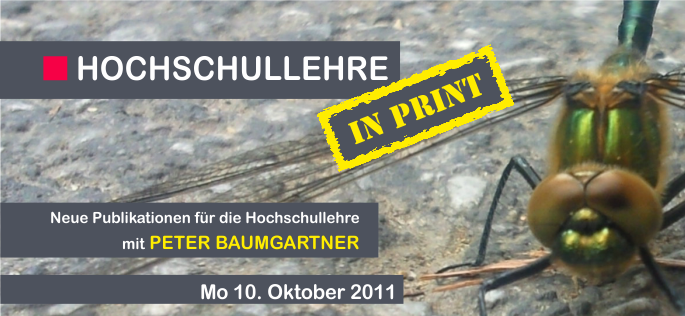 Es freut uns, dass wir – das iUNIg-Team – eine neue Veranstaltung ankündigen können: Neue Publikationen für die Hochschullehre. Am 10. Oktober 2011 stellen Prof. Baumgartner und Elke Lackner ihre neuen Bücher an der TU Graz vor. Ich selbst werde das Thema aufgreifen ob das Lehrbuch in Zukunft überhaupt noch ein Buch im klassischen Sinne sein wird und dabei auch über die Erfahrungen mit L3T reden.
Wir bitten um eine Anmeldung zu dieser ansonst kostenfreien Veranstaltung und ich würde mich freuen beim anschließenden Buffet über das Thema weiter zu diskutieren. Weitere Details findet man auf der iUNIg-Homepage [Link] bzw. im Folder [.pdf].
[poster] Welt der Widgets
Bei der diesjährigen DeLFI 2011 Tagung die ein Teil der Wissensgemeinschaften 2011 Veranstaltung sind, gibt es ein Poster von der Personal Learning Environment der TU Graz zum Thema „Welt der Widgets“. Wir zeigen hier erstmals die Konvertierung von Widgets für den Desktop der Betriebssysteme Windows und MacOS.
Die Welt der Widgets – ein wichtiger Schritt zur Personal Leanring Environment
Klicken Sie auf den unteren Button, um den Inhalt von www.scribd.com zu laden.
[iPhone App] SnailWrite
 Die nächste App der heurigen Vorlesung „AK Medientechnologien – iPhone Development“ ist ab sofort im App-Store verfügbar. Diese App ist zur Lese- und Schreibunterstützung für die erste Schulstufte angedacht. Im Stile des Klassikers Hangman werden Kinder nach einfachn Worten gefragt bzw. können fehlende Buchstaben ergänzen. Ein weiteres Level ist einfach das zugehörige Bild zum Wort zu finden:
SnailWrite is an educational game, the easier it is to children in early elementary school age to learn reading and writing.
It will be developed here is in compliance in four different modes with different difficulty levels and different words visually processed. According to different principles appropriate child-friendly learning materials can be playfully. The four modes of play include, among other things, learning the words to the Hangman principle, as well as associating images to words and letters of the successive letters of a word.
Hier kann die App downgeloadet werden [Link] und alle weiteren verfügbaren Apps der TU Graz findet man hier [iTunes Link].
[news] iTunes U bringt Havard ins Wohnzimmer
Unter diesem Titel ist ein Artikel in der österreichischen Zeitung Standard erschienen, wofür ich vor meinem Urlaub interviewt wurde. Bin selbst ganz überrascht, dass meine Aussagen sehr gut wiedergegeben sind und der Artikel sehr lesenswert ist:
Digitales Leben: iTunes U bringt Harvard ins Wohnzimmer
Standard.at am 12. August 2011
[l3t] Neue OER-Publikationsreihe – Buch über „Crowdfunding and Social Payments“
 Wir haben eine neue frei zugänglich Publikationsreihe über „Beiträge zu offenen Bildungsressourcen“ gegründet und freuen uns sehr, dass Julia Kaltenbeck ihre Arbeit über „Crowdfunding and Social Payements im Anwendungskontext von Open Educational Resources“ zur Verfügung stellt.
Ziel:
Seit vielen Jahren unterstützen wir, Sandra Schön und Martin Ebner, mit unserem Projekten den freien Zugang zu Forschungsergebnissen und Bildungsressourcen. So ist im Jahr 2004 die wissenschaftliche, frei zugängliche Fachzeitschrift „bildungsforschung“ entstanden und auch das „Lehrbuch für Lernen und Lehren mit Technologien“ (kurz L3T), das ebenso komplett frei zugänglich ist. Das Thema der offenen Bildungsressourcen selbst möchten wir mit der Herausgabe der Reihe „Beiträge zu offenen Bildungsressourcen“ unterstützen und eine Plattform für spannende Beiträge und wissenschaftliche Arbeiten zu schaffen. Hier sind Beiträge der unterschiedlichen Disziplinen gefragt, die einzelne Fragestellungen zu offenen Bildungsressourcen behandeln und nicht bereits in ähnlicher Weise erschienen sind. Wenn auch Sie einen Beitrag für diese Buchreihe zur Verfügung stellen wollen, kontaktieren Sie uns bitte einfach unter der E-Mail Adresse martin.ebner@l3t.eu.
Ab sofort ist die Reihe entweder über https://o3r.eu oder https://l3t.eu/oer erreichbar. Wir freuen uns wie immer sehr über Feedback und Gedanken zu den OER-Aktivitäten und jetzt ab in den Sommerurlaub 2011 – Blogpause :-).
Crowdfunding and Social Payments
Klicken Sie auf den unteren Button, um den Inhalt von www.scribd.com zu laden.
[publication] EduPunks and Learning Management Systems – Conflict or Chance?
Our publication for this year ICHL 2011 conference on „EduPunks and Learning Management Systems – Conflict or Chance?“ is now online available. The Slides are already published here.
Abstract:
The term Edupunk coined by Jim Groom defines a do-it-yourself concept of using the most recent Web tools available for teaching, instead of relying only on commercial learning platforms – it is the information, the content, the knowledge which matters. Technology itself does not make education valuable per se, it is the creation of individual knowledge which is of paramount importance. However, today, so much free technology is available, which can be used as hands-on tools to enhance learning and teaching of students. However, in this article, we demonstrate that such issues can also be included in a large university wide LMS, which has been developed at Graz University of Technology (TU Graz) during the last years. The development was initiated by the necessity to emphasize and implement three crucial factors for learning: communication, active participation and social interaction. We assess the potential of current Web 2.0 technologies for implementing such factors. We show that the development process was not technology driven; on the contrary, end user requirements of all end user groups engaged into university learning (students, teachers and administrators) were thoroughly investigated and mapped onto functional components of the LMS. Finally, we provide an overview of the platform functionalities with an emphasis on Web 2.0 elements and EduPunk concepts.
EduPunks and Learning Management Systems – Conflict or Chance?
Klicken Sie auf den unteren Button, um den Inhalt von www.scribd.com zu laden.
Reference: Ebner, M.; Scerbakov, N.; Tsang, P. .; Holzinger, A. (2011). EduPunks and Learning Management Systems – Conflict or Chance?. Pro- ceedings of International Conference on Hybrid Learning IHCL 2011. Springer Lec- ture Notes in Computer Sciences LNCS 6837. p. 224 – 238
[presentation] EduPunk and Learning Management Systems – Conflict or Chance?
Our presentation at this year International Conference on Hybrid Learning about „EduPunk and Learning Management Systems – Conflict or Chance?“ is now online available: