The third presentation at this year EDMedia conference (online) was about “ Implementation fo Interactive Learning Objects for German Language Acquisition in Primary School based on Learning Analytics Measurements „. Find here the slides of the talk of Markus:
Klicken Sie auf den unteren Button, um den Inhalt von www.slideshare.net zu laden.
The second presentation at this year EDMedia conference (online) was about „Practitioner Integration in Computational Thinking Education“. Find here the slides of the talk of Michael:
Klicken Sie auf den unteren Button, um den Inhalt von www.slideshare.net zu laden.
Abstract: We discuss if and how it is possible to develop meaningful e-assessments in Engineering Mechanics. The focus is on complex example problems, resembling traditional paper-pencil exams. Moreover, the switch to e-assessments should be as transparent as possible for the students, i.e., it shouldn’t lead to additional difficulties, while still maintaining sufficiently high discrimination indices for all questions. Example problems have been designed in such a way, that it is possible to account for a great variety of inputs ranging from graphical to numerical and algebraic as well as string input types. Thanks to the implementation of random variables it is even possible to create an individual set of initial values for every participant. Additionally, when dealing with complex example problems errors carried forward have to be taken into account. Different approaches to do so are detailed and discussed, e.g., pre-defined paths for sub-questions, usage of students’ previous inputs or decision trees. The main finding is that complex example problems in Engineering Mechanics can very well be used in e-assessments if the design of these questions is well structured into meaningful sub-questions and errors carried forward are accounted for.
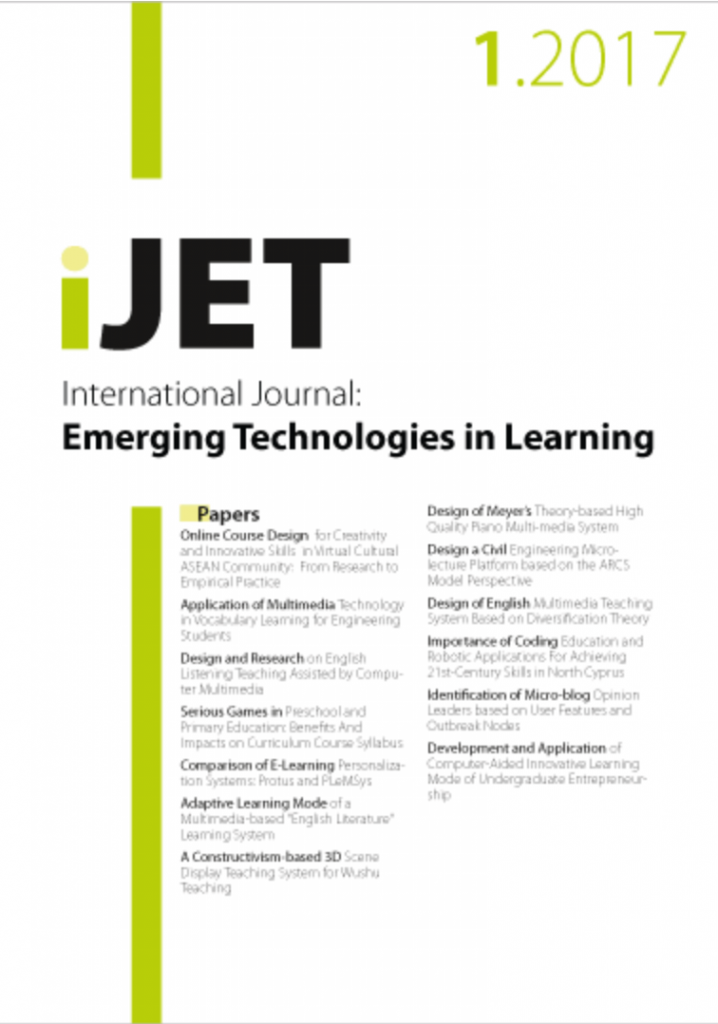
Reference: Orthaber, M., Stütz, D., Antretter, T., Ebner, M. (2020) Concepts for E-Assessments in STEM on the Example of Engineering Mechanics. International Journal for Emerging Technologies in Learnig. 15(12). pp. 136-152
In der ersten Augustwoche werden voraussichtlich die MakerDays 2020 an der TU Graz stattfinden – mehr Informationen findet man hier [Link] Nun aber der neue Trailer:
Mit dem Laden des Videos akzeptieren Sie die Datenschutzerklärung von YouTube. Mehr erfahren
Für den Lehrgang CAS eLearning und CAS eLearning Design (Luzern) unter der Leitung von Prof. Dr. Andréa Belliger haben wir im April 2019 das folgende Selbstlerndossier für OER im Schweizer Kontext erstellt: «Einstieg in das Urheberrecht und OER für E-Learning»
Das Dossier richtet sich an folgende Zielgruppe und verfolgt folgende Lernziele.
Zielgruppe: Das PDF-Dossier richtet sich an Lehrpersonen aller Bildungsbereiche und
E-Learning-Verantwortliche aus Unternehmen und Verwaltungen, d. h. Praktiker/innen ohne Vorkenntnisse zum Urheberrecht und offene Bildungsressourcen (kurz OER).
Lernziele: Die Teilnehmer/innen) kennen die Begrifflichkeiten rund um Open Content / OER wissen um die Vor- und Nachteile von Open-Content-Lizenzen und erhalten eine Übersicht über Quellen gemeinfreier sowie Bezahl-Inhalte.
In diesem MOOC geht es anlässlich der 25jährigen Mitgliedschaft Österreichs in der EU um eine Rückschau auf den europäischen Integrations- und den österreichischen Beitrittsprozess. Dabei wird insbesondere die Rolle der Steiermark als herausragendes Beispiel für das Europa der Regionen näher beleuchtet.
Aufgrund der derzeitigen Situation und darauf aufbauend die Vorrausschau auf den Herbst 2020 haben wir uns entschlossen, die Welcome Days der TU Graz teilvirtuell zu gestalten. Also dort wo Präsenz möglich ist, wird es diese auch geben, den Rest streamen wir aus unserem Studio live 🙂
#COVID19 was and is a big challenge for many people, for teachers as universities as well. And of course we love to share experiences we made or have seen at the TU Graz as well to enrich the contributions on teaching and learning with technologies in HEI.
This time we contributed to a book which collects 133 (!) experiences from colleagues worldwide, all available under CC BY NC ND. Please have look and check:
https://www.learntechlib.org/p/216903/
Our contribution describes:
To train future Austrian teachers in using digital media, a novel didactic design was implemented at several universities in Austria in summer semester 2019: The course includes the participation in a MOOC (massive open online course) on the topic, an accompanying group work at the universities and multiple-choice tests conducted at the universities. In the summer semester of 2020, due to the COVID-19 crisis, the group work and exams had to be switched to virtual space as well. Because the course materials are available under an open license, i.e. as open educational resources, further use is possible and offered.
Ebner, Martin & Schön, Sandra (2020). Remote Future Teacher Training with MOOCs. In: R.E. Ferdig, E. Baumgartner, E., R. Hartshorne, E. Kaplan-Rakowski, & C. Mouza, C. (Ed). Teaching, Technology, and Teacher Education during the COVID-19 Pandemic: Stories from the Field. Association for the Advancement of Computing in Education (AACE). Pp. 493-497. Book is available under CC BY NC ND: https://www.learntechlib.org/p/216903/;. Preprint at ResearchGate: https://www.researchgate.net/publication/342261714_Remote_Future_Teacher_Training_with_MOOCs