[imoox] Trailer zu „Startup-Journey“ #imoox #mooc #tugraz

Es freut uns mittels Trailer einen unserer nächsten MOOCs auf iMooX ankündigen zu können: „Startup-Journey“. Start wird im April sein, anmelden kann man sich aber jetzt bereits hier: [Link zur Anmeldeseite]
Zum Inhalt:

Es gibt viele Menschen mit vielen Ideen, die nur darauf warten umgesetzt zu werden und ein neues Unternehmen / StartUp entstehen zu lassen. Der Weg von der Initiierung der Idee bis zur Umsetzung in einem Geschäftsmodell, wirft viele Fragen auf. Unternehmerisches Denken und Handeln ist für eine Gründung obligate Voraussetzung. Hauptinhalt dieses Kurses ist die Erstellung eines Geschäftsmodelles die für die eigene Idee angewandt werden soll um sich mit einigen unternehmenswichtigen Fragen zu beschäftigen. Dafür werden Basiswissen und Methoden sowie deren Umgang vermittelt um am Ende des Kurses Kenntnis über die Erstellung zu besitzen.

YouTube

Mit dem Laden des Videos akzeptieren Sie die Datenschutzerklärung von YouTube.
Mehr erfahren

Video laden

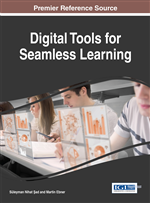
[book] Digital Tools for Seamless Learning #research

Seamless Learning BookTogehter with my colleague Nihat we did a book on Seamless Learning and we are quite happy now that it got published after 1,5 year hard work. Enjoy the different chapters, for sure worth to read.

Table of Content:

  • A Math Training Platform to Foster Individual Learning (pages 1-26)
  • Augmented Reality with Mobile and Ubiquitous Learning: Immersive, Enriched, Situated, and Seamless Learning Experiences (pages 27-41)
  • Brave New Digital Tools for Action Research in Education: A Beginner’s Guide (pages 42-64)
  • Designing Seamless Learning Using Role-Playing Experiences (pages 65-92)
  • Education, “Pointsification,” Empowerment?: A Critical View on the Use of Gamification in Educational Contexts (pages 93-118)
  • Enhancing Learning with Wearable Technologies In and Out of Educational Settings (pages 119-144)
  • Exploring the Educational Potential of Internet of Things (IoT) in Seamless Learning (pages 145-159)
  • How to Design a Mathematical Learning App Suitable for Children: The Myth of Digital Natives (pages 160-178)
  • Is Digital Age “A Tsunami” for Distance Education?: Functional Roles of Scaffolding and Meta-Communication in Digital Learning Environment (pages 179-194)
  • Learning with Social Media: A Case Study at a Latin American University (pages 195-213)
  • Linking Virtual and Real-life Environments: Scrutinizing Ubiquitous Learning Scenarios (pages 214-239)
  • Motivational and Ethical Issues in Seamless Learning: Use of Tablet PCs in a Mobile and Ubiquitous Technology-Enhanced Learning Context (pages 240-254)
  • Social Media in Higher Education: Enriching Graduate Students‘ Professional Growth Outside the Classroom (pages 255-277)
  • Social Media Strategies for Seamless Learning: Approaches and Metrics (pages 278-296)
  • The Adoption of Mobile Devices as Digital Tools for Seamless Learning (pages 297-324)
  • Virtual Learning: Videogames and Virtual Reality in Education (pages 325-344)

[Link to the book homepage]

Reference: Şad, S. N., & Ebner, M. (2017). Digital Tools for Seamless Learning (pp. 1-398). Hershey, PA: IGI Global. doi:10.4018/978-1-5225-1692-7

[app, iphone] Twitterwall #tugraz #iphone

Twittewall Rahmen einer Bachelorarbeit ist die App Twitterwall entstanden, die eine mobile Lösung für unsere Twitterwall darstellt. Viel Spaß bei der Verwendung.

Die TwitterWall der TU Graz jetzt auch auf deinem iPhone! Die Tweets können unterwegs praktisch verfolgt werden. Tweets sind nach User und Keywords sortiert. Für eine schnellere Suche können Tweets über einen bestimmten Zeitbereich oder bestimmte Suchwörter gefiltert werden. Der Aktualisierungs-Intervall kann nach Belieben gesetzt werden.

[Link zur App im Appstore]

[presentation] Emerging technologies – Wandel von Multimedia in der Lehre #edidactics #tugraz

edidacticsIm Rahmen des edidactics-Moduls Multimediaproduktion halte ich heute den Input. Ich versuche dabei die immer vielfältigeren Einsatzmöglichkeiten von Medien darzustellen. Dazu findet man hier die Folien, im zweiten Teil des Moduls werden dann vor allem die Erstellung von E-Books und Videos praktisch erprobt:

Klicken Sie auf den unteren Button, um den Inhalt von www.slideshare.net zu laden.

Inhalt laden

Die gesamten Workshopunterlagen sind hier online frei zugänglich.

[Interview] “We’re facing an educational revolution” #tugraz

FeedbackrI just feel honored. Honored, because I was asked to give an interview for a startup of my former students and I am indeed very proud that our former initial idea to create a small and simple application for giving feedback in lecture room is now a widespreaded and well suited tool. Congratultions to the feedbackr team, you are simply great 🙂

[Interview „We’re facing an educational revolution„]

Die TU Graz und ihr Weg in die Sozialen Medien #tugraz #facebook

… ist auf alle Fälle ein langer, aber es ist nun tatsächlich soweit. Man hat sich dazu entschlossen, dazu eine Strategie zu entwickeln und schickt diese nun in die Umsetzung. Ich freu mich wirklich darüber, wir haben jahrelang gefordert, dass wir dieses Kommunikationsmedien brauchen, um vor allem mit unseren Studierenden zu reden. Nun ist es soweit und wir werden sehen, wie es anläuft und ich bin fest davon überzeugt, dass alle Befürchtungen so nicht eintreten werden oder andersrum, wir werden uns den Kritiken, sorry den Shit-Storms, stellen. Also das Team Lehre der TU Graz wartet auf die zahlreichen Kommentare, Shares und Likes.

[Link zum Facebook-Auftritt der TU Graz]

[Link zum Twitter-Auftritt der TU Graz]

[interview] Learning Analytics #interview #tugraz #podcampus

Im Rahmen der Campus Innovation Konferenz in Hamburg bin ich auch zu einem Kurzinterview gebeten worden, welches jetzt zur Verfügung steht:

Klicken Sie auf den unteren Button, um den Inhalt von www.podcampus.de zu laden.

Inhalt laden

[publication] FACETS OF OPENNESS IN MOOCS – A REVIEW #imoox #mooc

Our contribution to the 11th DisCO 2016 conference – Towards open education an information society – got published. Find here the final publication and our thoughts and outcomes of a MOOC case study.

Abstract:

Openness is an eponymous and hence essential feature of MOOCs, but the defining criteria with regard to what does and does not constitute openness are still subject of debate. Different definitions emphasize various aspects that extend beyond obvious characteristics such as open access to content and magnify issues like the licensing of resources, availability of digital technologies or devices as well as skills and competencies necessary for usage. The focus can be extended even further to include social and cultural factors as well. While MOOCs theoretically offer a higher level of openness when compared to traditional means of education, practice has shown that some groups are notoriously overrepresented. It has even been suggested that the growing body of OER may actually widen instead of bridge the gaps between different socioeconomic groups, because user statistics indicate that the typical well-educated MOOC participant already has good access to higher education, whereas those who lack formal education are also underrepresented in the use of OER.
This paper will review the insights on influences that compromise openness in MOOCs, and we will also present a case study from the Austrian MOOC platform iMooX (www.imoox.at) to illustrate the problem as well as discuss some strategies that might prove useful in alleviating the effects of social exclusion. We argue that there are several mitigating factors that warrant consideration in order to strengthen MOOC participation among educationally alienated groups and to encourage a more extensive understanding of openness.

[Link to Full Paper @ ResearchGate]

Reference: Zimmermann, C., Höfler, E., Ebner, M. (2016) FACETS OF OPENNESS IN MOOCS – A REVIEW. DisCO 2016 – Towards open education an information society. 11th conference reader. Beseda, J. (ed.). Centre for Higher Education Studies. Prague. pp 193-203

[master] Konzept für den Einsatz von Learning-Analytics-Applikationen im Mathematikunterricht #LearningAnalytics

Michael Straßer hat in seiner Diplomarbeit den Einsatz unserer Learning-Analytics-Applikationen über einen längeren Zeitraum im Mathematikunterricht durchgeführt. Seine Ergebnisse stellt er in diesen Folien vor:

Klicken Sie auf den unteren Button, um den Inhalt von www.slideshare.net zu laden.

Inhalt laden