[OER] Issue 11 – Practical usage of OER material in the EFL classroom #OER #publication #coer16

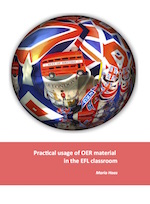
Issue 11We are very happy to announce issue 11 of our series on Open Educational Resources. Maria Haas did her masterthesis about „Practical usage of OER material in the EFL classroom“.

Abstract:

Little research with regards to Open Educational Resources (OER) usage in secondary education is available. Therefore, a two week long study was conducted in an Austrian middle school with second year learners of English. The study tried to determine how OER material could be used in an offline environment for this particular type of students. For this purpose, preparation time, available material and students’ feedback was evaluated. The findings suggest that there is a lack of available material which, alongside difficultes related to licensing, increased preparation time. Students’ feedback was overwhelmingly positive which imply that if the other challenges encountered can be overcome, OER material can be a useful additon to the English as a Foreign Language (EFL) classroom.
[Link to free pdf at O3R Website]

[Link to Book on Amazon]

[coer, imoox] OER erstellen #coer16 #imoox

COER 16Der MOOC zu Open Educational Resources – kurz coer16 – ist nun bereits in der dritten Woche. Nachdem OER erklärt wurde, ebenso die CC-Lizenzen und in der zweiten Woche OER gesucht und gefunden wurde, steht nun die Vorstellung von Werkzeugen an der Reihe, die es ermöglicht eigenes Material anzubieten.
Wie das geht wird in einem Video erklärt, darum also schnell noch anmelden, der Einstieg ist noch jederzeit möglich.

[video] Lange Nacht der Forschung #imoox #lnf16

Lange Nacht der ForchungWir waren heuer ja Teil der Langen Nacht der Forschung, wie ich bereits hier berichtet hatte. Neben den Vorträgen gab es auch eine Mitmachstation, wo wir live ein Video erstellt haben. Mein Dank gilt meinen Mitarbeitern und vor allem auch den vielen begeisterten Besucherinnen und Besuchern:

YouTube

Mit dem Laden des Videos akzeptieren Sie die Datenschutzerklärung von YouTube.
Mehr erfahren

Video laden

[publication] Guidelines for Leveraging University Didactics Centers to Support OER Uptake in German-Speaking Europe #OER #research #article

Our publication on „Guidelines for Leveraging University Didactics Centers to Support OER Uptake in German-Speaking Europe“ is now published as part of the Special Issue Models of Open Education in Higher Education.
Abstract:

Although less well established than in other parts of the world, higher education institutions in German-speaking countries have seen a marked increase in the number of open educational resource (OER) initiatives and in government-supported OER funding in recent years. OER implementation, however, brings with it a unique set of challenges in German-speaking higher education contexts, stemming in part from copyright laws and use permissions that have made sharing and reuse of educational materials less prevalent. The article discusses how instructional development centers, including university didactics centers (hochschuldidaktische Zentren) and e-learning centers, can play a key role in faculty uptake and adoption of OER, and concludes by proposing a set of OER implementation guidelines that leverage the expertise and interfacing role of these centers in German-speaking countries.

[Full article @ ResearchGate]

[Full article @ Journal Homepage]

Citation: Ebner, M., Schön, S., & Kumar, S. (2016). Guidelines for leveraging university didactics centers to support OER uptake in German-speaking Europe. Education Policy Analysis Archives, 24(39). https://dx.doi.org/10.14507/epaa.24.1856

[imoox, coer] OER suchen und finden #imoox #mooin #coer16

COER 15Der COER16 ist bereits in Woche zwei. Diese Woche geht es nach der Woche der Definitionen und Lizenzen einfach darum OER zu suchen und auch zu finden. Also wie kommt man denn als Lehrender oder Lernender an offene Bildungsressourcen, wo sind sie zu finden und wie kann ich diese weiterverwenden. Wir freuen uns im Forum auf viele Fundstücke 🙂

[Link zum MOOC „Online Kurs zu Open Educational Resources“ bei iMooX]

[Link zum MOOC „Online Kurs zu Open Educational Resources“ bei mooin]

[imoox, gol] Letzte Einheit bei „Gratis Online Lernen“ – das Finale – wie geht es weiter? #gol16 #imoox

Beim Kurs „Gratis Online Lernen“ schalten wir heute die neunte und damit letzte Einheit frei. Der Kurs war ja als allererster Start mit dem kostenlosen Online-Lernen gedacht: um Ideen und erste Erfahrungen zu erhalten, ob und welche Formen es beim kostenlosen Online-Lernen gibt, was einem selbst taugt (oder nicht) und worauf zu achten ist. Wir hoffen, dass beim Lesen im Forum und Stöbern im Internet die ein oder andere Lernmöglichkeit entdeckt wurde und der Kurs mit Lernvorsätzen und neuen Lernzielen beendet wird. Und wie das so mit Vorsätzen ist: Am ehesten werden sie realisiert, wenn möglichst viele davon wissen. Wir freuen uns also, von den Lernvorsätzen der Teilnehmer/innen zu erfahren! – Für alle die nicht im Zeitplan sind: Der Kurs wird noch einige Monate an gleicher Stelle zur Verfügung stehen.

CC BY Sandra Schön (BIMS e.V.) und Martin Ebner (TU Graz) | imoox.at 2014

[publication] A Field Study of a Video Supported Seamless-Learning-Setting with Elementary Learners

It’s a great honor that our publication about „A Field Study of a Video Supported Seamless-Learning-Setting with Elementary Learners“ got published in the Journal of Educational Technology & Society.

Abstract:

Seamless Learning shall initiate human learning processes that exceeds lesson and classroom limits. At the same time this approach fosters a self-regulated learning, by means of inspirational, open education settings. Advanced learning materials are easily accessible via mobile digital devices connected to the Internet. In this study it was explored whether and to what extent an open learning approach can be initiated by support of videos and incentives. The study took place in a real-world setting during a conventional mathematics class in an Austrian secondary school with N = 85 children of average age of 10, 6 years. For the investigation a traditional face-to-face maths-teaching environment was completely replaced by an open learning environment. In our study, the elementary learners were able to select their own learning pace and preferences via example videos. In addition to the use of an open education approach and videos, their learning was also incentivised via a reward system of “stars.” A pre-test-post-test-control-group study showed that the learning performance significantly increased. The reason was due to the combination of a novel teaching and learning setting and coupled incentives to foster the learning process.

[Full article @ ResearchGate]

Reference: Fößl,T., Ebner, M., Schön, S., & Holzinger, A. (2016). A Field Study of a Video Supported Seamless-Learning-Setting with Elementary Learners. Educational Technology & Society, 19 (1),321–336.

[imoox, gol] 8. Einheit bei „Gratis Online Lernen“: Selbermachen! #gol16 #imoox

Der Kurs „Gratis Online Lernen“ geht bereits in die achte und vorletzte Runde (Einheit) und diesesmal wollen wir darüber reden, wie wichtig es ist Wissen zu teilen oder anderen Informationen zur Verfügung zu stellen. Also genauso wie wir es mit diesem Kurs versuchen, wollen wir es auch den Teilnehmer/innen nahe legen, ihre Expertise zu teilen. Lernen dürfen wir das ganze Leben lang, also sollten wir es auch ermöglichen. Und ganz nebenbei, lernt man dadurch selbst auch noch eine Menge. Natürlich gibt es auch einiges zu beachten, nützliche Tipps aber auch notwendige rechtliche Überlegungen. Mehr dazu im Video bzw. im Arbeitsheft!


CC BY Sandra Schön (BIMS e.V.) und Martin Ebner (TU Graz) | 
imoox.at 2014
CC BY Sandra Schön (BIMS
e.V.) und Martin Ebner (TU Graz) | imoox.at 2014